
Background
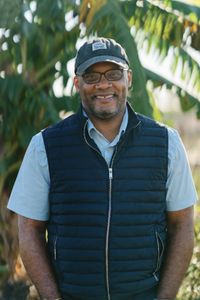
Kwabena Nkromo graduated from South Boston High School. He attended Tuskegee University and Clemson University. His career experience includes working as a business consultant.[1]
- High school:
- South Boston High School
In their own words
Who are you? Tell us about yourself.
I am Kwabena “Cubby” Nkromo, a grassroots civic leader, food-policy advocate, Green Party organizer, and candidate for Congress in Michigan’s 10th District. For more than three decades, I have worked where community organizing, food systems, public policy, entrepreneurship, and service meet. My experience ranges from developing urban agriculture projects and planning community food systems to civic organizing, small business, ministry, and working alongside families and neighborhoods trying to build better lives.
I am running for Congress because I believe political power should belong to ordinary people—not simply wealthy interests, corporations, or political parties. Government should protect our rights, provide essential infrastructure and a meaningful safety net, and then help communities develop the institutions, businesses, knowledge, and local capacity necessary to shape their own futures.
Michigan helped build modern America. I believe MI-10 can help build what comes next.
Please list below 3 key messages of your campaign. What are the main points you want voters to remember about your goals for your time in office?
Give Power to the People. I am running because too much political and economic power has become concentrated in places increasingly disconnected from ordinary people. Government should protect our rights, provide essential infrastructure and a meaningful social safety net, and then help communities build durable power of their own—through stronger local institutions, businesses, civic organizations, neighborhoods, and democratic participation. My governing principle is simple: federal power should help people build power where they actually live.Build What Comes Next. Michigan helped build the industrial prosperity of modern America, but we cannot build our future around waiting for yesterday's economy to return. MI-10 needs a citizen determined and led regional economic strategy for the next generation: investment in education for the AI economy, genuinely affordable housing, strong local and regional food systems, healthcare worthy of Michigan, modern infrastructure, entrepreneurship, and productive locally rooted businesses that allow more wealth and opportunity to remain in our communities.Finish What Has Been Left Incomplete. Public trust requires government to deliver. That starts with finally resolving the Flint water crisis—including remaining service-line infrastructure into affected homes—and extends to neglected infrastructure, housing, healthcare, education, and economic development. I want to bring an organizer's standard to Congress: identify the problem, listen to the people affected, assemble the necessary partners and resources, do the work, and remain accountable until the job is actually finished.
What areas of public policy are you personally passionate about?
I am especially passionate about community economic development, food and agriculture policy, participatory democracy, affordable housing and community land ownership, environmental sustainability, and education. Much of my life's work has centered on a basic question: how can public policy help ordinary people and communities develop greater power over the systems that shape their lives? I am particularly interested in policies that strengthen local economies, rebuild regional food systems, expand citizen participation, prepare people for an AI-driven economy, and transition America toward a more sustainable energy future.
Who do you look up to? Whose example would you like to follow, and why?
Chokwe Lumumba, the late mayor of Jackson, Mississippi. I admire his courage, fearlessness, and fidelity to the people he represented. What especially inspires me is his commitment to participatory democracy through the People's Assembly model. He did not view winning office as the people surrendering their power to an elected official. He sought structures through which ordinary citizens could remain organized, informed, engaged, and capable of holding government accountable. That example speaks directly to my own belief that elected leadership should help people build power rather than simply exercise power on their behalf. I would want my service in Congress to reflect that same courage, accountability, and commitment to keeping the people themselves at the center of democratic life.
What characteristics or principles are most important for an elected official?
Integrity, courage, humility, competence, accountability, and a genuine culture of service. An elected official should tell people the truth even when the truth is inconvenient, listen seriously to people whose experiences differ from their own, and remember that public office belongs to the public. I also value what I call a bias toward action: government should not endlessly study problems that people are already suffering from. Leaders should listen, learn, make responsible decisions, assemble the resources necessary to act, and remain accountable until the work is done.
What do you believe are the core responsibilities for someone elected to this office?
A member of Congress has three fundamental responsibilities: represent the people of the district, legislate in the national interest, and ensure that the federal government works for the people it serves. That means listening closely to constituents, protecting constitutional and civil rights, responsibly stewarding public resources, conducting meaningful oversight, and helping residents navigate federal agencies. I believe Congress should also use federal power to strengthen the capacity of communities themselves—investing in infrastructure, education, healthcare, housing, economic opportunity, and local institutions so that people have greater power to shape their own futures.
What legacy would you like to leave?
I would like to leave people and communities more powerful than I found them. I hope my legacy is measured less by offices held or titles accumulated than by institutions built, people developed, problems solved, and communities better equipped to govern and provide for themselves. I believe leadership should create successors rather than dependence. If my life's work helps ordinary people gain greater democratic, economic, and institutional power—and leaves behind organizations and ideas that continue serving people after I am gone—I will consider that a worthy legacy.
What was your very first job? How long did you have it?
McDonald's grill person. 6 months or so.
What is something that has been a struggle in your life?
Establishing loving relationships that meet the standards set for me by my mother Dolores.
What qualities does the U.S. House of Representatives possess that makes it unique as an institution?
The House was designed to be the part of the federal government closest to the people. Its members represent comparatively smaller constituencies and must return to the voters every two years for another judgment on their service. That creates both an opportunity and an obligation for representatives to remain closely connected to the communities they serve. The House also brings together hundreds of distinct American communities into one national legislature. At its best, it converts the experiences and priorities of ordinary citizens into national policy while requiring representatives to negotiate across regional, economic, cultural, and political differences.
What do you perceive to be the United States' greatest challenges as a nation over the next decade?
I believe three of America's greatest challenges over the next decade will be our continued overdependence on fossil fuels, the economic displacement likely to accompany artificial intelligence and automation, and the erosion of public trust in democratic institutions.
We must accelerate the transition toward cleaner, more sustainable and locally resilient energy systems without abandoning workers and communities whose livelihoods have depended on the old energy economy. At the same time, AI and automation could produce extraordinary gains in productivity while profoundly disrupting employment. We need education, workforce development, entrepreneurship, and economic policies that ensure technological progress improves ordinary people's lives rather than simply concentrating wealth.
Underneath both challenges is a crisis of democratic legitimacy. People must believe that government is competent, accountable, responsive, and genuinely influenced by their participation. Rebuilding that trust will require more than rhetoric. Government must deliver results while creating meaningful ways for citizens to exercise democratic power.
Do you believe that compromise is necessary or desirable for policymaking?
Yes. In a diverse democracy, compromise is often necessary to turn competing interests into workable public policy. I am willing to compromise on methods, timing, implementation, and the particulars of legislation when doing so advances the public good. But compromise should not become an excuse for abandoning fundamental rights, integrity, or the people one was elected to represent. Good policymaking requires knowing the difference between a negotiable position and a governing principle. I would rather work across differences to accomplish something useful than preserve ideological purity while problems remain unsolved.
What was the first historical event that happened in your lifetime that you remember?
Jimmy Carter's election as President of the United States
On the 2026 ballot
Links
Compiled from the candidate’s published profile as of September 30, 2026.
Source(opens in new tab)