
Background
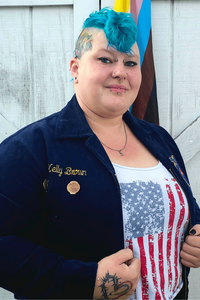
Kelly Brown (Democratic Party) ran for election to the U.S. House to represent Wisconsin's 6th Congressional District. Brown did not appear on the ballot for the Democratic primary on August 11, 2026.
- Associates:
- Moraine Park Technical College, 2018
- High school:
- Randolph High School
Campaign money
- Raised
- $0
- From individuals
- $0
- From PACs & party
- $0
- Own money
- —
FEC filings.
View on FEC.gov(opens in new tab)In their own words
Who are you? Tell us about yourself.
I am a disabled person who works in agriculture, quality control, and logistics, with experience in healthcare, animal care, telecommunications, and public service. I was born in Madison and raised on a dairy goat farm in Randolph, Wisconsin, where I learned the values of hard work, compassion, and responsibility. I’m autistic, non-binary, and the first openly transgender person to run for Congress in Wisconsin’s 6th District.
My career includes work in memory care, tech support, veterinary clinics, and the Department of Veterans Affairs. I am also a dog trainer and Reiki practitioner, combining animal science with holistic care. I have volunteered with LGBTQ+ ally groups, disability advocacy efforts, suicide prevention, and mental health mentoring. I currently mentor others through the Eating Disorder Foundation.
I hold a Health Information Technology degree from Moraine Park Technical College and am completing a bachelor’s degree in Leadership and Personalized Studies at UW–Parkside. I plan to continue on to a master’s program. I am a single parent and the child of a disabled vet. I’ve survived long COVID, medical trauma, poverty, and the opioid-related death of my son’s father. These experiences shape my commitment to compassionate, community-rooted policymaking.
Please list below 3 key messages of your campaign. What are the main points you want voters to remember about your goals for your time in office?
I bring firsthand experience with the systems Congress debates and leadership experience working to improve them.
I’ve navigated disability, long COVID, housing insecurity, and the opioid crisis as a working parent. These challenges shape my understanding of healthcare, economic justice, and mental health policy. I’ve held leadership roles in 4-H, student government, and service organizations, including Vice President of my college’s student senate and Publications Chair for Circle K. I’ve also advocated for accessibility and equity on campus. I don’t just understand where systems fail. I’ve worked to make them better.Rural communities deserve more than survival, they deserve real investment and opportunity.
I was raised on a dairy goat farm in rural Wisconsin and still live in a small town today. I’ve seen how underinvestment in healthcare, infrastructure, and housing harms rural families. My platform prioritizes support for family farms, rural healthcare access, reproductive and LGBTQ+ rights, clean energy, childcare availability, and affordable public transit between rural hubs. Strong local economies create stability statewide. Expanding rural broadband ensures no community is left behind.Everyone deserves the freedom to live fully, with dignity, safety, and care.
My platform is built on the belief that people should be free to work, love, and thrive, as long as they cause no harm to others, to animals, or to the planet. That means protecting civil rights, defending bodily autonomy, investing in community care, and holding systems accountable to the people they serve. From healthcare and environmental protection to labor rights and public safety, I’m focused on policies rooted in responsibility, compassion, and collective well-being.
What areas of public policy are you personally passionate about?
I am passionate about healthcare access, disability rights, rural revitalization, mental health care, and compassionate drug policy. As someone living with chronic illness, I’ve experienced the gaps in our healthcare system. I’ve also seen how underinvestment affects rural communities, especially in housing, childcare, and public transit. I support protecting civil rights, supporting family farms, expanding access to addiction treatment and mental health care, and ensuring people with disabilities can live with autonomy and dignity.
Who do you look up to? Whose example would you like to follow, and why?
As a child, I looked up to my dad. He was disabled and in pain for as long as I can remember, but he worked hard and could build or fix anything. He was a jack of all trades and mastered every skill he tried. But as I got older, I began to understand that much of what I saw as strength was actually survival. He never gave himself rest or grace. He stayed busy to avoid facing what hurt. I still love him, but I no longer see that version of strength as the one I want to model.
Today, the person I look up to most is my therapist, Sam. This July marks six years since I decided to give therapy another chance. In that first session, something shifted. Over many sessions, learned that I didn’t have borderline personality disorder. I had complex PTSD. I was also AuDHD. And over the years, I came to understand that I had been living with an eating disorder as well. None of that healing happened overnight, but Sam stayed with me through every step.
She saw me through the darkest part of my life. After surviving the ICU with COVID, I lost my federal health insurance. Sam could not take my Medicaid HMO at the time, but she saw me three times a week due to increase suicidal ideations and never sent a bill. Even now, with private insurance, she still waives co-pays because she knows I cannot afford them. I have never once felt like a burden.
Because of her, I have faith in people again. I believe healing is possible. I believe showing up for each other matters. And I believe that grace, consistency, and compassion are forms of strength worth following.
Is there a book, essay, film, or something else you would recommend to someone who wants to understand your political philosophy?
My recommendations aren’t your typical political picks. I believe everyone should have the chance to become the best version of themselves, and that starts with healing, self-awareness, and listening to voices that are too often left out. My political philosophy is rooted in justice, care, accountability, and the belief that we build better systems when we understand the harm we've internalized and the history we were never taught.
Books that reflect this include:
The Body Is Not an Apology by Sonya Renee Taylor
Untamed by Glennon Doyle
Radical Acceptance by Tara Brach
Hood Feminism by Mikki Kendall
Medical Apartheid by Harriet A. Washington
Fat and Queer edited by Bruce Owen, Miguel M. Morales, and Tiff Joshua TJ Ferentini
You Have the Right to Remain Fat by Virgie Tovar
Fearing the Black Body by Sabrina Strings
Anti-Diet by Christy Harrison
Women Like Us by Erica Abeel
Atlas of the Heart by Brené Brown
The Explosive Child by Dr. Ross W. Greene
White Fragility by Robin DiAngelo
These books explore the intersections of race, disability, gender, body autonomy, trauma, and how systems shape our lives. They’ve helped me unlearn shame, name injustice, and imagine new possibilities, both personally and politically. They reflect my belief that policy should be built by people who’ve had to survive what others only debate.
What characteristics or principles are most important for an elected official?
An elected official should be someone who listens first and speaks with intention. Too often, people in power are more focused on keeping their position than earning it. I believe leadership is about service, not status. That means being honest, transparent, and willing to admit when you don’t know something. It also means taking responsibility when you get it wrong, and doing the work to make it right.
I’ve spent my life listening to people who are often overlooked, in food service lines, hospital waiting rooms, homeless shelters, memory care wings, and in barns. I’ve sat beside people in grief, in crisis, and in recovery. I’ve heard the stories that never make it into legislation. That has taught me that compassion is not weakness, it’s the foundation of good governance.
I believe elected officials should understand the systems they’re shaping. Lived experience matters. So does humility. I’ve lived through housing insecurity, disability, medical trauma, and the loss of a loved one to overdose. I’ve also served in student leadership, volunteered through 4-H and community programs, and worked jobs where precision and accountability were non-negotiable. That combination, of showing up in hard times and stepping up when leadership was needed, shaped who I am.
The best elected officials don’t pretend to have all the answers. They surround themselves with people who challenge them, they ask hard questions, and they stay grounded in the lives of the people they serve. The most important principles to me are integrity, accountability, humility, compassion, and a deep commitment to justice, not just legal justice, but economic, medical, social, and environmental justice too.
What qualities do you possess that you believe would make you a successful officeholder?
I am not running for office because I think I am special. I am running because I know what it feels like to be left behind, and I believe people deserve representation that sees them, hears them, and tells the truth. I bring lived experience, deep empathy, and a long history of showing up even when it is hard, even when no one is watching.
I grew up on a dairy goat farm where I learned responsibility early. By five years old, I was feeding baby goats. By eight, I had started my first business. I have worked in veterinary clinics, memory care, customer service, tech, agriculture, and the VA. I have mucked stalls in subzero weather, managed lab logistics, and sat with grieving families during euthanasia appointments. I have also survived long COVID, medical trauma, poverty, and the loss of my son’s father to the opioid crisis. My strength does not come from theory. It comes from living what others only debate.
I am calm under pressure, deeply pragmatic, and able to find clarity in chaos. Whether serving in student government or organizing in my community, I have learned how to listen to people who disagree, hold space for hard conversations, and make decisions based on care and accountability. I have learned how to advocate, not just for myself, but for people who are rarely given a seat at the table.
I believe in transparency, shared responsibility, and building systems that work for everyone, not just those with power or privilege. I do not claim to have all the answers, but I bring honesty, resilience, and a willingness to do the work. I have spent my life learning how to survive. Now, I want to help others do more than survive. I want to help us all build something better, together.
What do you believe are the core responsibilities for someone elected to this office?
The core responsibility of a member of the U.S. House of Representatives is to serve the people of their district, not just those with the most power, wealth, or access, but everyone, especially those who are most often ignored. That means listening deeply, showing up consistently, and taking the time to understand how federal policy touches people’s lives on the ground. It also means communicating clearly and often, being transparent about decisions, and remaining accessible and accountable between elections, not just during campaign season.
It’s not enough to vote the right way. Elected officials should use their position to advocate, educate, and organize. That includes building coalitions, pushing for oversight when systems fail, and lifting up stories from their district that aren’t being heard. It means asking hard questions in committee meetings, drafting legislation that reflects lived experience, and resisting the temptation to perform for cameras while avoiding the actual work.
A representative’s job is also to act as a bridge, between local concerns and federal action, between people and government, and sometimes between conflicting priorities that all need attention. They should fight for resources that benefit their district while upholding the broader responsibilities of national service, justice, and constitutional duty.
As someone who has relied on public services, stood in long lines at underfunded clinics, and helped others navigate systems that were not built for them, I believe one of the most important roles of a representative is to center the experiences of those who are too often left out. Policy should be rooted in real life, not just party lines or polling data. Representatives should meet people where they are, not expect them to come polished and perfect to be worthy of help.
Above all, the role demands courage, humility, and follow-through. People don’t need saviors, they need someone who will listen, show up, and fight.
What legacy would you like to leave?
They tried.
They prevailed.
They lifted others.
Everyone won.
If I could be remembered for anything, I want it to be that I never stopped trying, not when it was hard, not when it hurt, and not when it felt like I was the only one standing. I want to be remembered as someone who refused to give up, who carried others when they were tired, and who never mistook power for purpose.
I want my legacy to be about showing up for people who were told they didn’t belong. Disabled people. Queer people. Poor people. Survivors. People from rural towns who felt forgotten. People who were always told they were too much, too complicated, or not worth the investment.
I want to help build a world where no one has to earn dignity with their suffering. Where compassion is the default, not the exception. Where we choose care, truth, and justice, not just because it is strategic, but because it is right.
If my work makes it easier for the next person to rise, then I have done something worth remembering. I do not need statues or stages. I just want to leave behind systems that hurt fewer people and lift more of us up.
That is the legacy I hope to leave.
What is the first historical event that happened in your lifetime that you remember? How old were you at the time?
The first historical event I remember is September 11, 2001. I was in 7th grade and had just finished clarinet lessons when one of our classmates' parents came rushing down the hallway. We had strong winds the night before, and she was picking up her son to help clean up their silo that was blown over. As she passed by, she said something about a plane hitting a tower. I was confused at first, thinking a plane had crashed into something on their property.
That confusion quickly turned to fear. When I entered my classroom, all eyes were glued to the television. Just moments later, we watched live as the second plane hit the second tower. Everything stopped. All classes were canceled. The entire school sat together, watching and praying. We felt helpless as we watched our country come under attack.
Until that moment, I didn’t think something like that could happen here. It changed the way I understood the world. It was the first time I saw that even in a small rural town, far from New York City or Washington, we were connected to a much bigger world. That day shaped how I see crisis, how I interpret fear, and how I understand the responsibility of leadership during uncertain times.
What was your very first job? How long did you have it?
If we are talking technically, my first job started when I was five years old. I was responsible for feeding the baby goats on our family’s dairy goat farm, earning twenty dollars a week. That early experience taught me that real responsibility means showing up, even when it is hard or inconvenient. The animals depended on me, and I never forgot that.
My first official W-2 job was at age fifteen, working as an animal care-taker and veterinary assistant at Columbus Countryside Veterinary Clinic. I stayed there for six years. I helped with kennel cleaning, surgical recovery, inventory, and vet tech support. Over time, I was trusted with more sensitive roles, especially around euthanasia care. I was often asked to be present during euthanasias at the clinic and was honored to be invited along on home visits as well.
I never saw it as a burden. I’ve always felt called to help animals pass as peacefully and comfortably as possible. I tried to be a calm presence for both the animals and their families. It was sacred work to me; the kind of work you carry with you long after the shift ends.
That job taught me how to lead with quiet care, how to hold space for grief, and how to show up for others when they are hurting. Whether I was cleaning up after surgery, helping a scared dog settle in, or supporting someone through their last goodbye, I learned that real service often happens in the background. It shaped the kind of person I strive to be: steady, compassionate, and grounded in care.
What is your favorite book? Why?
One of my favorite books is The Body Is Not an Apology by Sonya Renee Taylor. It was the first book that gave me permission to stop treating my body like a problem to fix. As someone who is disabled, neurodivergent, and in recovery from an eating disorder, I had internalized a lot of shame. This book helped me begin unlearning that.
Taylor writes about radical self-love not as a feel-good slogan, but as a deep act of resistance in a world that profits off of our self-hatred. She connects the way we treat ourselves to the systems we participate in, and shows how healing personally and dismantling injustice are part of the same work. That framework changed how I view politics, activism, disability, and even community care.
It is not a book about perfection. It is a book about returning to ourselves, choosing to stay in our bodies, and refusing to apologize for existing in a way the world doesn't always know how to hold. It helped me see that justice must include our relationship with ourselves, and that liberation starts at home.
If you could be any fictional character, who would you want to be?
I would probably choose Luna Lovegood from the Harry Potter series. She is eccentric, brilliant in ways most people overlook, and completely unapologetic about who she is. People underestimate her constantly, and she never lets it change her. She leads with empathy, loyalty, and a deep understanding of people that goes far beyond what others give her credit for.
Luna reminds me that it is okay to be different, to think differently, and to hold space for things that do not always make sense to others. She believes in people. She is kind without being naive, and strong without needing to dominate. That balance, staying soft while still standing firm, is something I strive for in my own life.
Also, as someone who is neurodivergent and spent a long time feeling out of place, I relate to Luna’s quiet confidence. She exists fully in her own truth, and she finds her people not by changing herself, but by staying true to who she is.
What was the last song that got stuck in your head?
Honestly? “Purple Pills” by D12. It has nothing to do with the lyrics, it’s the beat. That song has been stuck in my head more than any other, and for a good reason. Music is one of the ways I regulate my body and focus. As someone who is autistic and has ADHD, stimming through music helps me concentrate and feel grounded. Certain beats just click with my brain and body, and “Purple Pills” is one of them. It is actually the number one song that makes stimming feel physically good.
Eminem has been a significant part of my life in general. Even the tattoo on my back has a connection to him. I don’t always relate to the words, but the rhythm, pacing, and emotional intensity in his music have helped me stay centered during times when my mind was going a hundred directions at once.
Beats by artists like Eminem, Halsey, and Taylor Swift help me stay focused and emotionally regulated. Whether I am driving, working, or just trying to reset between tasks, music like that helps me move through the world with more ease. It’s not just background noise for me, it is a form of support and expression. And sometimes, it just makes me smile to have a chaotic song like “Purple Pills” playing in the back of my mind while I’m doing something serious.
What is something that has been a struggle in your life?
My own mind.
I have lived most of my life navigating complex PTSD, undiagnosed autism, ADHD, and dyscalculia. For years, I internalized the struggle. I thought I was lazy, inconsistent, or too sensitive. I was told to try harder, stop overthinking, or grow up. I believed it. I learned to mask just to survive, but I did not understand why everything felt harder for me than it seemed to be for everyone else.
It took my freshman year in college for my chemistry professor to notice I might have dyscalculia. I got tested, she was right. It was not until I was 30 that I realized I am autistic and have ADHD. Everything started to make sense, the sensory overwhelm, the executive function challenges, the emotional intensity, the way I could hyperfocus one minute and shut down the next.
Once I finally got the right diagnosis and support, I was able to access the medication I needed. I was prescribed ADHD medication and, for the first time, began to reduce my anxiety and depression meds. I started feeling more regulated and less like I was constantly failing at being human.
The hardest part was not the neurodivergence itself. It was the shame that built up over years of being misunderstood. The missed opportunities. The pain of not being believed. Of being labeled too much, too emotional, or too broken. I carried that weight for decades.
Therapy helped me unlearn a lot of that. I began to understand that I was not broken. I was adapting. I was surviving. And I was doing the best I could with the information and tools I had. I still have hard days, but now I know what I am working with. My mind may still be complicated, but I have learned how to work with it instead of against it. That shift saved my life.
What qualities does the U.S. House of Representatives possess that makes it unique as an institution?
The U.S. House of Representatives is unique because it is the chamber most directly connected to the people. Its members represent smaller districts, are elected every two years, and are meant to stay closely accountable to the communities they serve. That structure creates an opportunity for the House to reflect the changing needs, voices, and values of the country in real time.
Unlike the Senate, which was designed for longer terms and slower deliberation, the House was built for responsiveness. That can be a strength when it means uplifting local concerns, passing timely legislation, and responding to urgent needs. It can also create challenges when short-term political pressure overrides long-term solutions. But at its best, the House is where real people can be heard and where constituent concerns have a direct path to federal policy.
The House holds the power of the purse, meaning it plays a central role in federal budget decisions. Where and how we invest our national resources reflects what we value. That makes the House critical in shaping programs that affect healthcare, education, infrastructure, and public safety.
Because it has more members than any other federal body, the House also has the potential to be the most diverse. It can serve as a space where people from different backgrounds and lived experiences bring forward ideas that would otherwise be left out. As our country continues to grow and change, the House can lead by modeling inclusion, accessibility, and public accountability.
What makes the House truly unique is its potential to be the people’s chamber in both structure and spirit. The closer it gets to that vision, the better it serves all of us.
Do you believe that it's beneficial for representatives to have previous experience in government or politics?
Experience in government or politics can be helpful, but it is not the only kind of experience that matters. Lived experience, especially from those who have been directly impacted by policy decisions, is just as important. We need leaders who understand what it feels like to be on the receiving end of systems that are confusing, underfunded, or unfair.
I often think about how different our laws might look if politicians could only earn what the lowest-paid person affected by their votes is paid. In the United States, disabled people can still legally be paid less than minimum wage. There are people working full time who still cannot afford housing, healthcare, or childcare. These are the people most affected by policy, and too often, they are left out of political conversations entirely.
I have experience in service leadership, student government, healthcare, agriculture, animal care, and veterans’ support. I’ve also raised a child as a disabled single parent while navigating housing insecurity and chronic illness. I have worked on the ground in broken systems and seen how decisions made in Washington play out in real life.
What matters most is not whether someone has held office before. It is whether they are willing to listen, to learn, and to serve with humility and integrity. Government works best when it includes people who have had to survive what others only study. I believe that kind of experience is not just valuable. It is necessary.
What do you perceive to be the United States' greatest challenges as a nation over the next decade?
One of the greatest challenges we face in the next decade is rebuilding unity across lines that have been used to divide us. Political polarization, growing inequality, and social fragmentation have made it harder for people to see each other as neighbors. I believe our biggest challenge is helping people remember that all people are people, and that none of us can do this alone. We need each other. Always have.
There is a common phrase about pulling yourself up by your bootstraps, but the original meaning of that saying was that it is impossible. No one makes it entirely on their own. Every person who has ever succeeded had help, whether from a parent, a teacher, a government program, a union, or a community. The myth of total independence isolates us. The truth is we are all interdependent, and there is strength in that.
We need to reconnect the working class and build solidarity across race, class, gender, geography, and disability. The issues we face — economic inequality, climate change, housing instability, rising healthcare costs, and the mental health and addiction crisis, cannot be solved in isolation or competition. They require collective effort, shared responsibility, and leadership rooted in care.
We also face serious threats to democracy, including disinformation, extremism, and voter suppression. If we want a future where people feel safe, heard, and supported, we must recommit to public trust, truth, and participation. That starts by remembering our shared humanity and showing up for each other.
Do you believe that two years is the right term length for representatives?
Two years is both a strength and a challenge. On one hand, it keeps representatives directly accountable to the people they serve. It allows voters to respond quickly if their needs are not being met or if leadership is out of step with the district. That closeness to the public is part of what makes the House unique and important.
On the other hand, the constant campaign cycle can make it difficult for representatives to focus on long-term solutions. Too much time is spent fundraising, defending seats, and reacting to political pressure instead of doing the work. The short term can discourage bold policymaking, especially when representatives worry that taking a stand might cost them re-election before they even finish what they started.
I understand the value of accountability. I also understand how exhausting it is to live in survival mode, always looking over your shoulder and unsure if your efforts will be enough. That is how many Americans live every day, especially those facing poverty, illness, or discrimination. It is also how many representatives feel under this structure. The pressure is nonstop.
Rather than changing the term length, I believe we need to change the systems that make short terms so disruptive. That includes campaign finance reform, public financing options, and limiting the influence of corporate donors and lobbyists. When representatives can focus more on their communities and less on fundraising, the two-year cycle becomes less of a burden and more of a tool for public accountability.
The problem is not the number of years. It is the culture and structure that surrounds the role. Fix that, and the two-year term can do what it was meant to do, keep representatives close to the people.
What are your thoughts on term limits?
I believe term limits can be a useful tool, but they are not a complete solution to the deeper issues of power, access, and accountability in government. Simply rotating people through office doesn’t guarantee better representation. In some cases, term limits can actually weaken institutional memory and give more influence to unelected lobbyists and staffers. But when elected officials stay in office for decades without meaningful connection to their communities, the system becomes stagnant and less responsive.
The real issue isn’t always how long someone serves. It’s who has access to run and who gets the resources to win. We need to reduce barriers to entry for working-class, disabled, LGBTQ+, and BIPOC candidates. Campaign finance reform, voter protections, and stronger public ethics laws are esse
On the 2026 ballot
Links
Compiled from the candidate’s published profile as of September 30, 2026 and FEC filings.
Source(opens in new tab)