
Background
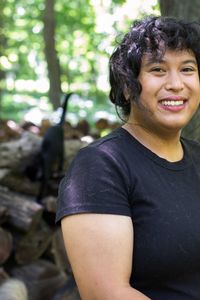
KathleenMae Rogers served in the U.S. Marine Corps.[1]
In their own words
Who are you? Tell us about yourself.
I think most of us know what it feels like to look at our lives and be grateful for what we have—the opportunities we were given, the people who helped us, and the things that worked out. I have worked hard for what I have, but hard work does not happen in a vacuum. I had opportunities to pursue and people who helped me along the way. Not everyone has that chance.
That matters to me. I don't believe having opportunities gives me permission to look away from people who are struggling. I'm just another American among nearly 400 million of us. I know what it means to work, study, build a life, worry about the future, and trust that the institutions around us will do what they're supposed to do. I don't want to live in a country where we only care when suffering reaches our own front door.
Before considering Congress, I believed I had found my place in service. I served as a Marine, returned to school to become a physical therapist, and began PhD research in rehabilitation focused on PTSD and recovery. I believed I could serve by helping people recover and rebuild their lives. Over time, I saw how decisions made far beyond a patient, veteran, farmer, or family can determine who receives help and who lives with the consequences.
That changed what service meant to me. At some point, asking why wasn't enough. I had to decide whether I was willing to step forward. I am running as an Independent because I believe my responsibility is to the Constitution and to the people.
Please list below 3 key messages of your campaign. What are the main points you want voters to remember about your goals for your time in office?
Representation is a responsibility, Loyalty is to the People
Elected officials should answer & be loyal to the people they represent. A limited, accountable government that does its job well means being willing to question decisions, demand answers, challenge powerful interests, & hold those accountable when they fail the people, they are responsible for even when doing so is politically difficult. Relationships, party loyalty, money, or fear should never come before the responsibility to represent the people. That's why I'm running as an Independent. My responsibility and duty are to the people I represent and to ensuring that the people I encounter every day can live with dignity, security and the opportunity to build a good life.Freedom means having the opportunity to actually live a life.
Americans should have the freedom to work, provide for their families, pursue happiness, and live healthy and fulfilling lives. That means addressing realities that limit that ability, including healthcare access, concentrated wealth and economic power, education, workforce development, and challenges facing veterans, families, farmers, workers, and especially rural communities across MO-04. Government should protect people's rights and safety without unnecessarily inserting itself into their private lives or dictating how they choose to live. Its role is to protect individual freedom and create the conditions in which people can thrive.American Strength Should Protect Life, Liberty, and the Pursuit of Happiness
America should be prepared to defend itself and its people. I believe those entrusted with our military should be held to high standards, and our nation should maintain the strength necessary to deter threats and defend our allies. But strength requires judgment. Congress must consider the human, economic, and social costs of conflict and whether our resources are being used wisely, including what those priorities mean for states and communities at home. We should pursue peace whenever possible, not because we are unwilling to fight, but because we understand the cost when we do.
What areas of public policy are you personally passionate about?
I'm most passionate about policies that help people build healthy, secure, and fulfilling lives: sustaining rural hospitals and clinics; supporting rural public schools, trade education, and apprenticeships; protecting farmers’ right to repair equipment, agricultural research, and fair competition; strengthening veterans’ healthcare and earned benefits; investing in infrastructure and local businesses; protecting clean air, water, public lands, and constitutional rights; and requiring Congress to account for the human and financial consequences of spending, regulation, and war.
What baffles me is how needs this basic have become so difficult for government to address and how often government choose to make it harder instead.
Who do you look up to? Whose example would you like to follow, and why?
I tend not to put people on pedestals. Instead, I try to learn from different people and take from their examples the qualities worth following. I especially respect those who use whatever position they hold to leave other people’s lives better than they found them, question their own side, admit when they are wrong, stand up to powerful interests, and accept responsibility when decisions or actions they supported cause harm, even when they were only one part of making them.
I would rather follow those examples of service, integrity, courage, and accountability than try to model myself after any one political figure.
What characteristics or principles are most important for an elected official?
Integrity, moral courage, accountability, independence of thought, curiosity, discipline, and an understanding of personal limits. An elected official should be willing to question their own assumptions, seek expertise, admit when they are wrong, and explain what informed their decisions and what could change their mind.
Leadership requires conviction without arrogance, empathy without assuming you know what is best for everyone, and the discipline to follow through when the work becomes difficult or politically inconvenient. Holding power should make someone more accountable, not less. A good elected official should know when to lead, when to listen, when to ask for help, and when new evidence requires a change in course.
What do you believe are the core responsibilities for someone elected to this office?
A representative’s first responsibility is to the Constitution and the people they represent. That requires knowing the district, understanding how federal decisions affect its communities, listening before deciding, and explaining major votes.
The job also includes helping constituents navigate federal agencies and benefits, maintaining responsive district offices, being present throughout the district, and holding regular town halls where people can question their representative directly.
Congress must exercise its constitutional authority over legislation, federal spending, executive oversight, and matters of war and national security. Taxpayer money should have a clear purpose, an expected result, and a way to determine whether it worked. Representatives must also protect Congress’s role as an independent branch rather than simply following a president or political party.
The responsibility continues after a vote through oversight of implementation, investigation of failures, correction of laws or programs that are not working as intended, and continued public accountability.
What legacy would you like to leave?
I would want my fellow Missourians to say they felt heard, that they were actually represented, and that I always tried to take the extra step. I hope they would remember me as someone willing to put up a fight when it mattered; a firm and fair challenger, and a representative willing to question decisions and stand my ground without forgetting that I still had to work with people who disagreed with me, and that all of us were there to serve the people.
I want my time in office to encourage more ordinary Americans to step forward and remember that running for office is their right too. I do not believe public office has to become someone’s entire identity or life’s work. When my time serving in Congress is finished, I want to return to fully to my family, my education, physical therapy, and PTSD rehabilitation research knowing I served when I believed I was needed and helped others believe they could do the same.
What was your very first job? How long did you have it?
My first paid job was in highschool at Chili’s, where I learned customer service and how to work with the public. My earliest sense of responsibility came before that, though, as the eldest sister in my family. Not long after Chili’s, I joined the Marine Corps. It was a transition, but both experiences taught me how different people can come together, do their part, and get through a busy day.
What is something that has been a struggle in your life?
One of my continuing struggles has been learning that working harder does not always mean I can fix a problem. In the Marine Corps, I became an artillery maintenance technician, troubleshooting complex systems sometimes down to something as small as a resistor. That taught me to find the cause, learn everything I could, and keep working until I understood the problem.
As I became a maintenance chief, responsibility meant more than knowing how to fix something myself. I had to build a good team: trust and delegate, teach what I knew, rely on other people’s expertise, and remain accountable for work I did not personally perform. Then I had to know what happened afterward whether the work actually solved the problem. That forced me to grow not just as a technician, but as a follower, a leader, and a person.
I carried that same curiosity into physical therapy and PTSD rehabilitation research, shifting from understanding equipment to studying people, from human movement to what is happening in the brain. But people and life cannot be troubleshot like equipment. People have their own experiences, beliefs, priorities, and the right to make their own choices.
I can research, listen, explain, seek expertise, and keep showing up, but understanding a problem does not guarantee a particular outcome. My struggle has been learning that persistence is not simply refusing to quit; it is knowing when more effort can make a difference, when to change my approach, and when I have done what I can while respecting an outcome that is not mine to control.
What qualities does the U.S. House of Representatives possess that makes it unique as an institution?
The House is supposed to be the part of the federal government closest to the people, but when one representative serves hundreds of thousands of people, an election alone is not enough to call that representation. Members have to stay connected through town halls, constituent services, district offices, and being present enough to hear from people who may not have money, access, or time to make themselves heard in Washington.
That matters because decisions made in the House can affect people’s healthcare, livelihoods, rights, and whether Americans are sent to war. A position with that much power should carry equally serious accountability: representatives should explain their decisions, answer for the consequences, and face political or institutional consequences when they abuse their authority or repeatedly cause avoidable harm.
The farther Washington feels from everyday life, the harder a representative should work to close that distance. The more power someone holds, the more accountability they should be willing to accept.
What do you perceive to be the United States' greatest challenges as a nation over the next decade?
One of our greatest challenges over the next decade will be whether ordinary Americans can still build stable, healthy lives as economic and political power becomes increasingly concentrated. That affects whether workers, families, local businesses, and family farms can compete, build wealth, and have a meaningful voice in the decisions that shape their lives.
We will also have to adapt to rapid changes in technology, healthcare, work, and the economy without leaving communities behind or resisting innovation simply because it disrupts what is familiar. That requires education, research, infrastructure, and opportunities for people to develop new skills throughout their lives.
We also have to be honest about whether our commitments are financially and demographically sustainable. An aging population, rising healthcare needs, the national debt, and competing priorities will require difficult choices about what government is responsible for, how we pay for it, and whether that spending actually accomplishes what was promised.
Our institutions must be able to do their jobs competently while Americans remain capable of disagreeing without treating one another as enemies. Partisanship, distrust, misinformation, and powerful interests make both harder when they prevent us from identifying problems honestly, using expertise, correcting failures, and holding decision-makers accountable. Constitutional freedoms and equal protection must remain protected even when doing so is politically difficult.
The United States must remain resilient enough to protect its people and capable of defending itself and its allies. That means secure infrastructure, food and energy systems, supply chains, and institutions that can withstand disruption, while exercising American power with judgment. Strength should deter threats, not replace diplomacy or prevent us from confronting the human, economic, and long-term consequences of conflict. Our challenge is not simply remaining powerful but using that power wisely.
Do you believe that compromise is necessary or desirable for policymaking?
Yes. In a country this large and diverse, governing requires working with people who disagree. Good policymaking should avoid both paralysis when action is needed and action taken without enough thought about the consequences. Different perspectives can expose weaknesses, unintended effects, and alternatives that one side may have missed.
Compromise should happen in the substance of a policy: its scope, cost, safeguards, implementation, and how we measure whether it works. It should not mean abandoning constitutional rights, ignoring evidence, accepting preventable harm, or burying unrelated provisions in legislation simply to assemble enough votes.
I will work with anyone willing to solve the problem in front of us. The purpose of compromise should be a better policy and a better result for the people, not simply passing something so Congress can say it acted.
What was the first historical event that happened in your lifetime that you remember?
9/11
On the 2026 ballot
Links
Compiled from the candidate’s published profile as of September 30, 2026.
Source(opens in new tab)