
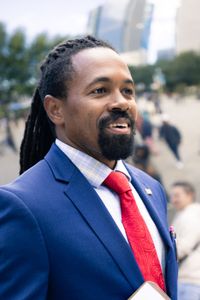
Background
Jump Shepherd was born in Melrose Park, Illinois. He graduated from Proviso East High School. He earned a bachelor's degree from South Carolina State University in 2018. His career experience includes working as an electrician, elementary science teacher, and astronomer.[1]
Shepherd has been affiliated with the following organizations:[1]
International Brotherhood of Electrical Workers
Chicago Federation of Labor
Electrical Workers Minority Caucus
National Association for the Advancement of Colored People
- Bachelor's:
- South Carolina State University, 2018
- High school:
- Proviso East High School
Campaign money
- Raised
- $4K
- From individuals
- $4K
- From PACs & party
- $0
- Own money
- —
FEC filings through February 1, 2026.
View on FEC.gov(opens in new tab)In their own words
Who are you? Tell us about yourself.
I’m Jump Shepherd, a union electrician with a past as a science teacher and Astronomer. I have my Supervising Electrician’s License, which is incredibly difficult to acquire. I have a B.S. in Physics with a minor in Music Education from South Carolina State University. I was born and raised in Chicago and the surrounding suburbs, attending Proviso East High School and playing trumpet in jazz, symphonic, and marching bands in my youth. I love video games, and play Smash Bros, OverWatch, Battlefield, and a few others to this day. Other games like Pokémon, Halo, and Metal Gear Solid raised me. I listen to most genres, but my favorite are Latin Jazz, Neo-Soul, and video game music. Lupe Fiasco taught me about the plight of being black in America and Sza taught me to protect women through their music. Martin Luther King Jr., Fred Hampton, and Malcolm X. taught me to stand up for what’s right and Barack Obama and my Dad taught me that you can be anything you believe you can be.
I want to save the world. I’m starting here in America, because we need help right now in this moment. We need a movement and I am the spark to create a better America for all its people.
Please list below 3 key messages of your campaign. What are the main points you want voters to remember about your goals for your time in office?
We need to tax billionaires. My Billionaire’s Bill does just that. It implements a 1950s era 92% tax rate on income over $10 million. It also creates a wealth tax of 2% annually on wealth over $50 million and 5% annually for over $1 billion in wealth. This bill will lower taxes for 99.9% of the population and create universal healthcare and a universal basic income from the $3-$5 trillion that will be raised from it. This bill also funds other key legislation I plan to bring to the senate. This immediately eliminates poverty and the crimes of poverty from our society. Just like that, we’re a big step closer to living in a utopian society.I am a union Electrician from IBEW Local 134 out of Cook County. We need someone from the working class to represent us. We need someone who takes the train to work every day. I take the train every day. I know what it’s like to be on food stamps and to receive free lunch. I know what it’s like to work 60 hours a week. The average age in the U.S. Senate is 65. The average net worth is over $4 million. They are out of touch with us. My opponent in this race is more of the same; someone who is beholden to the deforestry industry, the energy industry, and AIPAC. They receive millions in donations from these and far right dark money groups who expect a return on their investments. That is not someone who will act in our best interest.As a nation, we must protect our women. We must enact laws that prohibit gender-based price discrimination. We must end the “Pink Tax”
No more cost to women and mothers for products and services that women exclusively need to buy. This includes tampons, pads, and bras, and also up-charges on products like razors or deodorant.
The second part of includes subsidizing all the stages and costs of pregnancy, childbirth, and childcare. No more tax on being a woman!
What areas of public policy are you personally passionate about?
Climate Policy
Protecting Women’s rights to bodily autonomy
Tax Reform
Valuing teachers and farmers more highly through tax policy
Ending private owned prisons
Building Modular 3Bd2Ba 2000sq.ft. Homes for $100k cost to citizens
Strengthening Unions nationally
Who do you look up to? Whose example would you like to follow, and why?
My Dad, for sure. I wish he were here to be a key asset to my campaign. I believe in myself, sometimes when no one else does, because he told me over and over how I can do anything I put my mind to. Influential black figures like Bobby Rush and Barack Obama also are high on my list of living heroes. I liked Kanye West for his courage to be himself before he went down his spiral and I love the symbol that Beyoncé is in America, another person who can do anything she believes she can and supports her community while doing it. I’m also motivated by Alexandria Ocasio-Cortez, Ilhan Omar, and other members of the squad for their love of country and equality for all people. Bernie Sanders is the reason I and a lot of others my age and younger believe we can make a change in our country. He’s truly the father of the new progressive movement, and I wouldn’t be where or who I am today without him blazing a trail. I’d say I’m still a bit off his path, however.
What characteristics or principles are most important for an elected official?
Integrity and Honesty: Being truthful, transparent, and accountable, even when it’s uncomfortable.
Courage: Willingness to make difficult decisions and stand up for what’s right, not just what’s popular.
Empathy: Understanding and caring about the lived experiences of countrymen, especially the most vulnerable.
Practical Competence: Ability to get things done, understand policy, and work effectively within institutions.
Consistency and Reliability: Following through on promises, maintaining principles under pressure.
Public Service Over Self-Interest: Putting community needs above personal ambition or gain.
Justice and Fairness: Ensuring laws and policies treat people equitably.
Representation: Listening to and amplifying the voices of constituents, not just special interests or billionaires.
Transparency: Making decision-making processes visible and understandable to the public.
Accountability: Owning my mistakes and growing from them, inviting oversight, and staying aa accessible to voters as always
.
Stewardship: Protecting public resources, institutions, and future generations.
What do you believe are the core responsibilities for someone elected to this office?
In the senate, our core responsibilities include our day to day activities as well as more nuanced issues that come up. Some of them are listed:
Introduce bills and amendments in the Senate.
Debate proposed legislation and vote on laws.
Confirm or reject presidential appointments. This can include positions like cabinet secretaries, judges, ambassadors.
Ratify treaties negotiated by the President
Monitor, investigate, and check the actions of executive agencies and offices to ensure they follow the law and act in the public interest.
The Senate tries impeachment cases initiated by the House of Representatives. If someone in the executive or judicial branch is impeached, the Senate conducts the trial.
Balancing national policy considerations with the needs and concerns of the senator’s own state. This includes advocating for state specific needs like infrastructure, economic development, and other state needs.
Helping individual constituents with federal issues like problems with federal agencies, benefits and immigration.
Maintaining communication with constituents to understand and respond to their concerns through town halls and the like.
Serving on Senate committees where much of the detailed work is done: hearings, markup of bills, oversight.
Working with subcommittees, engaging subject matter experts, and participating in investigations.
Engaging in debate, sometimes shaping or delaying legislation through procedural tools (filibuster, holds, etc.).
Ensuring that legislation is scrutinized, that different viewpoints are heard.
Working on the federal budget, deciding funding for programs, oversight of federal spending.
Through treaty approval, confirmation of ambassadors, and oversight of foreign-affairs policy.
Upholding the Senate’s institutional norms and rules.
Managing procedural votes and helping set the pace as far as what comes to the floor and when.
Working with colleagues, across party lines when needed, to achieve results.
What legacy would you like to leave?
I want to save America and save the world. I want to help develop Faster-Than-Light (FTL) travel. I want to help us reach other Earth-like planets. I want to help build the next generation particle accelerator so that we can achieve these physics goals. I want to help bring about lasting world peace. To stop the genocides in Gaza, Congo, Sudan, and all over. To end slavery and oppression in America through the prison population and abroad with the Palestinians and Uyghurs in China. I want to restore the coral reefs before they’re bleached out of existence. I want to restore our climate to pre-industrial levels. I believe we have the resources to create a utopia for all people. We just have to want it for ALL people. The U.S. senate seat…it’s really a stepping stone. I believe in term limits. I want to enact important legislation, ensure it will last for generations, and then move aside for a younger group of leaders. My therapist says I have a super hero complex.
What is the first historical event that happened in your lifetime that you remember? How old were you at the time?
9/11. I was 11 years old and I remember being really frustrated that, for a month, Fox stopped airing my favorite show at the time, “The Simpsons” to give more context to the assault and the incipient war we’d involve ourselves with in the Middle East.
What was your very first job? How long did you have it?
I worked at Marshall’s, a clothing store in Broadview, IL, when I was 16 foot minimum wage.I wanted my own money and didn’t mind working for it. I mostly performed recovery and manned the fitting room station. I was there for a year and looked for a change of pace, so I went to then “E.B. Games” which is now GameStop and had a lot more fun around people I identified with.
What is your favorite book? Why?
“Meditations” by Marcus Aurelius reminds me that leadership is more than just power, it demands discipline and maintaining an objective perspective on the bigger picture. Marcus Aurelius ruled the known world, but his greatest battles were internal. That humility and clarity are what I try to carry into public service.”
If you could be any fictional character, who would you want to be?
The Jumperman, my own fictional character who is a physicist-engineer-programmer that goes into politics early in his life, but discovers hidden truths to the universe and becomes a galactic time traveler, protecting sentient life from enemies that exist in and outside of our chrono-sphere and our galaxy with his time-rending bender and other gadgets for moving around in 4 or more dimensions.
Or Batman. Batman is pretty freaking cool.
What is something that has been a struggle in your life?
Settling. I always want to make myself and the people around me better. It’s cost me friends sometimes, but here I am with a degree in physics, a background in education and astronomy, and a union Electrician still believing I can do more for my country and for the world.
What do you perceive to be the United States' greatest challenges as a nation over the next decade?
Climate change and environmental crises including extreme weather, mass migration, and the shift from fossil fuels while trying to meet increasing global energy demands seems to come to mind first.
Climate migration and conflicts will force millions to move, likely to more stable countries like America.
Immigration systems are already overstretched, and backlash politics may rise.
Rising authoritarianism and failing trust in institutions
Tensions between Russia, China, the Middle East, and the U.S. escalate and create global geopolitical instability.
Deepening polarization in the U.S. risks gridlock, instability, and political violence.
Misinformation, weakened trust in government, and declining civic engagement could undermine democracy itself.
Wealth inequality, especially between billionaires and working people, continues to grow.
Automation and artificial intelligence will displace jobs faster than workers can retrain.
Global supply chains will need to adapt to new technologies, climate pressures, and geopolitical fractures.
AI, biotechnology, and quantum computing will reform economies and what war looks like.
Ethical challenges around AI such as bias, surveillance, and control, will demand concise governance at the federal level.
The digital divide risks leaving millions behind if access isn’t expanded.
COVID-19 showed how unprepared America and the rest of the world was. By weakening the CDC through removal of experts and scientists, the next outbreak could be the end of humankind, and needs to be treated as such.
Rising antimicrobial resistance could make once-treatable infections deadly again.
Mental health crises, especially among youth, are accelerating at home and worldwide.
Water shortages will hit regions from the American West to South Asia.
Global food supply chains are vulnerable to both climate shocks and political conflict.
As a U.S. Senator who will deal heavily in foreign policy, I must be abreast of all these issues.
What are your thoughts on term limits?
We need term limits. And let’s be clear. the real term limit should be the ballot box. Voters deserve the final say on whether someone continues serving.
Faith without works is dead. Term limits without campaign finance reform won’t solve corruption. A revolving door of politicians still owned by billionaires and lobbyists doesn’t help working people.
We need stricter lobbying bans for former members and campaign finance reform.
What qualities does the U.S. Senate possess that makes it unique as an institution?
The U.S. Senate was deliberately designed by the framers of the Constitution to be different from the House of Representatives, including:
Constitutional Design — Equal Representation for States – Every state has two senators. This gives small states equal footing with big ones in the Senate.
Senators serve six-year terms which allows them to take a longer-term view on issues rather than constantly campaigning.
Staggered Elections: Only a third of the Senate is up for election every two years, providing institutional continuity and stability.
The Senate confirms presidential nominees to federal courts, cabinet positions, and top executive offices.
Only the Senate can approve treaties, and it requires a 2/3 vote.
The House can impeach, but the Senate conducts the trial and decides whether to convict and remove an official from office.
With just 100 members, the Senate is more intimate, allowing for closer relationships and more individual influence than in the 435 member House.
The Senate allows unlimited debate unless 60 senators vote to end it with cloture, making the Senate a chamber of deliberation.
Senators can place holds on nominations or bills, propose amendments more freely, and generally wield more procedural influence than House members.
“The World’s Greatest Deliberative Body”, The Senate has long seen itself as a forum for serious, extended debate and statesmanship.
The framers intended the Senate to be a stabilizing force that tempers sudden shifts in public opinion
The Senate is unique because it blends state equality, institutional stability, special powers of advice and consent, and traditions of extended debate and individual influence. This makes it a slower, more deliberate counterweight to the ever changing House.
Do you believe that it’s beneficial for senators to have previous experience in government or politics?
At a time where there is too much political experience in the Senate, where the average age is 65 and the average net worth is $4.5 million, we need less politicians, lobbyists, and millionaires who are out of touch with working Americans, and we need more union members, scientists, and teachers in the Senate that will represent those of us without representation.
What do you think of the filibuster?
The filibuster was born from an accidental change in the rules, and has evolved to block progress on urgent issues like healthcare, voting rights, and climate change. The filibuster has become a tool to obstruct legislation that the country voted for. One senator should not be able to block legislation supported by the majority of Americans, especially when the filibuster is rooted in protecting slavery and blocking civil rights to all Americans.
Is there a particular senator, past or present, whom you want to model yourself after?
Bernie Sanders is the reason I even started following politics back in 2016. I watched how the system that he devoted his life to chew him up and spit out the best presidential candidate we’ve had in a generation at least. His policies are what we’ve needed for decades, but he gets shouted down by younger voices.
Bobby Rush was an activist and Rep here in Chicago before I started following politics, but I love his energy, his character, and his determination to do what’s right in spite of how it might endanger his life. Fred Hampton died so this man could live on and represent underserved communities in the federal government.
I plan on being the successor to both of these fine men. Representing those whose voices get drowned out in the great scuttle in D.C. That includes black, brown, Muslim, LGBTQIA+, and disabled voices and any other that may arise in need of an ally in Congress.
How would you evaluate a judicial nominee?
As a U.S. Senator, my vote on judicial nominees is one of our most consequential powers. Confirmations shape not just the law of today, but can ripple generations into the future.
If they can answer every question with “Yes”, they’ll have my vote.
Are they forthright about their judicial philosophy and past decisions?
Red Flags include:
A record of extreme partisanship or rulings consistently favoring one political or corporate interest.
Ethics violations or undisclosed conflicts of interest.
Lack of experience in handling complex or constitutional issues.
Disrespect for democratic norms or dismissal of rights protections.
What kind of relationships would you build with other senators?
I’ll be, and already am, reaching out to senators and members of the House that I align with on progressive issues such as Bernie Sanders, Alexandria Ocasio-Cortez, and Jasmine Crockett. I also plan on converting moderate democrats over to progressive causes because it’s what their constituents demand. I’ll even work across the aside if it means getting non-partisan work done, like building a transcontinental railroad here in America that, again, has been overwhelmingly desired for decades.
Do you believe that compromise is necessary or desirable for policymaking?
In the Senate, there are 100 unique voices speaking for their constituents. We will all have different goals and expectations to meet, so yes, compromise is absolutely necessary. However, there are lines that I simply cannot cross as one of only two voices for Illinois in the senate. I can’t give up my integrity or honesty. I can’t sacrifice the wellbeing of my state and country for more tax breaks for large companies that are monopolizing entire industries. And I can’t become just another senator sitting in the office comfortably while my constituents are struggling working 2-3 jobs for 50-70 hours a week, making just enough to have to do it all again next week.
How should the U.S. Senate use its investigative powers?
The investigative power is one of the Senate’s most important tools. It comes from our role in oversight which is making sure government works in the public’s interest.
We must:
Ensure presidents, cabinet officials, and agencies follow the law and respect constitutional limits.
Expose corruption, waste, abuse of power, or mismanagement.
Gather facts and expert testimony that help write better laws.
Highlight gaps in regulation, enforcement, or resources.
Shine a light on corporate misconduct, unsafe products, labor abuses, or threats to public health.
Provide a voice for ordinary citizens against concentrated power, like corporate monopolies.
Investigate foreign interference, attacks on voting rights, or attempts to undermine democratic institutions.
Build the public record to deter future abuses.
Keep inquiries grounded in evidence, and refrain from political “point scoring”.
Share findings with the public so citizens understand what’s at stake.
Respect witnesses’ rights and ensure due process, even for those accused of wrongdoing.
Oversight is strongest when both parties agree facts matter more than winning. Bipartisanship is key.
Publish reports, then translate findings into legislation, reforms, or accountability measures.
Some great examples of the Senate’s investigative powers at work include:
The Teapot Dome Scandal in the 1920s where Senate investigations exposed massive corruption in oil leases, leading to criminal convictions.
The Army-McCarthy Hearings- In 1954, The Senate reined in abuses of power during the Red Scare.
Watergate in the 70s, where senate hearings revealed presidential wrongdoing, laying groundwork for reforms.
What criteria would you apply when deciding whether to confirm presidential appointees to their Cabinet?
Nominees must demonstrate honesty, transparency, and a clear record of public trust.
Anyone with major conflicts of interest, corruption allegations, or revolving-door lobbying ties will face heavy scrutiny.
Nominees must be qualified for the role, with real knowledge and ability to lead their department effectively. Expertise should matter more than connections or political loyalty. I will give priority to scientists, engineers, and doctors over nepotism picks, bankers, and tech CEOs.
I will ask every nominee how their policies will impact working families, labor rights, and the systems that benefit the wealthy.
Cabinet members must serve the American public, not corporate donors or billionaires.
I will oppose nominees who have undermined elections, promoted authoritarianism, or shown disregard for the Constitution.
Nominees should be willing to testify openly, answer tough questions, and commit to accountability once in office.
Candidates hear many personal stories from voters. Is there a story that you’ve heard that you found particularly touching or memorable?
There are so many people I meet on the trains and walking through the city that are already depending on me to make the change we all believe is possible, from the unhoused to people who feel trapped by section 8 housing vouchers to small business owners who just want to provide for their families. A particular story that stays with me came from a single mom I met on the Pink Line during the shutdown. She’s a federal worker who’d been furloughed for weeks. No paycheck, but still showing up to volunteer at her daughter’s school because she said, “Kids shouldn’t see grownups give up.”
What struck me wasn’t just her strength, but how unfair it was that people like her, people who make this country work, were being used as pawns in a political game. That moment reminded me exactly why I’m running: to build a government that serves working people with the same loyalty and dedication they show us every single day.
What is an accomplishment that you are proud of?
Two of the hardest things I’ve ever done were teach elementary science and pass Cook County‘a supervising electrician’s licensing exam. I have an immense respect for teachers and for supervising electricians. But I’m really proud of the fact that I made a promise to myself to run for senate AND WIN in a way that has never been done before, and that I’ll officially be on the ballot in Illinois, the hardest state in the union to gain ballot access as a candidate, and having done it with less than $10k is nothing short of hard work, dedication, and the world class ingenuity of my team. We have so much work to do, and I’m at a place where I believe nothing is impossible.
What role should the United States government have in the development or use of artificial intelligence?
This is one of the defining questions of the decade. Artificial intelligence has the potential to be transformative for good and also in abusive ways. The U.S. government’s role is not to slow innovation, but to ensure AI develops in a way that serves people, not just corporations or authoritarian dictators. *cough* Trump
Just like aviation, medicine, and food safety, AI systems that impact lives such as healthcare, finance, transportation, and defense, should meet rigorous safety standards that we, as Congress, set. Including:
Require disclosure when AI is used in decisions that affect people’s rights, credit, jobs, or safety.
If an AI system causes harm, companies or agencies using it must be held responsible as opposed to hiding inside a “black box.”
Prevent mass surveillance, discriminatory algorithms, and abuses in policing or immigration.
Guard against AI-driven disinformation campaigns that could destabilize democracy.
Ensure AI adoption doesn’t simply mean mass layoffs. We need to support retraining, wage protections, and collective bargaining rights in AI-impacted industries.
Fund open source, ethical AI research through universities and public institutions.
Prevent the tech giants from monopolizing AI infrastructure.
Lead in setting international AI norms, rather than letting China or authoritarian regimes write the rules.
Strict oversight on autonomous weapons. Humans must remain in control of life-and-death decisions.
Invest in AI for defense against cyberattacks while protecting civil liberties.
Work with allies to prevent an arms race in AI-driven warfare.
Mandate testing for racial, gender, and economic bias in AI systems.
Ensuring future AI systems remain under human control.
Create democratic processes like citizen assemblies or public hearings to give people a say in how AI is governed.
What legislation would you enact related to election administration in the United States?
This is one I’m currently working on.
Secure Accessible Remote Voting Act (SARVA)
Seniors, individuals with disabilities, and caregivers often face barriers to in-person voting, even with absentee and mail options.
The Help America Vote Act (HAVA) requires accessible voting systems, but technological progress has outpaced federal standards.
Secure, pilot-scale online voting can expand access while maintaining integrity through strict safeguards.
Purpose:
To establish limited, federally supported pilot programs that allow at-home online voting for seniors (55+), voters with disabilities, and caregivers, with paper verification, security audits, and fallback options.
This will expand voting access and give more people a voice in our democracy.
On the 2026 ballot
Links
- Campaign tiktok(opens in new tab)
- Personal tiktok(opens in new tab)
- Campaign website(opens in new tab)
- Campaign youtube(opens in new tab)
- Personal youtube(opens in new tab)
- Campaign facebook(opens in new tab)
- Personal facebook(opens in new tab)
- Personal linkedin(opens in new tab)
- Campaign instagram(opens in new tab)
- Personal instagram(opens in new tab)
Compiled from the candidate’s published profile as of September 30, 2026 and FEC filings.
Source(opens in new tab)