
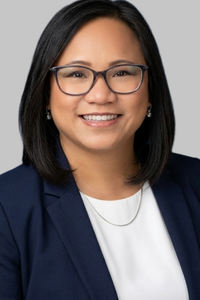
Background
Julie Le earned a high school diploma from Des Moines Roosevelt High School, a bachelor's degree from Grand View College in 2002, a graduate degree from Grand View University in 2014, and a law degree from the Mitchell Hamline School of Law in 2019. Her career experience includes working as an attorney.[1]
- Law:
- Mitchell Hamline School of Law, 2019
- Graduate:
- Grand View University, 2014
- Bachelor's:
- Grand View College, 2002
- High school:
- Des Moines Roosevelt High School
Campaign money
- Raised
- —
- From individuals
- $0
- From PACs & party
- $0
- Own money
- —
FEC filings.
View on FEC.gov(opens in new tab)In their own words
Who are you? Tell us about yourself.
I'm Julie Trang Le — a Vietnamese refugee, a mother, an attorney, and a candidate for Congress in Minnesota's 5th District. Before any of those titles, I was a fourteen-year-old who arrived here not speaking much English, and a teenager who slept in a car through Iowa winters before a shelter and a second-chance apartment gave me a foothold.
My grandfather served alongside U.S.-allied forces in Vietnam and died in a detention camp for it. My family spent nearly twenty years bringing him home. That taught me justice can be delayed for a generation — but you never stop fighting for it.
I worked my way through community college, college, a master's, and law school, one shift at a time. As an attorney I stood up for injured workers, immigrants, and families in crisis, then served as an Assistant Chief Counsel at Homeland Security and a Special Assistant U.S. Attorney during the Twin Cities immigration crackdown. Inside that broken system, I learned some problems can't be fixed from within — they have to be fixed through policy and accountability.
I've spent years giving back: translating for elders, mentoring youth, serving on community and education boards, and leading in my church. I don't see these as separate roles. They're one answer to the question my grandfather's life asked me: what will you do with the freedom others paid for?
I'm running to bring expertise, integrity, and lived experience to a district where every family has a fair shot and a seat at the table.
Please list below 3 key messages of your campaign. What are the main points you want voters to remember about your goals for your time in office?
Immigration Reform - As a former Assistant Chief Counsel and a Special Assistant U.S. Attorney, I've seen the shortcomings of our immigration system from the inside. I've stood in courtrooms and navigated the bureaucratic red tape that hinders dedicated officers and leaves families in uncertainty. Our framework is outdated and inefficient, and the consequences of an “enforcement-only” approach are clear — federal agents operating in Minneapolis neighborhoods, tragic outcomes, and fear in our schools. I'm committed to humane, sensible policies that are fair and just, reflect American values, and recognize the dignity of every immigrant. We need a leader who not only understands the law but knows how to reform it so it works for everyone.Healthcare access: Education — “Every Child, Every ZIP Code”
Every child deserves a quality education, and every teacher deserves fair pay. My plan raises the minimum teacher salary to $60,000 to keep our best educators in our neighborhoods. I'll fight to reform student loans so families aren't buried in debt, and I'll ensure equitable funding so that every school — regardless of its ZIP code — has the books, technology, and safety it needs. And I'll expand trade-school options so students can graduate ready for high-paying careers in the skilled trades.
●
Raise the minimum teacher salary to $60,000
●
Reform student loans
●
Equitable funding for all schools
●
Expand trade-schHealthcare: “Ensuring Accessible and Affordable Healthcare for Everyone.”
Healthcare is a human right, not a luxury, and I know firsthand the burden of a broken system. Like so many people, I've had to choose jobs based on which employer offered the best medical benefits rather than the work that fit my calling. No one should have to make career decisions out of fear of losing their doctor or their savings. I'm running to make sure your health coverage is a bridge to your dreams, not a barrier.
●
Expanding access to quality care
●
Lowering prescription drug costs
●
Protecting people with pre-existing conditions
What areas of public policy are you personally passionate about?
Three issues come up most, and each is personal to me. Immigration reform: I worked inside the system during the Twin Cities crackdown and know it can be fixed through expertise, oversight, and accountability — not slogans. Healthcare access: as a translator I sat with elders who couldn't navigate care alone, and I've known what going without feels like; every family deserves affordable care. Education funding: school was my way out of poverty, earned one shift at a time, and our schools are stretched too thin. I'll fight so the next kid who feels invisible gets the same chance I did. Underneath all three is one promise — a fair shot for working families, and a seat at the table for everyone.
Who do you look up to? Whose example would you like to follow, and why?
I look up to Mother Teresa. She was a small woman with an enormous heart — someone who loved people simply because they were people, and who chose to stand with the poor and serve them every day of her life. That is the example I most want to follow: to lead not from a place of power, but from a place of love and service.
A well-known poem hung on the wall of her home, about loving people even when they're unreasonable, and staying kind even when your kindness is questioned. That spirit has stayed with me. People won't always be fair, and motives will sometimes be doubted — but I want to serve anyway. That's the standard I hold myself to.
She is one of many saints I've turned to in prayer through the hardest seasons of my life — the difficult decisions, the rejections, the disappointments. My faith has carried me from a refugee camp to a courtroom to this campaign. I try to serve the way she did: one person, one family, one neighbor at a time.
What characteristics or principles are most important for an elected official?
Integrity, above all. It's the one thing my family carried out of Vietnam, and the principle my grandfather died protecting. For me it isn't a slogan — it means telling the truth even when it costs you, as I did the day I stood in a federal courtroom and said a broken system was breaking the people inside it. An elected official should do the right thing when no one is watching, and especially when everyone is.
Just as important is empathy grounded in lived experience. I've slept in a car, skipped meals, and navigated systems that weren't built for me. A representative should never forget what it feels like to be the person with no voice in the room — and should govern for them.
Then come courage and accountability: the courage to take hard positions, and the humility to answer for them. And finally, a genuine spirit of service — remembering that the office belongs to the people, not to the person who holds it.
These aren't abstract values to me. They're the standards I've tried to live by, and the ones I'll carry to Washington.
What do you believe are the core responsibilities for someone elected to this office?
I believe the core responsibilities of a member of Congress are diverse and demanding. First and foremost is the duty to craft, debate, and vote on legislation that addresses the pressing issues facing both our local communities and the nation, ensuring the laws we pass serve the best interests of constituents and country. Just as important is representation — being the genuine voice of the people I serve, advocating for their needs and making sure their perspectives are part of the legislative process. Oversight is another critical duty: holding the executive branch and federal agencies accountable to protect public trust and the integrity of government. Constituent service matters every bit as much — helping people navigate federal agencies and resolve issues with Social Security, veterans' benefits, and immigration. Beyond that, the job requires advocating for policies that benefit our district, building consensus with fellow lawmakers, engaging the community through town halls, and participating in the federal budget and appropriations process that funds the programs our families rely on. Balancing these responsibilities takes legislative skill, clear communication, and a deep understanding of the community's needs.
What legacy would you like to leave?
At the heart of my legacy is a deep commitment to faith and an unwavering dedication to living with purpose. By seeking guidance in every endeavor, I try to act with authenticity, so that my efforts reflect justice, heartfelt intention, and integrity. I strive to embrace life fully — approaching each moment with enthusiasm and respect, giving my all, and being a source of positivity and support for those around me.
Born in the Year of the Horse, I feel a special connection to 2026 — a year that embodies the Horse's qualities of freedom, independence, and dynamism. That spirit fuels my passion and drive, while reminding me to stay balanced and patient. I look forward to a year of transformation and renewed energy.
Above all, my interactions are guided by a genuine desire to uplift others and empower them to pursue their dreams. Through that, I hope to leave a lasting legacy of kindness, encouragement, and a shared journey toward growth.
What was your very first job? How long did you have it?
In my home country of Vietnam, I began working at a young age in small handicraft jobs. One of my earliest roles was bamboo and rattan weaving — making baskets and hat trays — work often done by the elderly, women, and children using local materials, mainly to help support my family. As I grew, I moved to home-based work making paper bags that we sold to vendors for packaging rice, fruit, and other goods. Eventually I opened my own little snack shop, driven by my own love of snacks, selling fruit, candy, and sweets, which let me indulge my cravings while earning a bit of independence. I learned that I could be that one customer, or a vendor to many.
After moving to the United States, my first job was as a locker attendant at a golf club in the summer of 1995. I kept the women's locker room clean and welcoming — cleaning, vacuuming, mopping, and managing laundry. Though it lasted only that summer, it taught me the value of diligence and of creating a pleasant environment for others.
What is something that has been a struggle in your life?
Learning a new language was one of the hardest struggles of my life. I arrived in America not speaking English, and the simplest, most ordinary errands could feel impossible.
I'll never forget standing at the meat counter at Hy-Vee, trying to buy chicken wings. I didn't have the words, so I pointed at the chicken and flapped my arms like wings until the employee finally understood what I wanted. We both ended up laughing — but moments like that were a daily reminder of how far I had to go just to be understood.
Adapting to a new culture, on top of the language, took years of patience and humility. But those struggles shaped me. They're why I never forget what it feels like to be new, unsure, and doing everything you can just to belong.
What qualities does the U.S. House of Representatives possess that makes it unique as an institution?
The House of Representatives is the people's house, and that's what makes it unique. More than any other part of our federal government, it was built to stay close to the people it serves — in my case, the people of Minnesota's 5th District.
Its members represent districts, not entire states, so each of us answers to a specific community and the real families who live in it. We face election every two years, which keeps us accountable and responsive in a way no other federal office is — there's no hiding from your constituents for long. And with 435 seats apportioned by population, the House is designed to mirror the country itself, in all its diversity.
That closeness shows up in its powers, too: spending and revenue bills must originate in the House, because the Founders believed the power of the purse should sit nearest to the voters. To me, that's the heart of it. The House works best when its members never forget who sent them — and that is exactly how I intend to serve the people of the 5th District.
What do you perceive to be the United States' greatest challenges as a nation over the next decade?
Over the next decade, our greatest challenge is the sheer amount of rebuilding we have to do — and doing it without losing who we are.
Immigration reform is at the top of the list. I've worked inside a system that nearly everyone agrees is broken, and we cannot spend another decade lurching between extremes. We need an approach that is both secure and humane, one that finally gives families, employers, and the economy the stability they've been missing.
Education is just as urgent. If we want to compete and lead, we have to invest in our kids and our teachers and make sure a child's opportunity doesn't depend on their ZIP code.
Underneath both is a larger task: repositioning America's reputation in the world. Our standing abroad rests on whether we live up to our own values at home — fairness, opportunity, and the rule of law. If we get the work right here, we earn back trust everywhere. It's a great deal of work, but it's exactly the work I'm running to do.
Do you believe that compromise is necessary or desirable for policymaking?
Yes — compromise is both necessary and desirable. Life is never perfect; it's a constant give and take, and policymaking is no different. I would rather compromise and actually accomplish something for the people I serve than stand rigidly on my ground and accomplish nothing at all.
As an attorney and a certified mediator, I've spent my career finding common ground between people who started far apart. The best agreements aren't the ones where one side wins and the other loses — they're the ones where everyone gives a little and walks away with real progress.
That doesn't mean compromising on your core values; there are lines worth holding. But on the how — the work of actually getting things done — flexibility is a strength, not a weakness. Washington has too many people who would rather score points than solve problems. I'm running to be someone who solves them.
What was the first historical event that happened in your lifetime that you remember?
The day I left Vietnam in 1992. I was a child dreamimg about how wonderful life in America was going to be — and I have never been back to visit since.
I remember it as both an ending and a beginning: leaving behind everything familiar for a country I had only imagined. Those dreams didn't unfold the way I pictured them. Life in America turned out to be a roller coaster, full of hard climbs and steep drops I never saw coming — homelessness, hunger, doors that closed before others opened. But I wouldn't trade that journey for anything. The ups and the downs are what shaped me, and they're why I understand, in my bones, what so many families in this district are living through today.
On the 2026 ballot
Links
Compiled from the candidate’s published profile as of September 30, 2026 and FEC filings.
Source(opens in new tab)