
Background
Email editor@[the profile publisher].org to notify us of updates to this biography.
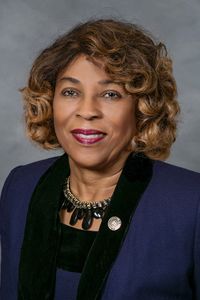
Waddell is a graduate of South Carolina State University and holds a master's degree from the University of North Carolina at Charlotte, North Carolina A & T State University and Appalachian State University. She earned her doctorate from the University of North Carolina at Greensboro. She has served on more than 15 boards and community organizations, many serving children, in appointed and elected capacities. Waddell has three decades of experience in education, including 21 years in Charlotte-Mecklenburg Schools as a teacher and administrator.[1]
- Ph.D:
- University of North Carolina, Greensboro
- Graduate:
- University of North Carolina, Charlotte
- Bachelor's:
- South Carolina State University
Campaign themes
Joyce Waddell has not yet completed [the profile publisher]'s 2026 Candidate Connection survey.
If you are Joyce Waddell, click here to fill out [the profile publisher]'s 2026 Candidate Connection survey.
Who fills out the candidate survey?
Any candidate running for elected office, at any level, can complete [the profile publisher]'s Candidate Survey. Completing the survey will update the candidate's [the profile publisher] profile, letting voters know who they are and what they stand for. More than 32,000 candidates have taken [the profile publisher]'s candidate survey since we launched it in 2015. Learn more about the survey here.
Help improve [the profile publisher] - send us candidate contact info.
Joyce Waddell did not complete [the profile publisher]'s 2024 Candidate Connection survey.
Joyce Waddell did not complete [the profile publisher]'s 2022 Candidate Connection survey.
Joyce Waddell did not complete [the profile publisher]'s 2020 Candidate Connection survey.
What would be your top three priorities, if elected?
1) North Carolina needs a strong, sound economy that promotes widespread growth and will benefit families across the state. The state’s current minimum wage of $7.25 does not provide enough income for impoverished families to survive on. We must free our hard-working citizens from the cycle of poverty. Women are the primary breadwinners in four out of ten households in the state. Women should be able to afford necessities and experience economic independence. Raising the minimum wage would benefit nearly 1.3 million citizens, which is one-third of North Carolina’s workforce, and the state’s overall economy. Every worker should be paid a fair wage, and as the economy grows, wages should grow with it. According to seven Nobel-prize winning economists, “increases in the minimum wage had little or no negative effect on the employment of minimum-wage workers.” Economists have found that jobs that increased the minimum wage experience better economic performance, lower unemployment rates, and higher job creation rates than other states that did not. Instead of prioritizing tax cuts for the wealthy, we should support our hardworking middle-class families.
2) Health and social services have often been neglected in minority communities. Access to optimal healthcare should no longer be a privilege; it should be a right. The Medicaid coverage gap refers to the group of uninsured people who are both ineligible for Medicaid under its previous rules and too poor to qualify for the Affordable Care Act’s subsidies and credits that were designed to allow middle-class Americans to purchase health insurance. North Carolina still has a coverage gap, and the legislature has opted not to enact a bill that would expand Medicaid. Approximately 244,000 uninsured North Carolinians fall in the Medicaid Coverage Gap, and as many as 400,000 citizens would benefit from extending Medicaid coverage. Under Medicaid expansion, the number of children without health insurance would significantly reduce, and outpatient providers could address many of the currently untreated issues that often result in patients seeking inefficient, costly, and inappropriate care in the emergency department. Closing the gap would benefit hundreds of thousands of North Carolinians, some of which are right here in Charlotte. If North Carolina had expanded Medicaid, 48,874 people in Mecklenburg County would have received coverage in the year 2017. By 2020, Medicaid would have created 4,465 jobs, over $2.9 million in new business activity, and over $18 million in new tax revenue for Mecklenburg County.
3) The North Carolina Constitution states that it is the duty of the state to provide a sound basic education for all students. The underfunded public school system is in dire need of assistance. It is vital to invest in public education and new programs that can lead to our state having future innovating entrepreneurs and business leaders. Public taxpayer money should be allocated to public schools exclusively to establish and maintain a uniform system of free public schools. North Carolina is the 9th largest state in the nation but ranks 41st in teacher pay and 50th in principal pay. The state also ranks 43rd nationally in per-pupil spending. The legislature's inability to offer competitive pay has cost North Carolina thousands of fine teachers to other states. North Carolina cannot afford to lose more talented educators. The legislature must raise teacher and administrator pay to show that we value our educators and the countless hours of work they do to provide our children with a sound education and bright future. Every year, $9 billion in state taxpayer money is distributed to North Carolina’s public schools. North Carolina is one of seven states that use an allotment system. The North Carolina Allotment System is based on a Resource Allocation Model. The model distributes funds using a series of allotments, such as classroom teachers, textbooks, etc. Based on that information, a certain base amount is allotted for each student. That base amount varies depending on the characteristics of the student –i.e., grade level, special needs, etc., -adding resources to account for increased costs to serve that child. The problem with this allotment system is that the student population is not indicative of the need that some school districts have for more funding, which causes resources for disadvantaged students to be disproportionately distributed. This is directly linked to teacher pay. Because funding is allocated based on student population, wealthier districts, which have more taxable property wealth per child available, are able to attract teachers who are more experienced and better-educated. North Carolina needs a sustained investment in teacher pay. It is important that we invest in our teachers who in turn invest in our children.[14][15]
What areas of public policy are you personally passionate about? Why?
My parents instilled in me the importance of education at a very young age. Education is one of the most powerful weapons we can use to change the world. Knowledge is power. I always had a great desire to educate and help others. I served on the Charlotte-Mecklenburg Board of Education, District 3, and have worked for over 30 years in the Charlotte Mecklenburg School System. Students will always be dear to my heart, and I will continue to do all that I can to ensure their future success.Cite error: Invalid <ref> tag; invalid names, e.g. too many[15]
On the 2026 ballot
Links
Compiled from the candidate’s published profile as of September 30, 2026.
Source(opens in new tab)