
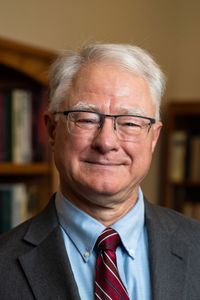
Background
John MacCarthy graduated from Elko High School. He earned a bachelor's degree from Carleton College in 1976, a Ph.D. from the University of Notre Dame in 1982, and a graduate degree from George Mason University in 2008. His career experience includes working as a systems engineer, physicist, professor, technical manager, senior technical and policy advisor, and research analyst. MacCarthy has been affiliated with Westminster Presbyterian Church, Wofford College, Rotary Club, Democratic Party, and Mom's Demand Action.[1]
- Ph.D:
- University of Notre Dame, 1982
- Graduate:
- George Mason University, 2008
- Bachelor's:
- Carleton College, 1976
- High school:
- Elko High School
In their own words
Who are you? Tell us about yourself.
My wife Betsy and I have been married for more than 40 years and we have two children and three grandchildren.
Over the course of my career, I have been a physicist, engineer, manager, and college professor.
I grew up and attended public schools in small conservative towns in the West and Midwest. I graduated from high school in Nevada, earned a B.A. in physics from Carleton College, a Ph.D. in physics from the University of Notre Dame, and an M.S. in Systems Engineering from George Mason University.
After beginning my career as a physics professor at Muhlenberg College, I went on to spend 23 years as a systems engineer in a variety of technical management and leadership roles on programs of national significance. I served as the Deputy Director of TRW’s Center for Advanced Technology, a technology and policy advisor to an executive in the Pentagon, and the Director of the University of Maryland’s Systems Engineering Education Program. I also served as a part-time adjunct professor of systems engineering at the University of Maryland, Baltimore County.
In 2020, my wife and I retired and moved to Simpsonville where I am now a part-time adjunct lecturer of physics at Wofford College.
I am a lifelong Presbyterian and a member of the Simpsonville Rotary and Chamber of Commerce. My values have been shaped by his faith and career of service. These values will guide me as I work to represent all the people of District 27.
Please list below 3 key messages of your campaign. What are the main points you want voters to remember about your goals for your time in office?
We need people in the State House with the values, motivation, experience, and skills required to guide our state.
As a scientist and an engineer, I spent most of my career integrating the perspectives of diverse groups of people to develop complex systems, that used advanced technologies to meet the needs of our country.
When elected, I will use these skills to address the real challenges facing our state.SC Electric companies are charging residential users more than twice as much per kWhr as industrial users and percent increases each year a greater for residential users as for industrial users. We need to lower residential energy rates and increase industrial rates.We need to improve our public schools. We can do this best by listening to the recommendations of those who have developed expertise in the area through their training and years of experience, that is, the public-school teachers themselves.
The Palmetto State Teachers Association has developed a 2026 Agenda that outlines the recommendations of these experts. We should work to implement these.
What areas of public policy are you personally passionate about?
I am passionate about state energy policy, affordability, public education, the environment, and supporting working families.
As a professor at Wofford College, some students and I developed a model for the Upstate electrical energy grid. As a result, I have a rather good understanding of how the grid works, how current and potential future technologies work, and their relative strengths, weaknesses, and costs.
I understand how critically important public education is both for preparing our children for careers and for developing citizens that are able to work with diverse groups of people.
Who do you look up to? Whose example would you like to follow, and why?
People who do the right thing, regardless of the political consequences.
What characteristics or principles are most important for an elected official?
A motivation to help others. A willingness to listen to others. A commitment to discovering the truth and acting on it. An openness to being wrong.
What do you believe are the core responsibilities for someone elected to this office?
To serve the interests of their constituents.
What legacy would you like to leave?
That I did the right thing.
What was your very first job? How long did you have it?
Assistant Professor of Physics at Muhlenberg College.
5 years.
What was the first historical event that happened in your lifetime that you remember?
Assassination of JFK.
Who are you? Tell us about yourself.
John and his wife Betsy have been married for more than 40 years and have two children and three grandchildren.
Over the course of his career, John has been a physicist, engineer, manager, and college professor.
John grew up and attended public schools in small conservative towns in the West and Midwest. He graduated from high school in Nevada, earned a B.A. in physics from Carleton College, a Ph.D. in physics from the University of Notre Dame, and an M.S. in Systems Engineering from George Mason University.
After beginning his career as a physics professor at Muhlenberg College, he went on to spend 23 years as a systems engineer in a variety of technical management and leadership roles on programs of national significance. He served as the Deputy Director of TRW’s Center for Advanced Technology, a technology and policy advisor to an executive in the Pentagon, and the Director of the University of Maryland’s Systems Engineering Education Program. During much of this time, he was also a part-time adjunct professor of systems engineering at the University of Maryland, Baltimore County.
In 2020, he and his wife retired and moved to Simpsonville where he is now an adjunct lecturer of physics at Wofford College.
John is a lifelong Presbyterian and a member of the Rotary. His values have been shaped by his faith and career of service. These values will guide him as he works to represent all the people of the Simpsonville/Mauldin area.
Please list below 3 key messages of your campaign. What are the main points you want voters to remember about your goals for your time in office?
I believe South Carolina’s representatives should reflect the values of our community.The state should not attempt to restrict a woman’s fundamental right to make her own reproductive decisions.South Carolina needs to make childcare affordable and available.
What areas of public policy are you personally passionate about?
In addition to protecting everyone's basic human rights, protecting and improving public education, supporting public safety and a growing economy that benefits families, working people, seniors and small businesses, I believe the State House needs representatives who understand the technologies that will provide the foundation for our State’s future economic growth.
What characteristics or principles are most important for an elected official?
Respect for others, truthfulness, character, maturity, and intellectual depth and independence.
What qualities do you possess that you believe would make you a successful officeholder?
I have learned to make decisions based on data, rather than opinion or political expedience. I have a diverse technical and management background that enables me to evaluate data from many different disciplines. I have experience teaching graduate courses in systems engineering, decision and risk analysis, and data communications. I have experience with life cycle cost analysis, root cause analysis (for why programs fail), and cost-effectiveness studies. I have worked in leadership roles with diverse teams of people to develop large, complex national defense and environmental systems. I know how to listen to the needs of all affected parties to ensure that a solution meets those needs to the extent possible.
What are your views on financial transparency and government accountability?
The State should be financially transparent and accountable.
On the 2026 ballot
Links
Compiled from the candidate’s published profile as of September 30, 2026.
Source(opens in new tab)