
Background
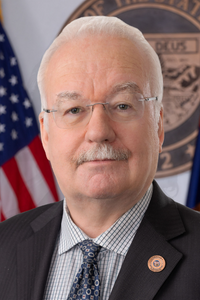
John Kavanagh was born in New York, New York. Kavanagh served in the U.S. Army National Guard from 1971 to 1976. He earned a bachelor's degree from New York University in 1973, a graduate degree from St. John's University in 1976, a graduate degree from Rutgers University in 1995, and a doctorate from Rutgers University.[2]
Kavanagh's career experience includes working as a college professor and police detective sergeant. He has been affiliated with the American Legion, Knights of Columbus, and Friends of the Chamber of Commerce.[2]
- Ph.D:
- Rutgers University
- Graduate:
- St. John's University, 1976
- Bachelor's:
- New York University, 1973
Campaign themes
John Kavanagh has not yet completed [the profile publisher]'s 2026 Candidate Connection survey.
Send a message to John Kavanagh asking him to fill out the survey.
If you are John Kavanagh, click here to fill out [the profile publisher]'s 2026 Candidate Connection survey.
Who fills out the candidate survey?
Any candidate running for elected office, at any level, can complete [the profile publisher]'s Candidate Survey. Completing the survey will update the candidate's [the profile publisher] profile, letting voters know who they are and what they stand for. More than 32,000 candidates have taken [the profile publisher]'s candidate survey since we launched it in 2015. Learn more about the survey here.
You can ask John Kavanagh to fill out this survey by using the buttons below or emailing info@electkavanagh.com.
John Kavanagh did not complete [the profile publisher]'s 2024 Candidate Connection survey.
Who are you? Tell us about yourself.
My name is John Kavanagh and I have spent a lifetime advancing conservative Republican principles.
Educationally I received a BA degree from NYU, a master’s degree in government from St. John’s University and a PhD in criminal justice from Rutgers. Occupationally, I served 20 years as a police officer with the Port Authority of New York and New Jersey Police Department, retiring as a detective sergeant. Upon moving to Arizona, I began my college teaching career at Arizona State University and finally for 20 years at Scottsdale Community College.
I have always been interested in public policy and even while a police officer, I served two terms on the town council of the small town where I lived. Upon moving to Arizona after retiring from the police, I served six years on the Fountain Hills town council. I then ran for the state legislature in 2005 and have served there in both the House and Senate ever since.
My conservative credentials are impeccable. I have a lifetime A+ rating from the NRA, a lifetime A rating from the American Conservative Union and a perfect voting record with the Arizona Center for Arizona Policy on pro-life, school choice and family issues.
Please list below 3 key messages of your campaign. What are the main points you want voters to remember about your goals for your time in office?
America’s southern border is under attack aided by the complacency or, perhaps, the support of the Biden administration. Millions of illegal aliens are crossing our border. One of the prime motives for my running for the legislature in 2005 was to stop the illegal immigration onslaught we were experiencing then. I am proud to say that I was a co-author and cosponsor of SB1070, Arizona’s anti-illegal immigration law. Today, I continue the fight and have pushed for and will get over half a billion dollars in budgetary expenditures for more border security and more border wall. My opponent has no experience in this area.While Arizona does a good job of educating our children, district and charter schools are still suffering from the budget cuts we were forced to make during the great recession. While we have restored almost all of those cuts, our schools still could use some additional funding, which I support. I also support the expansion of school choice because students and parents should be allowed to select the best educational option available.Arizona is getting deeper and deeper into a water crisis and we need to take action now before draconian measures are necessary later to deal with shortages. I support the appropriation that we will be making two bowls find new out-of-state sauces for water, advanced conservation measures within the state, and place pumping restrictions in aquifers that are suffering depletion.
What areas of public policy are you personally passionate about?
I am passionate in many areas of public service. Having spent all 16 years of my legislative time as a member of the appropriations committee, many times as its chairman, I am especially interested in the budget. I have acquired great knowledge in this area and hope to continue serving and using that knowledge to produce fiscally sound and conservative budgets.
I am also a champion of humane animal legislation. I am the only legislator to have been awarded the United States Humane Societies "Legislator of the Year" award three times. I have written and passed into law many humane animal bills and hope to continue this mission in the future.
As a retired police officer and a person with a PhD in criminal justice, I also pay attention to criminal justice issues. I am often troubled by the criminal justice reform measures that can go too far and threaten public safety. I hope to be retained in the legislature so that I can continue to keep a close eye on them to protect public safety. While some prisoners can safely be released from prison, others have no place back in society where they will victimize us.
Our nation and our state are in trouble times. Liberal Democrats control Washington, much of the media, much of our educational institutions and they pose a threat to our lifestyle, culture, economy and safety. Now is not the time to entrust lawmaking to inexperienced first timers. Experience counts.
Who do you look up to? Whose example would you like to follow, and why?
Politically, I look up to Ronald Reagan who I believe held sound conservative beliefs, was a great communicator, and a decent person.
What characteristics or principles are most important for an elected official?
The two characteristics that are best would be knowledge and honesty. In terms of principles, because I am a conservative I would obviously say the conservative principles of limited government, free enterprise, individual freedom and pro-life.
What qualities do you possess that you believe would make you a successful officeholder?
I am intelligent, honest, easy-going, transparent and committed. I also have a good sense of humor.
What do you believe are the core responsibilities for someone elected to this office?
To be true to the principles that he or she told the voters who elected him or her. A legislator also has a responsibility to be well researched in the bills that they vote on and transparent and communicative with their constituents. I meet with everyone who asks.
What legacy would you like to leave?
I would like people to say that I sponsored good bills, voted for good laws and opposed bad legislation.
What is the first historical event that happened in your lifetime that you remember? How old were you at the time?
I was 10 years old and sitting at my desk in elementary school when the loudspeaker in the front of the room came on with the radio coverage of the assassination of John F Kennedy.
What was your very first job? How long did you have it?
I was a paperboy in New York City and I did it for several years.
What was the last song that got stuck in your head?
Uptown Girl
What is something that has been a struggle in your life?
I have been blessed not to have been confronted with any excessive burdens that amount to a struggle.
What do you believe is the ideal relationship between the governor and state legislature?
I believe that the ideal relationship is one of communications and mutual respect. I believe that communications prior to passing bills is a good thing because then vetos can be avoided because problems can be dealt with before the bills are transmitted to the governor.
What do you perceive to be your state's greatest challenges over the next decade?
Without a doubt, water. Arizona is in the midst of a severe drought and some of the aquifers are being dangerously depleted. While most of the negative impacts will be on farming, some will spill over into business and residential uses, if the situation gets bad enough.
What are the benefits and drawbacks of a unicameral state legislature, in your opinion?
The benefit is that it will be easier to pass legislation out of a legislature. However that is also a major drawback because having two houses requires that there be an additional check and opportunity to correct bills, as problems become apparent. I think two chambers are the best.
Do you believe that it’s beneficial for state legislators to have previous experience in government or politics?
I do. It's nice to say that all it takes is common sense to do this job but that is not true. This job requires extensive knowledge of public policy and governmental procedure. I have been involved in politics since high school. I love public policy and have elective office experience on two town councils and in the state legislature for the last 16 years. However, I have always been employed elsewhere to support my family. I am not a career politician. I am a committed citizen-legislator.
I am in effective legislator and I am among a small group that pass a large number of bills into law each year. My experience and knowledge help me do this but I have also become the go to person for people who need laws to protect them, such as persons persecuted by rogue homeowners associations or the humane animal community.
Do you believe it’s beneficial to build relationships with other legislators? Please explain your answer.
Absolutely. One of the reasons why I get many of bills past is because I have worked with many of the members in both chambers and have developed relationships with them. They know that I produce quality legislation and they trust me not to lie to them. It's a big plus.
What process do you favor for redistricting?
While I have problems with the current redistricting situation, I must admit that it is far superior to the traditional one where the party in power gets drawn lines that give them a tremendous undemocratic advantage.
If you are a current legislator, what appealed to you about your current committees?
I like the appropriations committee because it is very influential. After all, where you spend the money is, in reality, what makes public policy. In addition, I get to influence policy in a manner consistent with my conservative Republican beliefs. I also serve on the public safety committee and as a retired police officer and a person with a PhD in criminal justice this obviously is an area that I have great knowledge of and great interest in.
Is there a particular legislator, past or present, whom you want to model yourself after?
While he is best known for his role as the mayor of New York City and was a Democrat and early in his career a liberal one to boot, I do have a great deal of respect for former NYC mayor Ed Koch. In particular, I like the way he was always transparent, frank and honest with people about his reasons for or against different policies. I think people deserve the truth and public policy can best be crafted in an atmosphere where everybody is on the level and not being deceptive.
Are you interested in running for a different political office (for example, the U.S. Congress or governor) in the future?
No. I am quite happy doing what I do because I do it well and it makes a difference.
Both sitting legislators and candidates for office hear many personal stories from the residents of their district. Is there a story that you’ve heard that you found particularly touching, memorable, or impactful?
I was recently asked to run a bill to make college and other organizational hazing a crime. I'm not talking about juvenile hazing that is not dangerous but serious hazing like making people drink full bottles of alcohol that can kill them. The family I was running the bill for was the family whose son died from being forced to drink too much alcohol as part of hazing and whose body was found by the Mesa Riverwalk area.
Should the legislature oversee or grant the use of emergency powers?
I believe that the legislature should share emergency powers with the governor. In fact, I crafted a constitutional amendment to allow that. Putting too much power in one person without any check can be a problem. I think the governor should be allowed to swiftly and act using emergency powers but that the legislature should come in a reasonable time afterwards, say 30 days, and have the ability to either amend or cancel it, with perhaps a 2/3 vote.
Do you believe that compromise is necessary or desirable for policymaking?
I believe that compromise is necessary, so long as it does not compromise or violate one's firmly held political philosophy.
John Kavanagh did not complete [the profile publisher]'s 2020 Candidate Connection survey.
Kavanagh's campaign website highlighted the following campaign themes:[16]
No Tax Increases
Excerpt: "Representative Kavanagh opposes tax increases. In these difficult economic times government must allow the people to keep as much of their money as possible. Taking money from the private sector to unreasonably grow government will only slow down the recovery."
Jobs Creation
Excerpt: "Representative Kavanagh helped write and supported individual and business tax cuts and other incentives to stimulate the economy and create more jobs. These policies have made Arizona's economic comeback amoung the fastest in the nation."
Fiscal Conservative
Excerpt: "Representative Kavanagh is a strong fiscal conservative. As chairman of the House Appropriations Committee, he crafted budgets that cut over $3 billion in government spending and has opposed tax increases."
Stop Illegal Immigration
Excerpt: "Representative Kavanagh co-sponsored and helped write SB1070, Arizona's tough anti-illegal immigration law. Kavanagh also wrote the law requiring that all levels of government check for proof of legal presence before issuing anyone a license of any type"
Quality Education
Excerpt: "Representative Kavanagh believes that educationis the foundation of our future and should be properly funded with accountability and enforced standards. Whed education funding needed to be reduced due to the recession, Kavanagh kept most cuts out of the classroom."
Medicaid expansion lawsuit
John Kavanagh was one of the 36 Republican members of the Arizona State Legislature who signed onto a lawsuit brought by the Goldwater Institute in September 2013 against Arizona Governor Jan Brewer (R) over the expansion of Medicaid in Arizona under provisions of the Affordable Care Act.[17] Brewer announced her support for Medicaid expansion in Arizona in 2013, and by June of that year the legislature passed a bill expanding Medicaid in the state .[18] In September 2013, the Goldwater Institute, a conservative think tank, filed a lawsuit seeking to block the law's implementation. They argued that the law contained a tax, and its implementation under the control of the executive branch violated state laws enforcing the separation of powers.[17] In 2015, a Maricopa County Superior Court judge ruled against the 36 Republican lawmakers and the Goldwater Institute, saying that the law contained an assessment, not a tax. The Arizona Court of Appeals upheld the Superior Court's 2015 ruling on March 16, 2017.[19]
On the 2026 ballot
Links
Compiled from the candidate’s published profile as of September 30, 2026.
Source(opens in new tab)