
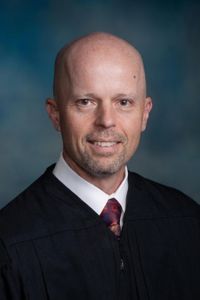
Background
Jerod Tufte served in the U.S. Army National Guard from 2008 to 2016. He earned a bachelor's degree from Case Western Reserve University in 1997 and a law degree from Arizona State University Law School in 2002. His career experience includes working as a judge.[3][4]
- Law:
- Arizona State University Law School
- Bachelor's:
- Case Western Reserve University, 1997
- High school:
- West Fargo High School
In their own words
Who are you? Tell us about yourself.
I'm a Justice of the North Dakota Supreme Court, seeking re-election to a full ten-year term. North Dakota voters first elected me to the Court in 2016, and I have served since January 2017.
I was born in Minot and raised in Grand Forks and West Fargo. I went to school in West Fargo through eleventh grade and still keep in touch with friends from the West Fargo High class of '93. Before the bench I practiced law: first at a large firm, then in my own main-street practice in Steele. I served as a Judge Advocate in the North Dakota Army National Guard, including one deployment, and as a state's attorney prosecuting cases for my county. I was appointed a district court judge in 2014 and elected to the Supreme Court two years later.
My approach to the work is straightforward and consistent: I decide cases on the law as written, the facts in the record, and nothing else. The legislature and the people make policy; a judge applies it — even when the result is not the one the judge would choose. Every opinion I have written is a public document. I invite voters to read the record and judge for themselves. I have been a leader on transparency and modernizing processes and technology.
My wife Mylynn and I live in rural Kidder County. I'm a lifelong runner — the Army made me one, and it stuck.
Please list below 3 key messages of your campaign. What are the main points you want voters to remember about your goals for your time in office?
A judge's job is to say what the law is, not what the law should be. I read the text, give it the meaning it had when it was enacted, and apply it as written — leaving policy to the legislature and the voters. I have applied the same method to every kind of case, for every kind of litigant, for a decade.Ten years. One consistent method. A written record any voter can read. I don't ask North Dakotans to take my approach to judging on faith — every opinion I have written is public. You can see exactly how I reason in every kind of case, and hold me to it.Justice has to be workable, not just legally correct. I've worked to make North Dakota's courts more open and more accessible — modernizing the judicial branch's open-records and open-meetings rules, advancing responsible court technology, and improving how the system serves North Dakotans who appear without a lawyer. There is more to do, and I want to keep doing it.
What areas of public policy are you personally passionate about?
As a sitting judge I'm deliberately careful here: it would be improper to campaign on policy outcomes, because my job is to decide cases on the law, not to advance an agenda. What I am passionate about is the administration of justice itself — the part of public life that is properly a judge's concern. That means courts that are open and transparent, courts that use technology well, and a justice system ordinary North Dakotans can actually navigate, including those without a lawyer. Access to justice and the integrity of the rule of law are what I care about most.
Who do you look up to? Whose example would you like to follow, and why?
Justice John Marshall Harlan, who served from 1877 to 1911. In 1896 he dissented, alone, in Plessy v. Ferguson, and wrote that "our Constitution is color-blind, and neither knows nor tolerates classes among citizens." He was right, and it took the country 58 years (until Brown v. Board of Education in 1954) to say so. I admire that he took the words of the Constitution seriously and followed them where they led, even when it meant standing by himself against every other member of the Court. That is what judicial courage actually looks like — reaching not for the popular result, but for the right one, and showing your reasoning so others can hold you to it.
Do you believe that empathy is an important quality for a judge?
Empathy can help shape how a judge listens, how a court session is run, and how an opinion is written, so the people involved can see they were actually heard. What empathy cannot do is decide a case. The promise of equal justice is that the same law reaches the sympathetic party and the unsympathetic one alike. The moment a judge bends the law toward the person he happens to feel for, he has broken that promise for the next person — the one who is harder to like, or who isn't in the room. So the answer is both: real respect for the people in front of me, and a method that applies the law evenly no matter who they are.
What organizations or individuals have endorsed your campaign?
Endorsements are coming in from around the state and we are sharing them out on Facebook.
What concerns, if any, do you have about the legal system in your state?
I am increasingly concerned about access — whether an ordinary North Dakotan can actually use the courts. Too many people, especially in rural parts of the state and especially those without a lawyer, find the system hard to navigate and hard to afford. I have worked on this directly by chairing the court's task force on lawyer licensing and alternative legal practice and helping modernize the rules that keep the judicial branch open. There is more to do. A justice system that is legally correct but practically out of reach is not doing its whole job. Keeping the courts workable for the people who actually need them is critical work for my second term.
Note: Tufte submitted the above survey responses to [the profile publisher] on May 23, 2026.
Show past responsesHide past responses
May 16 submission
Who are you? Tell us about yourself.
I'm a Justice of the North Dakota Supreme Court, seeking re-election to a full ten-year term. North Dakota voters first elected me to the Court in 2016, and I have served since January 2017.
I was born in Minot and raised in Grand Forks and West Fargo. I went to school in West Fargo through eleventh grade and still keep in touch with friends from the West Fargo High class of '93. Before the bench I practiced law: first at a large firm, then in my own main-street practice in Steele. I served as a Judge Advocate in the North Dakota Army National Guard, including one deployment, and as a state's attorney prosecuting cases for my county. I was appointed a district court judge in 2014 and elected to the Supreme Court two years later.
My approach to the work is straightforward and consistent: I decide cases on the law as written, the facts in the record, and nothing else. The legislature and the people make policy; a judge applies it — even when the result is not the one the judge would choose. Every opinion I have written is a public document. I invite voters to read the record and judge for themselves. I have been a leader on transparency and modernizing processes and technology.
My wife Mylynn and I live in rural Kidder County. I'm a lifelong runner — the Army made me one, and it stuck.
Please list below 3 key messages of your campaign. What are the main points you want voters to remember about your goals for your time in office?
A judge's job is to say what the law is, not what the law should be. I read the text, give it the meaning it had when it was enacted, and apply it as written — leaving policy to the legislature and the voters. I have applied the same method to every kind of case, for every kind of litigant, for a decade.Ten years. One consistent method. A written record any voter can read. I don't ask North Dakotans to take my approach to judging on faith — every opinion I have written is public. You can see exactly how I reason in every kind of case, and hold me to it.Justice has to be workable, not just legally correct. I've worked to make North Dakota's courts more open and more accessible — modernizing the judicial branch's open-records and open-meetings rules, advancing responsible court technology, and improving how the system serves North Dakotans who appear without a lawyer. There is more to do, and I want to keep doing it.
What areas of public policy are you personally passionate about?
As a sitting judge I'm deliberately careful here: it would be improper to campaign on policy outcomes, because my job is to decide cases on the law, not to advance an agenda. What I am passionate about is the administration of justice itself — the part of public life that is properly a judge's concern. That means courts that are open and transparent, courts that use technology well, and a justice system ordinary North Dakotans can actually navigate, including those without a lawyer. Access to justice and the integrity of the rule of law are what I care about most.
What organizations or individuals have endorsed your campaign?
Endorsements are coming in from around the state and we are sharing them out on Facebook.
On the 2026 ballot
Links
Compiled from the candidate’s published profile as of September 30, 2026.
Source(opens in new tab)