
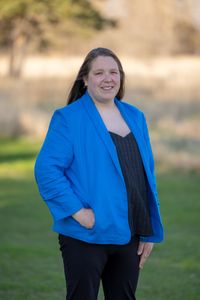
Background
Jennifer Compeau earned a high school diploma from Fisher High School and an associate degree from Northland Community & Technical College in 2024. She has attended Minnesota State University, Mankato. Her career experience includes working as a nonprofit professional.[1]
- Associates:
- Northland Community & Technical College, 2024
- High school:
- Fisher High School
In their own words
Who are you? Tell us about yourself.
My name is Jennifer Compeau. I was born and raised in East Grand Forks by two hardworking parents who instilled in me the value and importance of caring for others, showing up for your community, and treating people with dignity.
Like many people, my life has not been a straight path. I have faced adversity and challenges that gave me a deeper understanding of how systems can either serve people well or create barriers that make it harder for them to succeed. Those experiences shaped one of my strongest beliefs: the people closest to a problem are often the people closest to the solution.
My life has given me the opportunity to see our communities from many different perspectives, including as a young mother, someone who faced significant challenges and rebuilt my life, a nonprofit leader, and an advocate who now works every day alongside families across our region.
Those experiences shaped who I am. They taught me that resilience exists in every community, but systems do not always make it easy for people to succeed. They also inspired me to dedicate my career to helping others navigate those systems with dignity, hope, and practical support.
At my core, I am a listener, a problem solver, and someone who believes public service is about earning trust. I believe leadership starts with showing up, listening to people’s experiences, and working together to create solutions that strengthen our communities.
Please list below 3 key messages of your campaign. What are the main points you want voters to remember about your goals for your time in office?
Action: I believe leadership means showing up, listening, and getting things done. I will work across differences to deliver practical solutions that strengthen families, support local communities, and address the challenges facing rural Minnesota.Affordability: I hear from families every day who are working hard, making responsible choices, and still finding it harder to keep up with the rising cost of living. The cost of housing, health care, childcare, and everyday needs impacts all of us. I believe we need practical solutions that help working families build stability, expand access to affordable health care and housing, support strong public schools, and create opportunities for people to thrive.Accountability: Trust is earned through listening, transparency, and following through. I believe elected officials have a responsibility to be accessible, honest, and accountable to the people they serve. I will bring the voices and experiences of District 1B to the Capitol, make decisions with integrity, and always remember that public service is about serving people, not politics.
What areas of public policy are you personally passionate about?
The areas of public policy I am most passionate about are those that strengthen families, invest in prevention, and create opportunities for people to thrive. Through my personal experiences and my work as a Family Resource Coordinator, I have seen how policies impact people’s everyday lives and how early support can change the course of someone’s future. I am passionate about whole-person health care, including mental health and dental care, education, family resources, and community-based programs. I believe prevention starts by ensuring people have access to support before challenges become crises. When we invest in families and communities, we reduce barriers and create pathways for people to succeed.
Who do you look up to? Whose example would you like to follow, and why?
The person I look up to most is my dad. He showed me what is possible through hard work, kindness, compassion, and the importance of looking out for your neighbors.
My dad grew up in extreme poverty, but he understood the value of community and the power of people helping one another. He worked hard to create a better life for our family, but he also understood that success does not happen alone. Much of what we were able to build came through the support of others who stepped up when we needed help, just as we stepped up for others when they needed us.
One of the most important values my dad instilled in me was the responsibility to look out for people who may not have the resources, support, or opportunities to advocate for themselves. He taught me that a strong community is built when we care for one another and recognize that everyone has a role to play.
The example I hope to follow is his example of service, humility, and compassion. Leadership is not about being above others; it is about standing beside people and helping create opportunities for everyone to succeed.
What characteristics or principles are most important for an elected official?
The most important characteristics of an elected official are integrity, humility, accountability, and the ability to listen. Public service is a responsibility, and leaders must earn the trust of the people they represent through honesty, transparency, and a willingness to show up.
I believe effective leaders should listen to the experiences of their communities, especially those who are often overlooked, and work to find practical solutions. They should be willing to collaborate, admit when they do not have all the answers, and make decisions based on what will best serve the people, not political interests.
An elected official should remember that leadership is not about having power; it is about using that responsibility to make a positive difference in people’s lives.
What is something that has been a struggle in your life?
One of the greatest struggles in my life has been overcoming the challenges that came from making mistakes, facing difficult circumstances, and finding my way forward. There were times when systems and circumstances made it difficult to move ahead, but I chose to take responsibility, rebuild my life, and create a different future for myself and my family.
That journey taught me the importance of second chances, accountability, and the power of support from others. It also gave me a deeper understanding of the barriers many people face when they are trying to access resources, recover from setbacks, or build stability.
Today, I use those experiences to help others navigate challenges with dignity and hope. My struggles shaped my perspective, but they do not define me. They strengthened my commitment to building communities where people have opportunities to grow, contribute, and succeed.
What do you believe is the ideal relationship between the governor and state legislature?
I believe the ideal relationship between the governor and the state legislature is one built on collaboration, communication, and accountability. Each branch has an important role to play, and our state is strongest when leaders work together to solve problems rather than focus on political division.
The governor should provide leadership and a vision for addressing the challenges facing Minnesota, while the Legislature should represent the voices and needs of communities across the state. Legislators should ask thoughtful questions, advocate for their constituents, and ensure that policies are responsible and effective.
At the same time, a healthy relationship requires respect for differences of opinion. We will not always agree on every issue, but Minnesotans deserve leaders who are willing to listen, find common ground when possible, and put the needs of the people ahead of politics.
Do you believe that compromise is necessary or desirable for policymaking?
Absolutely. I believe compromise is necessary and desirable for effective policymaking. I do not get everything I want in life, and I do not know anyone who does. Public service requires the same understanding: listening, learning, and finding solutions that move us forward.
I believe good leaders should be willing to revisit policies, acknowledge when something is not working, and make improvements based on what we learn. We should focus less on political division and more on having honest conversations, listening to different perspectives, and finding common ground where we can.
Compromise does not mean abandoning your values. It means respecting the people we serve enough to work together and find practical solutions that improve the lives of Minnesotans.
What organizations or individuals have endorsed your campaign?
So far, I am endorsed by the Minnesota Democratic-Farmer-Laborer party, Education Minnesota, and Friends of the Boundary Waters Action Network
On the 2026 ballot
Links
Compiled from the candidate’s published profile as of September 30, 2026.
Source(opens in new tab)