
Background
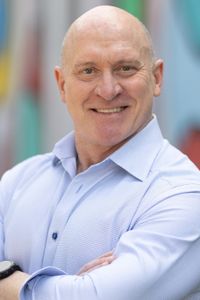
Jeff Newlin was born in Indiana. He earned a high school diploma from Western High School and a bachelor's degree from Purdue University in 1989.[1] His career experience includes working as a business executive. As of 2024, Newlin was affiliated with Command Alkon.[2]
- Bachelor's:
- Purdue University, 1989
- High school:
- Western High School
In their own words
Who are you? Tell us about yourself.
I'm Jeff Newlin, a business executive, not a career politician. I grew up in a small town in rural Indiana, one of 5 boys, and started working at age 9 on a paper route. I worked 3 jobs to put myself through Purdue University, where I graduated in 1989. I then spent 37 years in the private sector building and leading technology companies, most recently as Chief Revenue Officer of Command Alkon, the largest technology provider in the building materials industry. Today I serve as Executive Director of the Georgia Ready Mixed Concrete Association, working every day with the businesses and workers who build our state.
My wife and I have been married 33 years. We have lived in the Atlanta area for 36 years, the last 15 in the Lakeside area of DeKalb County, where we raised 3 children and became grandparents this spring. We are parishioners at Immaculate Heart of Mary Catholic Church, where I lead the men's group. Outside of IHM, I have volunteered at the Bashor homeless men's shelter in downtown Atlanta since 2015.
I am a health and fitness advocate and long-time member of the Atlanta Track Club and the Atlanta Triathlon Club.
I ran for this seat in 2024 because families in District 41 are being taxed out of their homes while our schools spend more and deliver less. I'm running again in 2026 because little has changed, and some things have gotten worse. I will bring what 37 years in business taught me: show up, listen, measure results, and answer for them.
Please list below 3 key messages of your campaign. What are the main points you want voters to remember about your goals for your time in office?
Affordability and Tax Relief for Georgia Families. Georgia families are stretched thin by rising costs, and they deserve a senator who will fight to put money back in their pockets. I will push for income tax reductions, property tax relief, and homestead exemptions that protect families from being taxed out of their homes. Seniors on fixed incomes deserve property tax freezes and retirement income exclusions so they can age in place with dignity. Every dollar the state takes from a working family is a dollar that family can't spend on groceries, child care, or saving for the future. I will vote for every responsible tax cut that comes to the Senate floor.Education, Workforce Development, and Parental Rights. Parents should have a meaningful voice in their children's education, and every student deserves a path to a good career. I support school choice so families can find the best fit for their kids. I will fight for workforce development programs and trades training that create real career paths for young Georgians who don't follow the college route. Our schools need accountability: we should measure results, not just spending. A strong education-to-career pipeline is how we grow Georgia's economy from the ground up.Public Safety, Veterans, and Stronger Communities. Safe communities are the foundation of everything else. I support law enforcement and oppose soft-on-crime policies that put families at risk. I will defend Second Amendment rights and stand against any effort to defund the police. Our veterans and military families deserve our full support: property tax exemptions, small business programs, mental health resources, and workforce transition assistance. In my current role, I am working with a national organization to engage ready mixed concrete companies in a program focused on transitioning active duty military into a trades career.
I will be a senator who prioritizes the safety and well-being of every person in District 41.
What areas of public policy are you personally passionate about?
Prosperity and affordability are at the top of my list. I've watched families in our district struggle with rising property taxes and costs of living, and I believe government should be finding ways to return money to taxpayers, not take more. Workforce development is another passion. After 37 years in the private sector, I know firsthand that we need stronger pipelines from our schools into skilled trades and technical careers, not just 4-year degrees. I'm also deeply committed to supporting our veterans and seniors, two groups that have given so much and often receive too little attention from state government. And I believe strongly in public safety. Every family deserves to feel safe in their home and their community.
Who do you look up to? Whose example would you like to follow, and why?
Politically, it is Ronald Reagan. Not because I agree with every policy decision he made, but because he showed that you can hold firm convictions while still treating your opponents with respect and finding ways to work together. Reagan came from outside the political establishment. He was a private sector leader who believed government should serve the people, not the other way around. He communicated a clear, optimistic vision for the country, and he backed it up with actions and results. What I admire most is his ability to build coalitions across party lines. He worked with Tip O'Neill, a Democrat, to pass major legislation because both men understood that results mattered more than political theater. He made tough decisions that at times ran contrary to the Republican establishment. This is the kind of leader I strive to be: principled, optimistic, action-oriented, and results-driven. I have proven this in my professional life and in my charitable work. I keep the main thing the main thing, and as a member of the legislature, that main thing is improving the lives and livelihoods of the people we represent.
What characteristics or principles are most important for an elected official?
Integrity comes first. An elected official should vote their conscience and be honest about why, even when it's unpopular. If you can't explain your vote to a constituent face-to-face, you shouldn't have cast it. Accountability is next. Accountability is next. You must own your record and your mistakes, and never blame others when things go wrong.
Accessibility matters greatly. Too many officials are available to donors and lobbyists but invisible to the regular families they represent. A senator should be reachable, responsive, and present in the community.
Pragmatism over ideology. I'd rather pass an imperfect bill that helps real people than hold out for a perfect bill that never moves.
And finally, humility. The best leaders listen more than they talk, especially to people who disagree with them. The moment an elected official starts believing they have all the answers is the moment they stop serving effectively.
What do you believe are the core responsibilities for someone elected to this office?
First and foremost, represent all of your constituents. Not just the ones who voted for you, not just your party's base, but every family in the district. That means showing up: attending sessions, serving on committees, holding town halls, and being accessible when people call or write. A state senator should vote on principle, explain those votes transparently, and never hide behind vague language or party talking points. You owe your constituents a clear accounting of why you voted the way you did. Beyond that, the job is about fighting for practical results: lower taxes, safer communities, better-performing schools, and a stronger economy. It's about exercising genuine oversight of state spending so taxpayer dollars are used responsibly. And it's about being a voice for the people in your district who feel like the Capitol has forgotten them: our seniors, our veterans, our small business owners, and our working families who are just trying to make ends meet.
What legacy would you like to leave?
I want to be remembered as a senator who made District 41 more affordable for families to stay and thrive. Not as someone who gave good speeches, but as someone who delivered measurable results: lower taxes, better-performing schools, a stronger workforce pipeline, and safer communities. I want people to say that Jeff Newlin showed up, listened to everyone regardless of party, and fought for practical solutions over political posturing. If I can prove that a private sector leader, someone who spent a career building businesses and solving real problems, can translate that experience into effective public service, then I'll have left something worth leaving. Most importantly, I want my children and grandchildren to grow up in a Georgia where hard work is rewarded, families can afford to put down roots, and every community has the opportunity to prosper.
What was your very first job? How long did you have it?
I started delivering newspapers for the Kokomo Tribune when I was 9 years old, as backup to my older brother's route. By 11, it was mine. 60-plus families, 365 days a year. Every Christmas, every holiday, never a day off. In the summer I rode my bike. In the winter I pulled a sled through the snow. On rainy days my mom drove me.
I was an entrepreneur before I knew the word. I purchased the newspapers from the Tribune and resold them to my customers. Every week I went door to door to collect the $1.25 payment. Some families couldn't afford it, and I learned to let them slide and try again the next week. Some wrote checks that bounced, and I had to go back as a kid and ask for the money again. If I didn't collect, it came out of my pocket.
That job taught me more than any classroom ever did. It taught me that families struggle, that $1.25 can be the difference between paying a bill and not. It taught me empathy, patience, and persistence. It taught me to balance work with school and sports. And it taught me that when you knock on 60 doors a week, you learn to listen to people. I have been knocking doors ever since.
What is something that has been a struggle in your life?
In January 2015 I lost my mother to cancer and my brother to suicide in the same week. My brother's struggles began with an addiction that followed a surgery, and it took his finances, his health, and finally his life. I have watched family members and close friends struggle with addiction, anxiety, abuse, suicide, and violent crime, and I have seen what it costs a family when help comes too late. That is the hardest thing I have carried.
What do you believe is the ideal relationship between the governor and state legislature?
The governor and the legislature are co-equal branches of government, and the healthiest relationship between them is one of constructive partnership, not submission and not obstruction. The governor sets a vision and proposes an agenda. The legislature scrutinizes, debates, amends, and funds that agenda on behalf of the people they represent. Both sides should push each other to do better work.
In practice, that means the legislature should exercise genuine oversight of the executive branch: reviewing budgets line by line, questioning agency decisions, and holding the governor accountable for results. It does not mean rubber-stamping the governor's priorities, and it does not mean blocking good policy because it came from the other party.
I spent 37 years in the private sector working with boards, investors, and executive teams. The most effective organizations are the ones where leadership challenges each other respectfully, negotiates in good faith, and focuses on outcomes over ego. That is the relationship Georgia needs between its governor and its legislature.
What do you perceive to be your state's greatest challenges over the next decade?
Affordability is the most urgent challenge facing Georgia families. Property taxes and the cost of living are pushing working families and seniors out of communities they have lived in for decades. In DeKalb County the tax digest grew 50% in 5 years while wages grew about 19%. If the state does not act on meaningful tax relief, income tax reductions, homestead exemptions, and property tax freezes for seniors, we will lose the middle class families that hold our communities together.
Education and workforce development are the challenge that will define the next decade and beyond. Georgia is attracting major employers in manufacturing, technology, and logistics, but we are not producing enough skilled workers to fill those jobs. If we cannot supply those workers, businesses will look to other states that can.
We need to get our schools back to the basics so that students enter high school proficient in reading and math and understand personal and family budgeting. We need to invest in trades training, technical education, and apprenticeship programs so that every young Georgian has a clear path to a good career, whether or not they pursue a 4-year degree. Without well-paying jobs with a career path, affordability will never be solved. Individual and family prosperity is the best solution to the affordability problem.
Public safety and infrastructure round out the picture. Communities that do not feel safe do not grow. We need a plan for roads, public transportation, rapid transit, water infrastructure, and a power grid that can handle the demands of a strong, growing economy without adding more costs to Georgia families.
Do you believe that compromise is necessary or desirable for policymaking?
Yes. In 37 years of business leadership I have negotiated thousands of contracts and closed deals on every continent but Antarctica. You learn quickly that digging in your heels on a negotiable topic is a lose-lose approach. The goal is not to win the argument. It is to reach an outcome that works for both sides.
Compromise does not mean abandoning your values. Your core principles should never waver. In business, you never put your company at financial or ethical risk just to close a deal. In the legislature, I would never compromise on protecting taxpayers, defending constitutional rights, or keeping families safe. But the path to achieving those goals almost always requires working with people who see the problem differently than you do.
You also have to understand the needs and challenges of everyone you represent, not just the people who voted for you. Most voters in District 41 did not vote for me, and they had their reasons. My job is to understand why, find the common ground, and reach across the aisle to partner with Democrats on sound policy that helps my constituents, even when it is not a priority for Republican leadership.
What was the first historical event that happened in your lifetime that you remember?
I do not have one single moment. I have a lifetime of them. I remember watching Walter Cronkite report on the Vietnam War every night on CBS and not fully understanding why my parents looked so worried. I wrote a high school term paper on Agent Orange and interviewed veterans who told me not just about the chemical burns, but about coming home to a country that did not welcome them back. That stayed with me.
I remember watching Watergate on the television. I remember the Bicentennial celebrations in 1976. I watched the Challenger explosion live from my dorm room at Purdue in 1986. I was on a plane from Atlanta to Indianapolis on September 11, 2001, and landed at a silent, empty airport with my voicemail full of messages I could not make sense of.
But the event that shaped me most happened closer to home. I grew up in Kokomo, Indiana, a town built entirely on the Chrysler transmission plant and Delco Electronics. When the early 1980s recession hit and foreign imports flooded the market, our unemployment rate passed 20%, and Kokomo found itself in the national spotlight for all the wrong reasons. My parents divorced when I was 16. I watched families who had done everything right lose everything they had. That is the event I carry with me into public service, because I know what happens to a community when the economy fails its people. Many communities across Georgia, and especially in DeKalb County, continue to struggle economically. I don't want them to become the hometown I left over 40 years ago.
Jeff Newlin did not complete [the profile publisher]'s 2024 Candidate Connection survey.
On the 2026 ballot
Links
Compiled from the candidate’s published profile as of September 30, 2026.
Source(opens in new tab)