
Background
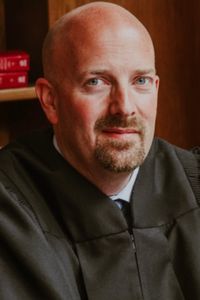
Jason Helland was born in Ottawa, Illinois. He graduated from Seneca Township High School in 1994. Helland earned an associate degree in applied sciences in law enforcement from Joliet Junior College in 1996, a bachelor's degree in political science from the University of St. Francis in 1999, and a J.D. from the John Marshall Law School in 2003. Helland's career experience includes working as a professor at the University of St. Francis and as an assistant state's attorney at the Kankakee County State's Attorney's Office. He was elected Grundy County State's Attorney in 2012.[1][2]
- Law:
- John Marshall School of Law, 2003
- Associates:
- Joliet Junior College, 1996
- Bachelor's:
- University of St. Francis, 1999
- High school:
- Seneca Township High School
In their own words
Who are you? Tell us about yourself.
Jason Helland was born in Ottawa, Illinois. He graduated from Seneca High School in 1994. Helland earned an associate's degree in applied sciences in law enforcement from Joliet Junior College in 1996, a bachelor's degree in political science from the University of St. Francis in 1999, and a juris doctor degree from the John Marshall Law School in 2003. Helland's career experience includes working as an adjunct professor at the University of St. Francis and as an assistant state's attorney in Kankakee County from 2004-2012. Helland served as the Grundy County State's Attorney from 2012 to 2022. Helland currently serves as a Circuit Court Judge in the 13th Judicial Circuit.
Please list below 3 key messages of your campaign. What are the main points you want voters to remember about your goals for your time in office?
I will strive to maintain and enhance confidence in the legal system and will respect and honor the judicial office.I will maintain the dignity of the judiciary and avoid the appearance of impropriety in both my personal and professional life.I possess the legal knowledge, skill, thoroughness, and preparation necessary to competently perform the responsibilities of an Appellate Court Justice.
What areas of public policy are you personally passionate about?
A judge plays a different role than that of a legislator or an executive office official. Rather than making decisions based upon expressed views or preferences of the voters, a judge makes decisions based upon the law and the facts of each individual case. In the furtherance of this interest, I will remain free from political influence and pressure.
What organizations or individuals have endorsed your campaign?
I have not sought out any endorsements in this judicial campaign in an abundance of caution to show my independence.
Who are you? Tell us about yourself.
Jason Helland was born in Ottawa, Illinois. Helland graduated from Seneca High School in 1994. Helland earned an associate in applied science degree from Joliet Junior College in 1996. Helland earned a bachelor's degree in political science from the University of St. Francis in 1999. Helland graduated magna cum laude from the John Marshall Law School (now UIC) in 2003. Helland worked as an assistant state's attorney in Kankakee County from 2004-2012. Helland also was an adjunct professor in the criminal justice department at the University of St. Francis from 2006-2013. Helland won three contested elections for Grundy County State's Attorney in 2012, 2016, and 2020. Helland served as Grundy County State's Attorney from 2012-2022. In 2022, Helland was elected as an At-Large Circuit Court Judge in the Thirteenth Judicial Circuit and assumed office on December 5, 2022. The Thirteenth Judicial Circuit consists of La Salle, Grundy, and Bureau counties. Previously, Helland was a candidate for Illinois Secretary of State in 2018. Helland has won 4 contested elections in his career.
Please list below 3 key messages of your campaign. What are the main points you want voters to remember about your goals for your time in office?
I will respect and honor the judicial office as a public trust and strive to maintain and enhance confidence in the legal system.I will maintain the dignity of the judicial office and avoid the appearance of impropriety in both my personal and professional life.I possess the legal knowledge, skill, thoroughness, and preparation necessary to competently perform the responsibilities of the appellate court.
What areas of public policy are you personally passionate about?
A judge plays a different role than that of a legislator or executive branch official. Rather than making decisions based upon the expressed views or preferences of the electorate, a judge makes decisions based upon the law and facts of each individual case. In the furtherance of this interest, I will remain free from political influence and pressure.
Who do you look up to? Whose example would you like to follow, and why?
I look up to my parents and former teachers and coaches. Without a good support system, I would have never been able to get on the right path to succeed in life.
Is there a book, essay, film, or something else you would recommend to someone who wants to understand your political philosophy?
Judges should participate in activities that promote ethical conduct among judges and lawyers, support professionalism within the profession, and promote equal access to justice for all. Politics are inherently divisive; therefore, I do not possess a political philosophy.
What characteristics or principles are most important for an elected official?
Honesty. Integrity. Diligence. Compassion. Patience. Clear communication. Common Sense. Good temperament. Independence.
What qualities do you possess that you believe would make you a successful officeholder?
Honesty. Integrity. Diligence. Compassion. Patience. Clear communication. Common sense. Good temperament. Independence.
What do you believe are the core responsibilities for someone elected to this office?
The appellate courts do not retry cases or hear new evidence. They do not hear witnesses testify. There is no jury. Appellate Courts review the procedures and the decisions of the trial court to make sure that the proceedings were fair and that the proper law was applied correctly.
What legacy would you like to leave?
I would like to leave a legacy of great integrity, compassion, and wisdom. When I retire, it is important to me that the community has a positive opinion of my decades of public service. I want to be known for treating people fairly and impartially without outside influences.
I hope to leave a legacy full of accomplishments that everyone can be proud of.
What is the first historical event that happened in your lifetime that you remember? How old were you at the time?
The launch of MTV in 1981. I was 5. That was my generation’s YouTube.
I also remember a lot of news stories on space exploration in the 1980s including the Space Shuttle Challenger explosion in 1986.
What was your very first job? How long did you have it?
I worked at a grocery store for 8 years. During that time, I was assigned to nearly every department including produce, dairy, front end, and cashier. When you work in a grocery store, you learn a lot of skills that will make you successful in life including customer service skills, promptness, attention to detail, reliability, and hard work.
What is your favorite book? Why?
Helter Skelter by Vincent Bugliosi. I was assigned to read this book when I was getting my law enforcement degree. Our assignment involved a critical read of what errors law enforcement made during their investigation. It piqued my curiosity into law enforcement and made me want to go to law school.
Outrage:The Five Reasons Why O.J. Simpson Got Away With Murder also by Vincent Bugliosi.
When I was an adjunct professor, I had my criminal justice students read this book for a better understanding of the court system and trials.
The O.J Simpson case helped propel my decision to go to law school and become a prosecutor.
If you could be any fictional character, who would you want to be?
A judge makes important decisions based on real cases and controversies in their courtroom. Therefore, I do not want to be a fictional character.
What was the last song that got stuck in your head?
Although I listen to all types of music, I would say that it was Uptown Funk featuring Bruno Mars. Currently, I play bass guitar at a local community college so I always have music thoughts in my head. I watch a lot of sports, and it seems like crowds also like to sing the melody to the White Stripes’ Seven Nation Army.
What is something that has been a struggle in your life?
The number one struggle in my life has been the pressure from a career. It has not been easy to get to where I am at. No one in my family went to law school and I did not know any lawyers when I enrolled in law school; however, I knew I was at the right place.
When I was at every important stage of my career, I always had someone tell me that I was not going to be successful.
I heard that I could never graduate law school or I could never win an election for State's Attorney or Circuit Judge.
I learned a long time ago to disregard negative comments. In order to be successful in your career, you need to make sure that you surround yourself with a positive support structure.
I read a book called "The Mental Game of Baseball: A Guide to Peak Performance". A former professional athlete recommended that I read it and almost everything in the book rings true.
In order to be successful, you need to remind yourself of what you did to be successful and not what you did to fail. People often say that 90% of sports is mental, and that holds true for the legal profession. Batters visualize watching a ball hit the bat, not swinging and missing by a foot.
In order to succeed, you need to focus on positive thoughts. Success is all in the approach.
Are there any little-known powers or responsibilities held by this office that you believe more people should be aware of?
Illinois recently abolished monetary bail in criminal cases; as a result, Supreme Court Rule 604 was amended to allow an appeal from orders imposing conditions of pretrial release, granting or denying a petition for pretrial release, or revoking or refusing to revoke pretrial release. These appeals are done in an expedited manner.
Just like any new law, appellate courts throughout the state are issuing decisions on these matters to give the trial courts guidance on how to apply the law. The law went into effect on September 18, 2023.
Previously, monetary bond decisions in criminal cases were not final and appealable issues.
How would you describe your legal philosophy?
I will decide cases based on the clear, plain meaning of the law or constitution without allowing my personal or political preferences to influence decisions.
Is there a particular judge, past or present, whom you admire?
There is not a particular judge, past or present, whom I personally admire; however, there were traits of several judges that I personally admired. I admired one judge who remained cool and calm even when the litigants were out of control in the courtroom. The judge set the tone for the courtroom and showed how he was in charge. I admired another judge for treating everyone with respect. When I walked into their courtroom, I knew that the case would be decided based on the facts and the law, not based on a popularity contest. It is important for me to treat everyone fairly and with respect.
Do you believe that empathy is an important quality for a judge?
Empathy is an important quality for a judge. Empathy is generally described as the ability to take on another's perspective and to understand their experience. It is important to have equal justice under the law. These words are written on the United States Supreme Court building and express the ultimate responsibility of judges throughout our country. Under the Constitution, all persons are guaranteed the right to have the same access to the law and courts and must be treated equally. I think the best way to display empathy in the courtroom is giving a litigant an adequate opportunity to address the Court and to remain calm at all times. A judge needs to be a good listener and allow attorneys and litigants ample time to address the Court. In civil law courtrooms in Illinois, a majority of the litigants represent themselves because they cannot afford a lawyer. The Illinois Supreme Court has focused on increasing access to justice over the last decade. It is my goal that litigants from various backgrounds feel that they have been treated fairly when they leave my courtroom.
Have you ever been rated by a Bar Association? If so, what was the rating?
Yes. I was rated by the Illinois State Bar Association for the 2022 primary election. The rating was "not recommended".
Why are you running for this particular court seat?
I believe my life experiences make me uniquely qualified to fill the vacancy of Mary K. O'Brien on the Third District Appellate Court. It would be an honor and a privilege to serve the district which consists of Iroquois, Kankakee, Grundy, La Salle, Bureau, Will, and DuPage Counties.
Do you believe that it's beneficial for a judge to have previous experience in government or politics?
Illinois has approximately 1,000 judges statewide. There is no formula on what makes a successful judge.
What is your primary concern about today's legal system in your state?
Justice delayed is justice denied. The Illinois Supreme Court has set time standards for case closure in the trial courts. This was effective on July 1, 2022. The purpose of the time standards is to assist the circuit courts in meeting their fundamental obligation to resolve disputes fully, fairly, and promptly. Implementing time standards establishes a statewide expectation for judges, litigants, and attorneys, and requires each court to evaluate its actual performance compared to a statewide expectation.
It is important that cases move through the court system in a timely manner.
What do you consider the greatest opportunity for the legal system in your state?
One great opportunity is to perform pro bono legal services. In 2006, the Illinois Attorney Registration and Disciplinary Commission (ARDC) implemented a pro bono reporting requirement for attorneys licensed in Illinois. According to the committee comments to the amended rule 756(f), the report is intended to serve as an annual reminder to Illinois lawyers that pro bono legal service is an integral part of a lawyer's professionalism.
Under Rule 3.7 comment 5, a judge can promote broader access to justice by encouraging attorneys to participate in pro bono legal services.
I believe attorneys should take a couple of pro bono cases a year to increase access to justice.
Another issue is that Illinois faces a shortage of attorneys in rural areas. New attorneys have a great opportunity to bring their skills to underserved communities. Many Illinois counties have no more than a couple of attorneys, and many of those are approaching retirement with no one to take their place. The shortage of attorneys poses the greatest hurdle for lower income individuals and others for whom traveling long distances to see a lawyer is difficult or not feasible. New attorneys have great opportunities to establish themselves in downstate communities.
Would you be interested in serving on a higher court in the future? If so, which court appeals to you?
Life is very unpredictable and you never know what the future holds. Opportunities sometimes happen when you are not even looking for them.
Do you believe that Bar Association ratings are an accurate reflection of a judge’s ability?
I do not believe that bar association ratings are an accurate reflection of a judge's ability. There have been articles written that have questioned this exact subject. Criticism of bar polls include inaccurate voter representation, a discrepancy between positive bar poll responses and reversal rates, a fluctuation in bar poll responses from year to year, discrepancies between responses and factual evidence, likelihood of discrimination with the evaluation process, treatment as a popularity contest, and the influence of political parties. Although no evaluation process is perfect, I think improvements can be made in the process.
Tell us your favorite joke.
I do not have a favorite joke and refrain from telling jokes. The Court's business is serious and I understand that my decisions have consequences for the litigants.
Judges cannot be involved in jokes or other remarks that demean individuals based upon their race, sex, gender identity, religion, national origin, ethnicity, pregnancy, disability, age, sexual orientation, or socioeconomic status.
I will not tolerate discriminatory actions or expressions of bias in my presence.
What organizations or individuals have endorsed your campaign?
I am not actively seeking endorsements for this campaign because I do not want to compromise the independence and impartiality of the judiciary.
The only endorsement that I am seeking is the approval of a majority of the voters.
On the 2026 ballot
Links
Compiled from the candidate’s published profile as of September 30, 2026.
Source(opens in new tab)