
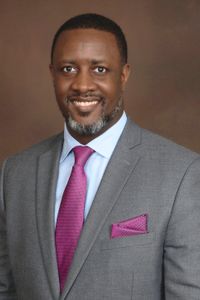
Background
James Macon III served in the U.S. Air National Guard in 2010. He earned a high school diploma from East St. Louis Sr. High School, a graduate degree from Northern Illinois University in 2002, and a graduate degree from the University of Tennessee in 2005. Macon's career experience includes working as an executive director.[1]
- Graduate:
- University of Tennessee, 2005
- High school:
- East St. Louis Sr. High School
In their own words
Who are you? Tell us about yourself.
I am first and foremost a husband, blessed to be married to my wife, Monica, for 16 years, and a proud father. My faith, family, and commitment to service shape everything I do. Professionally, I am a global business strategist with more than 25 years of Fortune 500 leadership experience spanning Operations, Procurement, Engineering, Human Resources, Benefits, Sales, Professional Services, Medical Consulting, Energy, Sustainability, Travel, Fleet, Real Estate, Facilities, Security, Logistics, Warehousing, Project Management, Sterilization, and Information Technology. I currently serve as a Senior Director at Stryker and have held executive leadership roles with Medtronic, Wright Medical, and other global organizations.
My journey also includes five years as a journalist with major media organizations, including CNN, and a decade of church leadership as a Pastor, Administrative Pastor, and educator. I hold an MBA from the University of Tennessee and an MA from Northern Illinois University, and I am driven by a passion for learning, independent thinking, and creating meaningful impact. My life’s work has been bringing people together, solving complex challenges, developing leaders, and leaving organizations, communities, and individuals better than I found them.
Please list below 3 key messages of your campaign. What are the main points you want voters to remember about your goals for your time in office?
I’m running for the United States Senate because I believe Tennesseans deserve a government that solves problems instead of arguing about them. My focus is simple: lower costs, better jobs, and stronger communities. I will fight to bring advanced manufacturing, infrastructure investment, and workforce training to every corner of our state so that young people can build a future here instead of feeling forced to leave. When families can afford housing, healthcare, groceries, and education, quality of life improves for everyone, and Tennessee becomes a place where opportunity is not determined by your ZIP code.I believe the best solutions are the ones that unite us. Whether you live in Memphis, Nashville, Knoxville, Chattanooga, or a small rural town, you want safe neighborhoods, good schools, reliable healthcare, and a fair shot at success. I will work to expand access to doctors, strengthen mental health services, support law enforcement while demanding accountability, and invest in education from early childhood through career training. We may not agree on every issue, but we can agree that every Tennessean deserves dignity, security, and the chance to reach their full potential.I refuse to accept the idea that America’s best days are behind us. Tennessee can lead the nation in innovation, entrepreneurship, energy, agriculture, and technology if we have leaders willing to think beyond the next election. I will fight for transparent government, responsible spending, modern infrastructure, high-speed internet access, and policies that reward work, innovation, and personal responsibility. My campaign is about bringing people together around practical solutions, restoring confidence in our institutions, and building a future that gives our children more opportunities than we had ourselves.
What areas of public policy are you personally passionate about?
The issues I’m most passionate about are creating opportunity, strengthening families, and restoring trust in our institutions. I care deeply about improving education, expanding access to affordable healthcare, supporting good-paying jobs, modernizing infrastructure, and ensuring every community has a fair chance to succeed. I’m also passionate about government accountability because people deserve to know their tax dollars are being spent wisely and transparently. My goal isn’t to divide people into political camps—it’s to solve problems. I want to leave Tennessee stronger, safer, healthier, and more prosperous for our children and grandchildren than it is today.
Who do you look up to? Whose example would you like to follow, and why?
I look up to Yeshua, my parents, grandparents, and ancestors, Harriet Tubman, Martin Luther King Jr., Norman Borlaug, Nelson Mandela, and Henry Dunant because each, in their own way, devoted their lives to serving others, overcoming adversity, and improving the human condition. Their legacies are built on faith, courage, sacrifice, compassion, perseverance, and a commitment to justice and human dignity. They changed the world by freeing the oppressed, feeding the hungry, healing division, caring for the wounded, and inspiring hope. From their example, I have learned that leadership is service, that principle matters more than popularity, and that lasting change comes from courage, humility, and a willingness to put others before yourself. Those lessons will guide every decision I make in the U.S. Senate.
What characteristics or principles are most important for an elected official?
I believe the most important qualities in an elected official are integrity, humility, courage, wisdom, competence, and accountability. If I am entrusted with public office, I must always remember that it is a position of service, not status. I believe leaders should tell the truth, keep their word, listen to people with different viewpoints, and be willing to admit mistakes. I want to be judged by whether I put the public good ahead of personal gain, political ambition, party loyalty, or special interests. In the end, character matters because policies affect people's lives, and character determines how power is used.
What do you believe are the core responsibilities for someone elected to this office?
If I am elected to the United States Senate, my responsibility is to represent the people of Tennessee while upholding and defending the Constitution of the United States. I would vote on laws, budgets, treaties, and nominations to federal courts and executive offices, always considering how those decisions affect Tennesseans and the nation. I would provide oversight of the federal government, work to solve problems facing our communities, and ensure taxpayer dollars are used responsibly. Above all, I would listen to the people I serve, protect their rights and freedoms, and strive to leave Tennessee and America stronger, safer, and more prosperous for future generations.
What legacy would you like to leave?
The most important legacy I can leave is not a title, a law, or a political victory, but a life of service that made other people's lives better. I want to be remembered as someone who acted with integrity, treated every person with dignity, stood for what was right when it was difficult, and used every opportunity I was given to create hope, opportunity, and justice for others. If future generations can say that I helped strengthen families, improve communities, protect liberty, and inspire people to serve something greater than themselves, then I will have left a legacy that truly matters and endures beyond my time in office.
What was your very first job? How long did you have it?
I learned the value of hard work early. As a kid, I earned money cutting grass, shining shoes, restoring leather furniture, washing cars, painting, and taking on whatever honest work I could find. At 16, I left for college and quickly secured my first W-2 jobs as a dishwasher in the dormitory cafeteria and a life-gesture model for the Northern Illinois University Art Department. Later, I became a short-order cook and worked in the university bookstores while also building experience at Dakotah Direct (telemarketing). There, I sold credit cards, provided customer service for Ameritech (telecommunications), and became a licensed insurance agent in seven states. Every job taught me responsibility, resilience, and the dignity of earning success through hard work.
What is something that has been a struggle in your life?
Like everyone, I have faced struggles, but I do not believe any single hardship defines me. Nearly everything worthwhile I have pursued has come with challenges, setbacks, and sacrifices. I have seen suffering in my own life and in the lives of many others, and those experiences have taught me the importance of listening, empathizing, and meeting people where they are. I do not dwell on the negative, nor can I afford to ignore it. There is always work to be done and opportunities to help. The good times and the difficult times have both shaped me, teaching resilience, gratitude, perspective, and compassion. Together, they have made me who I am and strengthened my commitment to serving others.
What do you perceive to be the United States' greatest challenges as a nation over the next decade?
I believe the greatest challenge facing the United States over the next decade is whether we can solve our problems without losing our unity. We must restore trust in our institutions, address our growing national debt, strengthen education and economic opportunity, remain competitive in technology and manufacturing, and ensure that hard work still leads to a better life. But none of that will matter if we allow division to overwhelm our sense of shared purpose. I believe America’s future depends on our ability to come together, tackle difficult challenges with honesty and courage, and leave our children a nation that is stronger, more prosperous, and more united than the one we inherited.
What qualities does the U.S. Senate possess that makes it unique as an institution?
The United States Senate is unique because it was designed to balance the passions of the moment with long-term deliberation. Every state, regardless of population, has equal representation, giving both large and small states an equal voice in shaping national policy. Senators serve six-year terms, which allows them to focus on long-range challenges rather than constant election cycles. The Senate also possesses special constitutional powers that no other legislative body has, including confirming federal judges and senior executive officials, ratifying treaties, conducting impeachment trials, and providing a critical check on the executive and judicial branches.
What has always impressed me most is that the Senate was intended to be a place of thoughtful debate, institutional stability, and independent judgment. Its traditions encourage deliberation, compromise, and careful consideration of issues that can affect the nation for generations. In many ways, the Senate's unique role is to look beyond the urgency of today and help safeguard the long-term interests of both the states and the American people.
Do you believe that compromise is necessary or desirable for policymaking?
I believe compromise is often necessary in policymaking, but it is not an end in itself. In a diverse nation of more than 300 million people, reasonable people will disagree, and lasting solutions often require finding common ground. At its best, compromise allows progress, respects differing viewpoints, and helps build broad support for policy. However, I do not believe every principle should be negotiable. I am willing to compromise on methods, timelines, and details when it leads to better outcomes, but I would not compromise on core values such as integrity, equal justice, constitutional rights, human dignity, or the public trust. To me, effective leadership means knowing the difference between being flexible on policy and being firm on principle. Compromise is desirable when it produces a better solution, but not when it requires abandoning what is right.
What organizations or individuals have endorsed your campaign?
When people ask me who has endorsed my campaign, I understand the question, but I hope voters will judge me by my character, principles, and ideas rather than by a list of names or organizations. I respect anyone who chooses to support me, but endorsements should never replace independent thinking. I’m not running to represent special interests, political machines, wealthy donors, or powerful institutions. I’m running to represent the people of Tennessee. My loyalty is to God, my conscience, the Constitution, and the citizens I seek to serve. In the end, I would rather earn a voter’s trust through integrity and solutions than borrow credibility from someone else’s endorsement.
What was the first historical event that happened in your lifetime that you remember?
My earliest memory is Christmas in a small house on 82nd Street in East St. Louis, Illinois. I was only two or three years old, the youngest of three children, and my parents were a young couple working hard to build a life for our family. I still remember the excitement when we got an Atari 2600, a simple gift that felt magical through a child’s eyes. I also remember another day when a bird somehow got into our house and flew wildly from room to room as my parents scrambled to get it out of the house. Those moments may seem small, but they remind me that joy, wonder, and family are often found not in what we have, but in the memories we create together.
On the 2026 ballot
Links
Compiled from the candidate’s published profile as of September 30, 2026.
Source(opens in new tab)