
Background
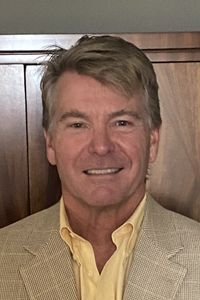
James Hemenway was born in Connecticut. Hemenway's professional experience includes working in financial services. He has also worked as an analytics manager and director at a bank. Hemenway earned a bachelor's degree from Colorado State University in 1985 and a graduate degree from the University of Rochester in 1990.[1]
- Graduate:
- University of Rochester, 1990
- Bachelor's:
- Colorado State University, 1985
In their own words
Who are you? Tell us about yourself.
My relationship with Colorado goes way back. My parents moved our family to Colorado in 1978. I graduated from Cherry Creek High School and then received a degree in Applied Math at CSU. I left Colorado for my first professional job, programming in the Aerospace industry. After an MBA from the University of Rochester, I spent the first part of my work life out of state. My wife Paula and I moved back to Colorado with our two sons in 2014. In May, I retired from Wells Fargo after 24 years in the analytics field.
I've been active in politics since I was in high school and have voted in every election and primary. I read around 25 politically oriented books per year and stay current on all major policy issues. I never had time to run for office while working full time, but since retiring I want to give it a go.
I think that polarization is a problem and am committed to taking steps to diminish it where possible. On both sides, a prerequisite to de-escalation is to acknowledge that the other side has some legitimate beefs.
I will be a provocative and unconventional candidate. Let me say it right up front – the Democrats aren’t wrong about everything. If we want to win in Colorado’s 7th district or nationwide, and govern with confidence, we need to appropriate some of their positions and take some of their voters. Bill Clinton called it “triangulation”, but it's just common sense.
Please list below 3 key messages of your campaign. What are the main points you want voters to remember about your goals for your time in office?
Our country has a lot of problems. Both immigration and our national debt/deficit are out of control and our foreign policy is irresponsible.Incumbents of both parties have failed, let issues fester and allowed polarization to go too far.I believe there are limits to things in all realms of life. I.e. limits on how big the deficit and debt can be, on how many immigrants we can absorb and how much CO2 we pump into the atmosphere.
What areas of public policy are you personally passionate about?
Immigration.
The numbers have been too high for too long and we've been too lax about it. Across the developed world there’s a growing backlash to high immigration levels. We need to get much more comfortable deporting people.
Rapid demographic change and reduced levels of social cohesion, stress on infrastructure and the environment, expensive housing, and high levels of income inequality are all well documented downsides to high immigration levels. The alleged economic benefits are so small as to be negligible and new empirical research confirms this.
We have to decide whether the U.S. is a nation or a business/sociology experiment.
Climate.
Global warming is real, it’s due to human emissions of CO2 and we need to begin attacking it.
Please read the Climate Leadership Council's proposal to see how Republicans should address global warming. George Schultz and James Baker founded the group to encourage a conservative response knowing that willful blindness is a bad strategy. Their "carbon tax and dividend" proposal in early 2019 started at $40/ton and generated roughly $2,000 dividend payments back to citizens. H.R. 763 was introduced in the House in 2019 but didn't pass. I support these efforts because they encourage innovation and conservation.
Increased use of nuclear energy is part of the solution too.
Foreign Policy
We seem to have a lot of enemies in the world. We need to be open to new approaches to cold conflicts.
What characteristics or principles are most important for an elected official?
Ability to listen and understand voters' concerns. Ability to recognize and convey limits on government action to audiences..
What qualities do you possess that you believe would make you a successful officeholder?
Strategic view. Historical and life knowledge to be able to foresee outcomes of potential actions.
What legacy would you like to leave?
He helped solve some problems.
What is the first historical event that happened in your lifetime that you remember? How old were you at the time?
Nixon's resignation in '74. I was 11.
What was your very first job? How long did you have it?
Cleaning offices.
What qualities does the U.S. House of Representatives possess that makes it unique as an institution?
Terms are short and turnover is higher than in Senate. It's the "people's house".
Do you believe that it's beneficial for representatives to have previous experience in government or politics?
Not necessarily.
What do you perceive to be the United States' greatest challenges as a nation over the next decade?
Fiscal reform
Immigration/Identity Politics
Climate action.
What are your thoughts on term limits?
I support term limits and pledge to serve no more than 3 terms.
Is there a particular representative, past or present, whom you want to model yourself after?
Paul Tsongas. He was a Democrat from Massachusetts in the 80s and was very candid with voters. He was jokingly described as an "eat your peas" politician.
Both sitting representatives and candidates for office hear many personal stories from the residents of their district. Is there a story that you’ve heard that you found particularly touching, memorable, or impactful?
Not yet.
Do you believe that compromise is necessary or desirable for policymaking?
Yes.
Moreover, I actually say that Democrats aren't wrong about everything. E.g. i agree with them on the need for action on climate, antitrust policy and certain aspects of health care.
On guns, I’m a gun owner and defender of the 2nd amendment, but I'm open to certain common-sense reforms like universal background checks and red flag laws. Some gun owners oppose all restrictions on a slippery slope basis, but I think our legal position is strong enough to take some actions with sunset provisions and fix any abuses that occur.
On the other hand, I can foresee real threats to gun ownership by repeatedly saying “nothing” when voters ask what we can do about mass shootings.
The Constitution says that all bills for raising revenue must originate in the House. What role would this power play in your priorities if elected?
We need a grand bipartisan bargain between Republicans and Democrats to solve our fiscal problems. The house needs to be the source of that.
What organizations or individuals have endorsed your campaign?
none
On the 2026 ballot
Links
Compiled from the candidate’s published profile as of September 30, 2026.
Source(opens in new tab)