
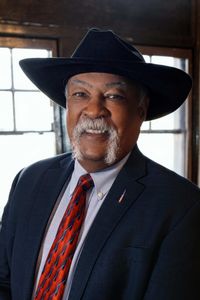
Background
James Byrd earned a high school diploma from Cheyenne Central High School and attended both Laramie County Community College and the University of Wyoming.
Byrd worked in the following positions: Security Consultant, Computer Network Design, Exploration Geophysicist for the Compagnie Générale de Géophysique and American Oil Company (British Petroleum/Amoco), Contract Computer Project Manager for Communication Systems Interactive, and Software for American Express, Cargill, and Network Assessment and Optimization Group.[1][2]
- High school:
- Cheyenne Central High School
Campaign money
- Raised
- $23K
- From individuals
- $16K
- From PACs & party
- $0
- Own money
- —
FEC filings through July 29, 2026.
View on FEC.gov(opens in new tab)In their own words
Who are you? Tell us about yourself.
I am a fifth-generation Wyomingite, a professional geophysicist, and a former State Representative with ten years of legislative experience in the Wyoming House (2009–2019). Raised by parents dedicated to public service—my mother, Liz Byrd, was Wyoming’s first Black state senator, and my father, Jim Byrd, was the state's first Black police chief—I grew up understanding the deep value of community and independent leadership. My background bridges the physical sciences, energy exploration, and technology management. I’m running for the U.S. Senate because Washington needs practical, unscripted leadership that puts working families ahead of partisan theater.
Please list below 3 key messages of your campaign. What are the main points you want voters to remember about your goals for your time in office?
Everybody counts. This is the core belief that drives my approach to leadership and community representation. In a state like ours, small communities cannot afford to be invisible to Washington. I answer to the people of Wyoming, not party bosses or special interests. I bring an independent, straight- talking approach to leadership—focused on results, not political theater. I’ve never been afraid to ruffle feathers or cross the aisle to get things done. I will always vote my conscience and stand up for everyday Wyomingites over corporate billionaire influence.Working families are getting hammered by the "Daily Squeeze." Let’s be honest: while corporate balance sheets look great, folks across our 23 counties are paying out the nose for groceries, gas, and basic housing costs. Washington's out-of-touch policies are directly driving this strain. I’m running to tackle these kitchen-table realities head-on. That means fighting for economic policies that let small towns thrive, keeping local families from being priced out, and aggressively protecting our rural healthcare clinics from corporate neglect.Keeping public lands in public hands while leading the energy future. As a professional geophysicist, I know Wyoming's terrain isn't just a balance sheet—it’s our heritage. I will fiercely protect public access to our lands for hunting, fishing, and outdoor recreation against any federal overreach or corporate sell-off schemes. Simultaneously, we must secure a future for our traditional energy workers while positioning Wyoming as the World’s Energy Lab. That means scaling up advanced, next-generation nuclear technology like the Kemmerer project and pioneering deep geologic carbon storage. We can innovate without abandoning the people who power America.
What areas of public policy are you personally passionate about?
I am deeply focused on rural healthcare infrastructure, energy innovation, and workforce education. Protecting critical access hospitals and community clinics is a matter of survival for our rural towns. My background as an exploration geophysicist fuels my focus on making Wyoming a pioneer in grid modernization, software project integration, and carbon capture. I also advocate for robust federal support for community colleges, like LCCC. They are uniquely nimble, providing rapid workforce training that keeps high-paying technology and energy jobs right here in Wyoming.
Who do you look up to? Whose example would you like to follow, and why?
I look up to my parents and grandparents, who showed me what quiet, dedicated community leadership looks like. On the world stage, I’ve always admired Egyptian President Anwar Sadat. In 1978, he had the sheer guts to buck intense political pressure, sit down with Jimmy Carter and Menachem Begin at Camp David, and essentially say, “Enough is enough.” He risked his political standing—and ultimately his life—because he cared more about stopping historic bloodshed than playing to the cameras or appeasing hardliners. That kind of independent, unscripted courage is exactly what is missing from leadership today.
What characteristics or principles are most important for an elected official?
Honesty and transparency are the absolute bedrock of public trust. Too many politicians read from pre-approved scripts and answer to party bosses instead of the people who elected them. True leadership means telling voters the plain, unvarnished truth, even when it’s uncomfortable or cuts against the party line. I believe an elected official should be completely transparent about their motivations and accessible to every constituent. If we don’t restore real accountability and honest dealing to our government, the entire system breaks down.
What do you believe are the core responsibilities for someone elected to this office?
The core responsibility of a U.S. Senator is representing the constituents, first and foremost. In Washington, it is incredibly easy for a sparsely populated state like Wyoming to get drowned out by big-city interests and corporate lobbying power. My job is to be an independent, unyielding voice for our people—not party bosses or special interests. That means protecting our communities from federal overreach, defending our public lands, and ensuring our energy workers aren't left behind. True representation means listening to every voice and delivering results back home.
What legacy would you like to leave?
I want my legacy to be measured by the tangible, everyday success of the people of Wyoming. I am not interested in a legacy of partisan bickering or climbing a political ladder. I want to look back at my time in the U.S. Senate and know that my independent, straight-talking leadership directly lowered the cost of living, saved our rural health clinics from closing, and kept our public lands open to the public. If Wyoming families have more real opportunities to thrive and build stable, prosperous lives right here at home, then that is the only legacy I need.
What was your very first job? How long did you have it?
My very first job was flipping burgers and serving customers at Scotty’s Hamburgers right here in Wyoming. I held that job for a summer during my youth. Working in a busy local drive-in at an early age teaches you the absolute value of a hard day's work, the importance of reliable teamwork, and how to properly show up for your community. It gave me a foundational respect for small business owners and the hardworking front-line employees who keep our local economy moving every single day.
What is something that has been a struggle in your life?
My greatest lifelong struggle has been balancing the heavy emotional burden of helping others while managing my own life. In my younger years, I earned my professional certification as a rescue diver. Through that rigorous training, you learn the cardinal rule of emergency response: know your limitations, and never become part of the rescue yourself. If you push past your safety margins, you just become another victim instead of a lifesaver. Learning to manage that pressure and protect my own boundaries has shaped exactly how I approach public service—ensuring I stay grounded, focused, and effective for the long haul.
What do you perceive to be the United States' greatest challenges as a nation over the next decade?
Our greatest national challenge is two-fold: repairing our fractured global relationships and rebuilding trust in our own government. On the world stage, we must lead with stability, honoring our alliances and restoring America’s reputation as a reliable partner. Locally, we face a deep crisis of confidence. People are tired of a gridlocked Washington that feels bought by special interests and detached from real life. To fix this, we need absolute transparency, honest budgeting, and leaders who do their job and focus on everyday kitchen-table realities instead of constant partisan theater.
What qualities does the U.S. Senate possess that makes it unique as an institution?
What qualities does the U.S. Senate possess that make it unique as an institution? The U.S. Senate's true institutional uniqueness lies in its constitutional design to serve as a stabilizing, deliberative force—but it only works if members actually do their jobs. The Senate was created to rise above short-term political theater and focus on long-term national stability. Today, that purpose has been broken by hyper-partisan gridlock. We must restore both chambers of Congress to their proper legislative functions. That means stepping up, debating in good faith, passing real budgets, and checking executive overreach rather than outsourcing our constitutional duties to unelected agency bureaucrats.
Do you believe that compromise is necessary or desirable for policymaking?
Do you believe that compromise is necessary or desirable for policymaking? Compromise is absolutely necessary if you actually want to pass laws that last. Real policymaking isn't about getting 100% of what you want while the other side gets nothing; that just leads to a broken system where laws get flipped every time power shifts. Bringing more perspectives and competing opinions into the same room always leads to a better end result. It forces you to stress-test ideas, filter out bad policy, and find common-ground solutions that actually work for regular people. True strength is sitting at the table and doing the hard work to find a path forward.
What was the first historical event that happened in your lifetime that you remember?
The earliest historical event I remember from my childhood is the assassination of President John F. Kennedy on November 22, 1963. I was just nine years old, but I will never forget the sudden, overwhelming sense of shock and profound sadness that gripped our entire community. Regular television programming completely stopped, and the nation gathered around its screens in a collective state of mourning. Experiencing that pivotal moment firsthand gave me an early, deeply felt awareness of public service, history, and how deeply our national leaders impact the everyday lives of regular citizens.
James Byrd did not complete [the profile publisher]'s 2022 Candidate Connection survey.
James Byrd did not complete [the profile publisher]'s 2020 Candidate Connection survey.
.survey-result {padding:10px;}
p.survey-question {font-weight:bold;}
p.survey-response {margin-left:10px;}
p.survey-response {white-space: pre-line;}
div.survey-scrollbox { height:400px; overflow:scroll; margin:20px; padding:10px; border:1px solid gray; }
What would be your top three priorities, if elected?
1. New voting machines and upgrade existing statewide system
2. Move WY away from burning fossil fuels to a synthetic carbon manufacturing business model using coal, oil, and natural gas as the source materials.
3. Streamline the on-line access of the business entities divisions. Remove unnecessary rules & regs.
4. Keeping public lands in public hands.
What areas of public policy are you personally passionate about?
Revamping the budget and budgeting process to follow GAP models.
Getting WY out of the energy fuels market
Developing high-tech industries (block-chain), data centers, and manufacturing.
Who do you look up to? Whose example would you like to follow, and why?
Nixon, Kennedy (president), Saddat, MLK, Mohammed Ali. Most of all my parents and grandparents who taught me how to respect every individual along with strong morals and ethics.
Is there a book, essay, film, or something else you would recommend to someone who wants to understand your political philosophy?
Pale Blue Dot and Varieties of Scientific Experience by Carl Sagan.
What characteristics or principles are most important for an elected official?
Compassion, morals and ethics. An understanding of the "cause/effect" relationship of government policy.
What qualities do you possess that you believe would make you a successful officeholder?
Percipience, tenacity, a very thick "skin", and a view that the "glass is half full".
What do you believe are the core responsibilities for someone elected to this office?
To provide for the welfare of the general public while creating a platform for new business and intellectual advancement without damage to the historical past.
What legacy would you like to leave?
Wyoming get back to leading by example of how to make the energy development co-exist beneficially with environmental requirements. Fix the state budget process nightmare.
What is the first historical event that happened in your lifetime that you remember? How old were you at the time?
Sputnik. In elementary school.
What was your very first job? How long did you have it?
Paper route. then fast food cook, a local hamburger place. Lasted two weeks (age 14) at fast food.
What happened on your most awkward date?
All of them were/are awkward.
What is your favorite holiday? Why?
Holloween. Reminds me of happy times as a kid.
What is your favorite book? Why?
Pale Blue Dot. Because of Sagan's understanding of humanity, the planet, and the cosmos.
If you could be any fictional character, who would you want to be?
Ben Rumson, from Paint Your Wagon
What is your favorite thing in your home or apartment? Why?
My toaster oven. I can cook anything in it.
What was the last song that got stuck in your head?
This little light of mine.
What is something that has been a struggle in your life?
Maintaining the balance between work and personal lives.
What qualities does this office possess that makes it a unique and important part of the state government?
Ten years of legislative experiance and direct working with the SOS/county clerks. Geophysics/science and computer science (security & networking) for twenty years. Most important I am an independent business owner with employees so I get it, when talking about the problems between business and the government.
What responsibilities of this office do you personally consider the most important?
Elections, business entities and the SLIB (State Lands & Investment)
What kind of skills or expertise do you believe would be the most helpful for the holders of this office to possess?
Communication at all levels.
On the 2026 ballot
Links
Compiled from the candidate’s published profile as of September 30, 2026 and FEC filings.
Source(opens in new tab)