
Background
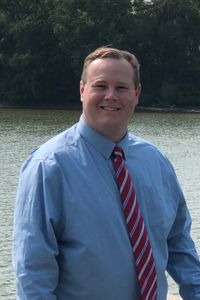
JD Leathers was born in Kansas City, Missouri. He earned a bachelor's degree from Southern Illinois University, Edwardsville in 2015. He earned a graduate degree from Webster University in 2017. Leathers' career experience includes working as a subsistence farmer, a management consultant, and as a public policy professional. He has been affiliated with Pi Sigma Alpha, the Truman Institute, and the Democratic National Committee.[1]
- Graduate:
- Webster University, 2017
- Bachelor's:
- Southern Illinois University, Edwardsville, 2015
In their own words
Who are you? Tell us about yourself.
JD Leathers is a polymath, consultant and subsistence farmer who served as a Traffic Commissioner for the City of Webster Groves, MO and a Public Policy Advisor for the City of Brentwood, MO.
Leathers graduated from Archie High School in 2006. Initially, he attended Missouri State University for Public Administration where he worked for the university, was President of the Missouri State College Democrats, and interned for Sen. McCaskill.
Leathers then studied Public Policy as a part-time student at the University of Missouri - Saint Louis and Managed the transportation department for The Muny.
Leathers graduated from Southern Illinois University Edwardsville with a BS in Political Science and Geography.
In 2017, he earned his Master of Management and Leadership from Webster University. Soon after, Leathers partnered to open a management consultancy firm that served clients in Missouri, Kansas, Colorado, and Illinois. With the Covid-19 Pandemic, Leathers closed his firm and returned to farming and volunteering in the nonprofit sector.
Please list below 3 key messages of your campaign. What are the main points you want voters to remember about your goals for your time in office?
A fresh voice of principled integrity and ethical standardsA Midwestern advocate that is on the side of the peopleA servant of the people
What areas of public policy are you personally passionate about?
Promoting truth in reporting and ethical journalism. Repairing, replacing and modernizing physical infrastructure. Bringing medical services back to rural America. Expanding public water and wastewater networks into rural America. Broadband and telecommunication modernization and expansion to provide real access to telephone and internet services. Reform on ammunition and after-market accessory regulations. Modernization and reform of law enforcement agencies and practices. Protecting women's rights and their choice in contraception and the legality of abortions. Supports freethought and the freedom to practice or not practice a religion or faith. Supports protecting the secular nature of the American government.
Who do you look up to? Whose example would you like to follow, and why?
I admire Jason Kander and would like to follow the example of Mel Carnahan. Secretary Kander exhibits strong moral fortitude. Governor Carnahan nearly always made decisions based on their efficacy and effectiveness for all his constituents.
What qualities do you possess that you believe would make you a successful officeholder?
JD is an academic person that puts what he learns to real-world tests. He has the integrity to follow through with issues that he speaks too. JD has a moral code based on the ideas of a more perfect union.
What do you believe are the core responsibilities for someone elected to this office?
1) Uphold your oath of office. 2) Listen to you constituents and advocate for them. 3) Make decisions based on what is the best option for the entire constituency.
What is the first historical event that happened in your lifetime that you remember? How old were you at the time?
Persian Gulf War/Desert Storm, aged 3.
What is your favorite book? Why?
Toksvig's Almanac: An Eclectic Meander Through the Historical Year by Sandi Toksvig. This almanac tell factual stories and folk stories about women throughout history that are largely left out of traditional history education. It also chronicles historical events and holidays that have deeper meanings than you would expect.
What do you perceive to be the United States' greatest challenges as a nation over the next decade?
I believe that as a country, we all need to relearn how to work towards a common, greater good and avoid our tribalism. This means we all need to understand the same reality and facts. The global climate crisis will have a major negative affect on the United States. It is all of our responsibility to find ways to make the damage that we will incur, less.
If you are not a current representative, are there certain committees that you would want to be a part of?
The Energy and Commerce, Armed Services, Natural Resources, Veterans’ Affairs, Ethics, Oversight and Reform, Foreign Affairs, Agriculture, Education and Labor Committees.
The Joint Committee on Taxation, and the Joint Committee on the Library.
The Select Committee on Economic Disparity and Fairness in Growth, and the Select Committee on the Modernization of Congress.
Do you believe that compromise is necessary or desirable for policymaking?
I believe compromise is a desirable method of policymaking. However, it is not necessary, and should not be attempted by one group only. If there is to be a compromise, all parties must share in the compromise.
googletag.cmd.push(function() { googletag.display("div-gpt-ad-1548351761485-0"); });
On the 2026 ballot
Links
Compiled from the candidate’s published profile as of September 30, 2026.
Source(opens in new tab)