
Background
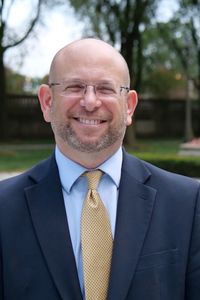
Howard Rosenblum was born in Chicago, Illinois. He earned a high school diploma from Evanston Township High School. He earned a bachelor's degree from the University of Arizona in 1988. He earned a law degree from the Chicago-Kent College of Law in 1992. His career experience includes working as a lawyer.[1]
- Law:
- Chicago-Kent College of Law, 1992
- Bachelor's:
- University of Arizona, 1988
- High school:
- Evanston Township High School
Campaign money
- Raised
- $141K
- From individuals
- $112K
- From PACs & party
- $0
- Own money
- —
FEC filings through March 31, 2026.
View on FEC.gov(opens in new tab)In their own words
Who are you? Tell us about yourself.
I am a Deaf civil rights lawyer with over 30 years of experience advocating for equal access. My career has combined 20 years of litigation in Illinois and 13 years of national leadership in disability rights, focusing on systemic change through law, policy, and public advocacy. My work has included landmark cases, such as requiring Netflix to provide captions on streaming content, holding Harvard and MIT accountable for website accessibility, reversing harmful USDA accommodation policies, and ensuring President Trump provided sign language interpreters at public briefings. I am running for Congress to continue this fight for civil rights and equal access for all Americans, and to make history as the first Deaf member of the U.S. House of Representative.
Please list below 3 key messages of your campaign. What are the main points you want voters to remember about your goals for your time in office?
Restore the rule of law and the Constitution to prevent further abuses of powerRewrite stronger civil rights protection and enforcement for all Americans, particularly those who have been marginalizedReconstruct federal agencies and critically needed programs and services
What areas of public policy are you personally passionate about?
I am most passionate about policies that promote equal access for all people, including civil rights protections on all bases including but not limited to: disability, race, color, gender, orientation, religion, national origin, and age. Every American deserves access to: quality education; full health care coverage; equitable wages; affordable housing; voting access; and safety from guns, crime, and federal overreach.
Who do you look up to? Whose example would you like to follow, and why?
There are many people I look up to as role models. My parents are my very first role models, and I would not be where I am now if not for their perseverance in ensuring that I, as a Deaf child growing up, had every opportunity to receive a full education and well rounded development. Senator Tom Harkin is another role model, as someone who led the right for the civil rights of people with disabilities, and that made it possible for my career as a civil rights lawyer. The determination, contributions, and leadership of Justices Thurgood Marshall, Ruth Bader Ginsburg, and Ketanji Brown Jackson inspire me to persist in advocating for everyone’s civil rights. I also look to the strength and conviction of disability rights leaders that paved the way for me including but not limited to Ed Roberts, Marca Bristo, and Judy Heumann.
What characteristics or principles are most important for an elected official?
Elected officials should uphold the Constitution and laws of the country and prioritize the best interests of Americans over any party or individual. This includes advocating for optimal economic and social developments that enable all Americans to have their best lives.
What do you believe are the core responsibilities for someone elected to this office?
The core responsibilities of a Congressional Representative for the 9th District of Illinois is to advocate for the needs and interests of all residents in this district as well as for all Americans. This includes doing everything possible to ensure that all residents have good wages, affordable housing, quality education, accessible health care, and safety from hate and federal overreach.
What legacy would you like to leave?
A safer and more equitable country for all residents without hate, with an optimal society that offers everyone good wages, affordable housing, quality education, and accessible health care. Moreover, through my candidacy, I would like to assist in creating more representation by people with disabilities within Congress.
What is the first historical event that happened in your lifetime that you remember? How old were you at the time?
When I was seven years old, Congress passed the Rehabilitation Act of 1973, which is the first disability rights law in this country and possibly the world. I did not know until much later how much of an impact this law had on my civil rights.
What was your very first job? How long did you have it?
My first job as a young person was as a camp counselor for children with developmental disabilities, and this was a job that I had for two summers. My first job as a professional was as an attorney with a private law firm for ten years.
What is your favorite book? Why?
To Kill A Mockingbird, by Harper Lee. This book was instrumental in shaping my view of how the legal system can achieve or corrupt justice based on the prejudices of people, and how we must work to always ensure justice prevails for all of us.
If you could be any fictional character, who would you want to be?
Atticus Finch
What is something that has been a struggle in your life?
Equal access to all parts of society, which is what most people with disabilities experience. It is my hope and goal to be a Representative that can help eradicate such barriers and discrimination for all people, especially those who are marginalized.
What qualities does the U.S. House of Representatives possess that makes it unique as an institution?
Each member of the U.S. House of Representatives represents their district and brings the views and experiences of their residents to this legislative chamber. Such direct representation for each district makes the House unique.
Do you believe that it's beneficial for representatives to have previous experience in government or politics?
There are many ways for representatives to gain the skills necessary to perform their duties in Congress, and previous experience in government and politics can be beneficial. However, such experience need not be as elected officials. My experience working within the federal government through service on the United States Access Board and within state government via the Illinois Human Rights Commission has given me the unique experience in governmental operations particularly with respect to civil rights. Moreover, I have worked closely with Senators, Representatives, Senate and House committees, and various government agencies such as the Federal Communications Commission, Department of Transportation, Department of Labor, Department of Education, Housing and Urban Development, and Health and Human Services. Such experience qualifies me as someone who fully understands the work of federal Representatives.
What do you perceive to be the United States' greatest challenges as a nation over the next decade?
Over the next decade, the greatest challenges for our country is how we will overcome polarizing differences and unite to ensure that we promote evidence based best practices for all aspects of federal governance.
Do you believe that two years is the right term length for representatives?
Two years is enough time for representatives to make their impact, and re-election allows representatives to continue to expand on their impact.
What are your thoughts on term limits?
Constituents have the right to elect the representatives they want, and term limits would deprive them of such choices.
Is there a particular representative, past or present, whom you want to model yourself after?
Senator Tom Harkin, who was a Representative before he became a Senator, has been a steadfast and dedicated champion of democracy who advocated for and ensured the passage of the Americans with Disabilities Act. This law made it possible for millions of Americans with disabilities to lead a life of equality, including myself. Senator Tom Harkin was also the first legislator to use sign language on the floor of Congress, and I seek to become the second.
Both sitting representatives and candidates for office hear many personal stories from the residents of their district. Is there a story that you’ve heard that you found particularly touching, memorable, or impactful?
Many individuals in the district have shared their worries and concerns that the United States is losing its Democratic nature and is becoming or has become a fascist police state. It is important that we restore this country to its ideal of a Constitutional Democracy that has three equally separate branches of government.
Do you believe that compromise is necessary or desirable for policymaking?
Compromise is the best option for policymaking given the nature of our legislative system. At the same time, there are ways to pursue legislative progress where compromise is not possible.
The Constitution says that all bills for raising revenue must originate in the House. What role would this power play in your priorities if elected?
If I am elected, I would take every action possible to ensure that Congress reclaims its powers over raising revenue and appropriations from the President.
How should the U.S. House use its investigative powers?
Given how the current President is abusing the power of his office and repeatedly violating the separation of powers, giving rise to hundreds of lawsuits filed against the White House, it is imperative that the U.S. House use its investigative powers to bring attention to such abuses and use whatever options are available to reclaim how government agencies are funded.
What organizations or individuals have endorsed your campaign?
Marlee Matlin
Senator Tom Harkin
What is an accomplishment that you are proud of?
Over my 33 years as a civil rights attorney and disability rights leader, I am most proud of having strategized significant systemic change including but not limited to: requiring Netflix and other streaming video service providers to fully caption their entire video content; mandating Harvard and MIT to ensure their websites are accessible; persuading the Department of Transportation to grant Commercial Drivers Licenses to over 2000 deaf and hard of hearing drivers; and compelling President Trump in the first ever civil rights lawsuit against the White House to provide sign language interpreters during COVID press briefings.
What role should the United States government have in the development or use of artificial intelligence?
The United States government should have all of its science divisions involved in overseeing and monitoring all development and use of artificial intelligence, including but not limited to: the White House’s Office of Science and Technology Policy (OSTP); the National Science Foundation (NSF). Moreover, we should create a new agency that has centralized responsibility to ensure that AI research is done reasonably, safely, and conforms to privacy safeguards.
What legislation would you enact related to election administration in the United States?
Legislation is needed to ensure safe and equal access for every citizen to have equal access to voting anywhere in the country including through absentee ballots and voting by mail, and do so without oppression, discrimination, or barriers. We need such legislation to restore and strengthen the requirements of the Voting Rights Act. Further, it is necessary to eradicate the Electoral College so that each person’s vote counts equally.
On the 2026 ballot
Links
Compiled from the candidate’s published profile as of September 30, 2026 and FEC filings.
Source(opens in new tab)