
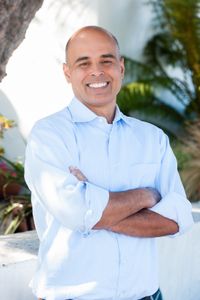
Background
Gus Mattammal was born in St. Louis, Missouri. Mattammal earned a bachelor's degree from Pomona College in 1994 and a graduate degree from Yale University School of Management in 2000. His career experience includes working as an educator, as the director of a national private tutoring group, and in TV advertising sales, consulting, and operational finance.[1][2]
Mattammal has been affiliated with the following organizations:[2]
Midcoast Community Council
San Mateo County Transportation Authority Citizens Advisory Committee
San Mateo County Measure W Citizens Oversight Committee
SHIFT-Bay Area
- Graduate:
- Yale School of Management, 2000
- Bachelor's:
- Pomona College, 1994
- High school:
- St. Louis University High
In their own words
Who are you? Tell us about yourself.
I grew up in inner-city St. Louis and was the only kid on my block to graduate high school at all, let alone go to college. My neighborhood public high school had a 25% graduation rate for 25 years in a row, with a student population that was about 70% Black and 10% Latino. An entire generation of low-income, mostly Black and Brown kids was fed into a school that functioned as a pit stop on a school-to-prison pipeline.
The only reason I didn’t follow the same path as the other kids was that I won the parent lottery. My parents were great long-range planners: they rented half our house to another family and squirreled away the rent for years. So, after I graduated from my public middle school, they used what they’d scrimped and saved to send me to the Jesuit high school. I got a great education there, and it allowed me to come to California for college. I attended Pomona College, majoring in physics and math.
I began my career in TV ad sales, got my MBA from Yale, worked in consulting and in corporate finance, and then joined Advantage Testing, the nation’s premier tutoring firm. I came back to California in 2007 to found Advantage Testing Silicon Valley, and have since built a multimillion dollar operation across ten states.
I have had a great life—a life made possible by education. It was my hand up, and it could be a hand up for so many more kids. But here in California our kids aren’t getting a hand up, and as your Superintendent, I will work tirelessly to change that.
Please list below 3 key messages of your campaign. What are the main points you want voters to remember about your goals for your time in office?
Demand excellence:
It is unacceptable that $130 billion is spent on our public school system despite students being unable to read a book, do math, or get a job; enough is enough. Districts must be committed to evidence-based pedagogy, including the science of reading and balanced mathematics frameworks. The California Department of Education also must take a proactive role in providing training and model curricula to districts, which no previous Superintendent has done. Last, we must reprioritize civic and home skills education to equip students to be highly capable adult citizens. Excellence in California schools is possible, but only with the leadership to expect it.Get back to basics:
Strong basic skills are more important now than ever. As Artificial Intelligence grows in its capabilities, students need to be able to critically think, reason, and articulate ideas to keep up. The best way we can achieve that is with a genuine emphasis on reading and math education, which our kids are not currently receiving. As Superintendent, I will be a force for the universal adoption of the science of reading. Under my leadership, the California Department of Education will also publish evidence-based model science of reading and mathematics curricula, all made available to districts at low or no cost at all. Every child deserves to learn from what we know works, regardless of their zip code.Let kids be kids:
Schools should be a place where kids can grow and thrive. That’s why I am a proud advocate for bell-to-bell cell phone bans in schools and a vocal supporter of the recently-introduced AB 2071, supporting digital wellness and mental health education for students. I am also an advocate for quality, nutritious school lunches, extended break and recess time, increased school safety measures, and age-appropriate sex education aligned with the California Healthy Youth Act. The role of the Superintendent, first and foremost, is to advocate for what is best for kids in the public school system, and that is exactly what I intend to do.
What areas of public policy are you personally passionate about?
Education is a hand up – not a hand out, but a hand up. Education is a path to a middle class life and achieving the American Dream. It has downstream effects on virtually every other domain of public policy. A quality education leads to increased innovation, lifetime earnings, and family stability, not to mention lower levels of virtually everything we would like to eliminate, like violence, poverty, and substance abuse.
Every dollar spent wisely on education translates to multiple dollars saved in combating downstream public problems. Unfortunately, in California, we often do not spend those dollars wisely. As your Superintendent, I will harness the energy of every parent, student, teacher, and voter who wants to see that reality change.
What qualities does this office possess that makes it a unique and important part of the state government and legal system?
The most important aspect of the Superintendent’s office is its political independence. The Superintendent’s office is a constitutional office: it was created as an independent political office in the original 1849 California constitution. Four times in the past, California governors have tried to remove that independence by putting a constitutional amendment before the voters, and each time the voters have decisively defeated the proposed amendment. The people of California greatly value the Superintendent’s independence.
As an independent political actor, the Superintendent is free to influence education policy in whatever way they think is best. Where possible, the Superintendent should work collaboratively with the legislature, the State Board, and district-level leadership. However, if any of these actors refuse to do what is in the best interests of the students, then the Superintendent can and should pursue the best interests of the students independently, including through creating and amplifying grassroots political pressure. The Superintendent should not be afraid to work directly with parents and civic groups to create the political pressure necessary to drive change at the district or the state level. It has been a long time since we had a Superintendent who utilized the full independence of the office, but if elected, I will make full use of that independence.
A second key element of the Superintendent role is that it is arguably the second-loudest megaphone for education in the country after the Secretary of Education in Washington DC. The Superintendent will have the opportunity to learn from peers in other states, identifying best practices and potentially implementing them in California. There will also likely be opportunities to partner with large foundations to help fund pilot projects to test new ideas. Again, the Superintendent can pursue this kind of work independently, without requiring permission from the legislature or the State Board.
What characteristics or principles are most important for an elected official?
Integrity is a non-negotiable characteristic for an elected official, because the higher up in politics someone goes, the more often people will attempt to get them to do things that are not in the best interest of those they were elected to serve, typically by offering either access to power or access to money. A high level of integrity, which comes from having strong values and a strong sense of self, is necessary to resist these attempts and remain focused on serving the people you were elected to serve.
A willingness to listen is also critical, because great leadership isn’t about telling people what the answer is or giving them orders. Great leaders bring out the best in the people they lead, and they work hard to help those people be successful. That only happens when a leader spends more time listening than talking.
Willingness to listen is rooted in humility: you have to acknowledge to yourself that other people will often have better ideas and insights than you will. Humility allows you to step back and let others be center stage when that’s what’s best.
Finally, a sense of humor is critical to surviving life as an elected official. We live in an incredibly divisive time politically, and being a public official necessarily means upsetting or disappointing people sometimes. When that happens, they’re likely to let you know it, and only a good sense of humor and a willingness to not take oneself too seriously will allow you to withstand that and keep focused on doing the work you were elected to do.
What do you believe are the core responsibilities for someone elected to this office?
The role of State Superintendent is both important and multifaceted. The guiding principle of the office should be to always focus on what’s best for the kids. If we get that right, then the other groups in the system: teachers, administrators, and staff, will all benefit. Unfortunately, today the system is run by adults for adults, and that’s part of why our school system performs so poorly relative to other states.
With regard to students, the Superintendent should focus on ensuring a safe environment, improving the quality of their curricula, and setting a culture of high expectations. With regard to parents, the Superintendent should set a culture of being far more responsive to parental concerns. With over 900 districts in CA, no one person can watch what’s happening everywhere, so parents can provide critical insight into where the Superintendent ought to be looking for either excellent performance or terrible performance. Where performance is either excellent or terrible, the Superintendent should call that out, so that people in the surrounding community are aware.
With regards to teachers, the Superintendent should work to ensure that teachers have a safe environment, are well-paid, and are well-respected. The Superintendent should also be an aggressive promoter of teaching as a profession; it is fundamentally joyful, offers the opportunity to change lives, and allows you to see the impact of your work on a daily basis. Few other professions can offer this.
With regard to administrators and staff, the Superintendent should set the expectation that the Dept of Education serves not merely as a conduit for compliance processes mandated by the legislature and State Board, but rather as a supportive force that is always asking the question, “What else can we be doing to help you be more successful in your work?”
If we do all these things, our school system can begin the long journey back to being the envy of the rest of the country, as it was 50 years ago.
What legacy would you like to leave?
California’s public school system was once the envy of the nation. Now, we’re near the bottom on everything that is measured except per-student spending. Upon leaving office, I hope to see that California’s schools are on a clear and steady path toward once again being a model for other states. I want to see reading and math scores that are clearly rising, both when you look at aggregate numbers and when you break them down by race. Currently, California has a two-tiered system: upper-income, mostly White/Asian students have one kind of outcome, and lower-income, mostly Black/Latino students have another kind of outcome. This gap is one of the most difficult, intractable social problems, but we can make real progress closing the gap, and I hope to see that progress happening when I leave office.
I’d also like to see that people’s attitudes toward teaching as a profession are improving, and I’d like to see that we made some progress helping teachers earn more money. I’d like to see that we overcame the political barriers that prevent good ideas like merit pay from being implemented, and I’d like to see that we made progress toward a retirement system that is financially sustainable.
I’d like to see that we made more progress building a robust career technical education pathway in the public school system, one equally well developed and held in equal esteem with the college pathway. We should not view one path as intrinsically better than the other. And I’d like to see California make use of the incredible business community that exists in this state. The opportunities for students to gain valuable entrepreneurship experience, especially in underserved areas, are there if we have leadership that makes them a priority.
Because of the education I received, I got a hand up and made a better life for myself. I’d like to leave office knowing that every student in California was getting a real hand up, regardless of background or which school district they lived in.
What is your favorite book? Why?
My favorite book is “The Alligator and His Uncle Tooth,” by Geoffrey Hayes. It’s a story about a young alligator named Corduroy, who doesn’t fit neatly into the life and the labels of his community. One day he discovers his Uncle Tooth, who lives alone by the sea. Tooth was once an optimistic adventurer, but after some bad experiences, lost his faith in other alligators and in the world as a positive place to be. As a result of telling his stories to Corduroy, he rediscovers his sense of adventure and his desire to explore the world, and at the end of the book the two of them repair Tooth’s boat and sail off to go find the place where the sun meets the sea.
To me, America today is like Uncle Tooth: once a confident, optimistic adventurer, but now a country that has lost faith in itself, in people, and in the world as a positive place to be. I am like Corduroy: labels do not fit well on me (though politics always tries hard to pin labels on you). In politics, I have always striven to be a force that brings people together and helps them constructively tackle the challenges they face. I think our politics could use more of that.
California faces many big challenges, education among them. But we can meet those challenges, we can do the work to give our children a good education, and we can find our way back as a state to a place where we are a good role model for other states to follow. I look forward to working with the people of California to make that happen. Let’s go find the place where the sun meets the sea.
What kind of skills or expertise do you believe would be the most helpful for the holders of this office to possess?
First and foremost, the Superintendent should have experience as an educator. As a full-time educator for 23 years, and having worked with students of every race, socioeconomic background, and ability level, I have insight into how policy impacts the classroom. For example, my proposal for how to redesign the supplemental and concentration grant funding for our schools is informed by my many years of experience teaching large classes of low-income, mostly English language-learner students.
Second, the Superintendent role is an executive role, so a candidate for this position should have executive experience. Over the last 19 years, I’ve built a multimillion dollar education business that extends to ten states. I built and manage a team of 50 people, so I know how to recruit and develop talent. I’m particularly proud that three of my four leadership roles are held by women; I’ve worked hard to mentor and elevate women into leadership roles, and I think politics is another area where we could use more mentorship of women, so that they can step into leadership roles and be successful.
Third, the Superintendent should have public service experience. As an elected member of the Midcoast Community Council, I represent the 12,000 people who live between Half Moon Bay and Pacifica. In only my second year on the Council, I was elected Chair; the other members of the council, most of whom had significantly more experience, felt I was the best choice to lead. I also serve on a countywide board covering transportation issues and on one dealing with tax oversight. These experiences have helped me learn the rhythms, processes, and language of government, and that knowledge will be key to getting things done as Superintendent.
Finally, as I mentioned earlier, I grew up in an area with a failing public school, so I know the damage it does to a community when its public school isn’t getting the job done. That lived experience provides an important perspective.
What organizations or individuals have endorsed your campaign?
I’ve been endorsed by people across the political spectrum, and across many levels of government. Some examples:
Former State Senator Mark Wyland (Rep)
Former State Senator Quentin Kopp (Ind)
Former Mayor of Palo Alto Lydia Kou (Dem)
Former Mayor of Los Altos Lynette Lee Eng (Rep)
Former Superintendent of Templeton Unified Curt Dubost (Ind)
Former Paso Robles School Board member Chris Arend (Rep)
Saratoga City Mayor Chuck Page (Rep)
Former Chair, Midcoast Community Council Gregg Dieguez (Dem)
Current Chair, Midcoast Community Council Kimberly Williams (Dem)
Former Chair, Santa Clara GOP Shane Patrick Connolly (Rep)
Former Regional Vice Chair Jason Clark (Rep)
President, Contra Costa County Taxpayers Association Marc Joffe (Libertarian)
Candidates hear many personal stories from voters. Is there a story that you’ve heard that you found particularly touching or memorable?
Very early in my campaign, I met a woman named Stephisha. Stephisha had been working hard to get a business up and running, and she’d entrusted the public school system with the education of her son. Unfortunately, she’d found out that he could barely read, despite being in 3rd grade, and Stephisha and her wife were forced to divert serious time to fixing that problem themselves.
But Stephisha didn’t stop there. She also helped mobilize other parents to put pressure on the school district to refocus on teaching fundamental skills, and shift away from spending so much time and energy on peripheral political concerns. Stephisha is a wonderful example of the impact one person can make if they are willing to do the work to mobilize others. As Superintendent, I want to meet all the Stephishas across our state, and I want to help connect them with each other and amplify their work. Only through sustained political pressure can meaningful change be achieved.
On Day 1 as your Superintendent, I will announce that every school district in California that has not gone fully to using the Science of Reading has one year to commit fully to it, and after that, any district that does not do it, I will visit with my GusBus and some news cameras, and I will publicly shame whoever is standing in the way of teaching our kids to read properly.
I saw Stephisha and her family at an event recently, and her son was sitting by himself in a chair, reading a book. Stephisha did what she had to do for her son, but she shouldn’t have had to do all that work, and it’s up to us as voters to make sure parents don’t need to cover for a school system that isn’t teaching something as basic as reading.
Gus Mattammal did not complete [the profile publisher]'s 2024 Candidate Connection survey.
Video for [the profile publisher]
Video submitted to BallotpediaReleased March 8, 2022
Who are you? Tell us about yourself.
I’m an educator and a small businessman, and I’ve built a successful business throughout the Bay Area and around the country by working with individual families, listening to them to understand their goals and the obstacles they face, and helping them achieve those goals. I look forward to listening to you to understand your dreams and your challenges, and I want you to know: I am willing to work with anyone and everyone to help make our government work better for you, no matter who you are.
One strength I bring to the table is a diverse background, both racially and economically. My father was an immigrant to this country, and he and my mom started at the bottom of the ladder. Through education and hard work, they built a middle-class life for themselves and their children, and they instilled those same values of education and hard work in me and my siblings. Because of my parents’ sacrifices, my own efforts, and the opportunities this country offers, I’ve gone on to achieve the American dream. I’m excited to go to Congress to work hard to make it easier for others to do the same.
Please list below 3 key messages of your campaign. What are the main points you want voters to remember about your goals for your time in office?
Republicans and conservatives: I want to bring the focus of our party back to problem-solving. All too often, our energy as a party is directed at criticizing what the Democrats do rather than offering our own solutions. Conservative policies centered on personal choice, free markets, and careful scrutiny of spending will appeal to voters across the political spectrum and would be a clear path to electoral success in red, blue, and purple states. In addition, by emphasizing a more constructive vision, our party will lead the way in making politics less emotionally fraught and in reminding everyone that though we may be conservatives, or liberals, or independents, we are, above all, Americans.Democrats/liberals/independents: this election offers an opportunity to help me refocus my party on constructive problem-solving. A world in which the Republican party is focused on problem-solving is a world that’s better for all Americans, including you. If we come to the table with our own good-faith plans for healthcare, education, climate change, and economic opportunity, then we have a basis for negotiation and compromise. Policies developed through negotiation and compromise are more lasting and stable; policies developed and passed by one side alone (e.g., “Obamacare”), are far more likely to be torn down when the government changes hands. Winning this election will help me show my party the appeal of a constructive vision.I chose “Faith in People, Faith in America” as my campaign slogan because, over the last 25 years, I’ve watched people increasingly lose their faith in capitalism and markets, in democracy and elections, and, most tragically, in each other as Americans. I’m running for Congress because I want to restore people’s faith in each other and in this great country of ours. That won’t happen overnight—it will take a lot of hard work. But it can be done. Our district is perfect to lead this effort. We can show America what healthy politics look like, and, in doing so, restore people’s faith in this country and in each other. Vote Gus on June 7th and November 8th. Send me to Washington, and let me show you what we can accomplish— together.
What areas of public policy are you personally passionate about?
I’m a policy geek, so I’m excited about almost every area of policymaking.
Healthcare: I will develop a healthcare plan that achieves universal coverage through health savings accounts that follow you. You make the decisions, and you don’t have to worry about what happens if you lose your job.
Education: I will develop a comprehensive education reform proposal that creates education savings accounts that follow the student, so that students have greater freedom to choose their education and aren’t forced to stay in failing schools.
Entrepreneurship: My path from inner-city St. Louis to a middle-class life on the coast involved entrepreneurship, and I want to work with Republicans and Democrats, economic development organizations and business leaders, to identify ways to make it easier for people to start businesses, especially in immigrant and lower-income communities.
Climate change: I will design a plan that combines the power of the private sector with targeted federal investments to develop new technologies to address climate change. I’ll work with environmental groups, established industries, and local communities to ensure that we address the challenges of a changing climate in a way that strengthens our economy and our ability to lead on the world stage.
I’m also interested in getting everyday people more involved in generating policy. The ideas shouldn’t all be coming from corporations and think tanks financed by billionaire donors.
Who do you look up to? Whose example would you like to follow, and why?
I believe you can learn something from everyone. So rather than look up to or follow one person, I’ve found elements and traits to admire and emulate in many different people:
George Washington: I’m inspired by his ability to motivate people to follow him to a better future, his capacity to wield power for the good of all Americans, and the wisdom and strength he demonstrated in handing power over to someone else when the time came.
Abigail Adams: Abigail was the wife of our 2nd President, John Adams. She was an equal partner to her husband at a time when that was not the norm. Abigail was fiercely patriotic, extraordinarily eloquent, and very much the intellectual equal of her husband. The letters she and John wrote to each other show that he sought out and valued her advice and perspective.
I’m blessed to have married a similar woman; my wife Jill is also fiercely patriotic, extraordinarily eloquent, and very much the intellectual equal of her husband. Jill has spent most of her career working tirelessly in the Justice Department, the nonprofit sector, and the private sector on behalf of victims of domestic violence and human trafficking. Like John Adams, I value my wife’s insight and perspective.
Barack Obama: I’m inspired by his ability to break barriers and to speak to people’s desire to be one country, to be simply “Americans.”
Donald Trump: I’m inspired by his courage to be himself at all times and to advocate for what he believes, regardless of whether conventional politicians and pundits think it’s a good idea.
Christ: I’m inspired by his vision of leadership as being fundamentally about service and about what you as a leader are willing to sacrifice for those who follow you.
My mom: I’m inspired by her example of true commitment, something she demonstrated by taking care of my father full-time for 13 years after he had a crippling stroke. That was one-third of their marriage; it was very hard on her, but she did it without complaint.
What characteristics or principles are most important for an elected official?
A successful elected official must have a broad range of characteristics, but chief among them is the ability to actively listen to people, most especially people who disagree with you. It’s easy to listen to people who agree with you, but harder to listen to those who don’t. The job of an elected official is to represent everyone in their district. If I’m elected, I will work hard to reach out to and listen to everyone in the 15th district: Republicans, Democrats, and Independents. I want to listen to their hopes and their fears as well as their dreams and their anxieties. And I want to develop conservative policies that can improve their lives.
Other important characteristics include humility, particularly with respect to recognizing when other people know more about something than you do. I’ve been an educator for 18 years, so I understand clearly when I’m the expert and when I’m not. Knowing the difference between the two is a key part of how you effectively harness the skills, talents, and expertise of others in service of common goals.
Another important characteristic is the ability to find and develop talent. I’ve built a team of almost 50 people for my business, and they have been very successful. In part that’s because they’re very talented, and in part it’s because I’ve invested a lot of my own time developing them and helping them become successful. If elected to Congress, I’ll build a very high-performing team to help me work for the people of the 15th district and for all Americans, and I’ll also work hard to identify and develop other talented individuals to run for political office.
What legacy would you like to leave?
America is enduring an era of increased political division. Over the past few years, I’ve watched people increasingly lose their faith in capitalism, lose their faith in democracy, and lose their faith in one another. I want to lead by extending a hand to people across the entire political spectrum to understand their problems, concerns, and frustrations, and then I want to talk about how practical, conservative policies can address those problems, concerns, and frustrations. In this way I’ll help people understand that we’re actually much less divided than it seems, and I’ll help people regain their faith in one another and in this great country.
Therefore, in terms of legacy I’d like to leave Congress knowing that I’d helped my colleagues come together and pass legislation in a bipartisan way addressing the many challenges we face as a people. I’d like to know that I’d helped Americans on opposite sides of the political divide recognize that what’s most important is that we’re all Americans on a journey together. Above all, I’d like to know that I left America in a much better place than it was when I first entered office.
What is your favorite book? Why?
My favorite book is “The Alligator and His Uncle Tooth” by Geoffrey Hayes. It’s the story of a young alligator named Corduroy who has a
On the 2026 ballot
Links
Compiled from the candidate’s published profile as of September 30, 2026.
Source(opens in new tab)