
Background
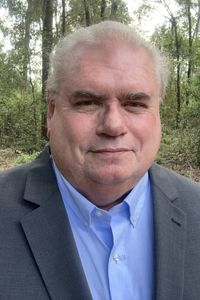
George Hubac served in the U.S. Air Force from 1983 to 1992. He graduated from Munich American High School. He earned a bachelor's degree from the University of Pennsylvania in 1980 and a graduate degree from the University of South Florida in 1994. His career experience includes working as a teacher.[1]
- Graduate:
- University of South Florida, 1994
- Bachelor's:
- University of Pennsylvania, 1980
- High school:
- Munich American High School
Campaign money
- Raised
- $17K
- From individuals
- $0
- From PACs & party
- $0
- Own money
- —
FEC filings through July 29, 2026.
View on FEC.gov(opens in new tab)In their own words
Who are you? Tell us about yourself.
Air Force veteran, retired teacher, and a former business owner. If there's one through line, it's a lifelong drive to learn and to empower others. At my core, I'm a catalyst. I have a creative, restless mind that sees how people, ideas, and resources connect, and the experience to make a plan work on real budgets and deadlines. My path has not been a straight line: jobs that did not last, a business that did not make it, years as full-time caregiver for my mom. Getting knocked down and then back up teaches us where the edges are, and knowing them is what keeps us safe and successful. When so many are struggling to find work and build a career, I've lived that, learned from it, and have a path forward.
I'm progressive in what I want for us, independent in how I think, and fiscally conservative by habit. I have always paid my bills, personally and in business, and want the same from government. I see the challenges coming, but also the possibilities. Our country has a drainage problem: for decades, communities like ours have been pumped dry. Our money and effort drawn out faster than anything flows back to refill us. I see it as my job to bring the resources we already pay for back home and put them to work here, so control is ours. I open doors and clear away obstacles, so we can speak for ourselves.
That's what a catalyst does.
Please list below 3 key messages of your campaign. What are the main points you want voters to remember about your goals for your time in office?
Securing our independence. Financial, physical, and over our own data. Our jobs and our money have been leaving this area for decades. As they start coming back, I want them to come all the way home, so this district owns more of its own economy and no crash can knock people below a basic floor.A catalyst who completes the broken circuit. My job is to open doors, clear obstacles, and train people to hold those doors open: making the resources working people already pay for actually come back to them, and lowering the threshold so others can advance too.Progressive in values, independent in method, fiscally conservative. I will fight for working people, but I will not be anyone's rubber stamp, and I will guard your tax dollars like they are my own. In a district like this, that mix is how you win and deliver.
What areas of public policy are you personally passionate about?
The shift from the industrial age to the digital age lets us bring the economy home and rebuild it locally: cooperatives, community-owned broadband and energy, and a basic income floor no one can fall below. An economy that sustains us first and sends the rest on to other markets, joining the values we have always had to the technology of the future. The same instinct runs through the rest: health people can actually reach, growing the VA's public-provider model into a public option with mobile clinics for rural residents; restoring our springs and keeping our aquifer clean; our privacy, so it is not extracted by governments and big business; and getting concentrated money out of politics, so the system serves us again.
Who do you look up to? Whose example would you like to follow, and why?
My junior high science teacher, Mr. Roy McCarty. He looked like Honest Abe and he acted the part. Whether you were an A student or the class troublemaker, he treated you exactly the same, with the same respect. That left a mark on me, and I carried it into my own years as a teacher. Here is how I know it was real and not just a fond memory. Decades later, in our old Frankfurt American Junior High Facebook group, he is the one teacher who still earns respect from every one of us, the honor students and the hard cases alike. That almost never happens. That is a role model: a man whose fairness is remembered by everyone, on every side, a lifetime later.
What characteristics or principles are most important for an elected official?
Honesty even when it costs you, and the willingness to be candid rather than rubber-stamp. An open mind that works with every caucus to get the district results. And a single test for every vote: does it move power and money back toward the people, or further away? An official should answer to constituents, not to concentrated money, which is why I refuse every special-interest donation.
What do you believe are the core responsibilities for someone elected to this office?
Two things. First, do the job the Constitution actually gives us: write laws for the country we are becoming, not the one we used to be; keep a close eye on how our money is spent; and stop handing Congress's power to the president and the agencies. Second, fight for this district. We grow the food, we train the graduates, and we raise the kids who go on to serve this country, in uniform and in a hundred other ways. We send so much out into the world, and my job is to make sure a fair share comes home to the people here.
What legacy would you like to leave?
That I left the ground under this district more solid than I found it: an economy the community owns instead of rents, a floor no one can be knocked below, and a seat handed back stronger than it was given to me, with the doors we opened still open and people trained to hold them. I would rather be the catalyst who cleared the path for others than the person who held the power.
What was your very first job? How long did you have it?
I was living in Frankfurt, Germany. The US Army ran a summer employment program for the kids there, and you took whatever came open. Mine was in a warehouse that stocked all the printed forms the military used across Europe. A few of us would each get a list of forms and quantities, track down every one, and bring them back to be shipped out to whatever unit had requested them. It lasted 5 weeks, but it was my first look at how a big operation really depends on ordinary people making sure the right thing gets to the right place.
What is something that has been a struggle in your life?
I'm a generalist in a world built for specialists. For most of my life that felt like a liability. The world rewards going deep on one thing, and I was always spread across many, rarely the expert in the room, and it was a real struggle to find where I fit. But that same struggle became my strength. Being a generalist forced me to adapt to almost any situation, to see a problem from several sides at once, and to find the thread that connects things that do not obviously belong together: opposing ideas, different people, separate fields. Where a specialist sees one deep lane, I see how the lanes join. It turns out that is exactly what a catalyst does.
What qualities does the U.S. House of Representatives possess that makes it unique as an institution?
The House is the chamber closest to the people, elected every two years from districts small enough to actually know. It is where the people's legislative work begins, and the Constitution gives it the lead on raising revenue. That closeness is its strength, but it only matters if the House does its job instead of handing its power to the president. I want to put that power back to work for the district.
What do you perceive to be the United States' greatest challenges as a nation over the next decade?
After 9/11 we traded much of our freedom for security, and the price is too high. Our greatest challenge now is winning it back, by bringing decision-making home. The Industrial Age centralized everything: big factories, distant owners, power pulled upward. The Digital Age runs the other way. Our tools are finally good enough for a community to make most of what it needs nearby. We have already decentralized communications and computing, and we are working on decentralizing energy. Privacy, manufacturing, and farming are next. The old system got us here and we can be grateful, but even a good thing can go too far. The answer is not to tear it down. It's to rebuild closer to home, with work that stays in our community and makes us healthier and freer.
Do you believe that compromise is necessary or desirable for policymaking?
Yes, when it moves power and money toward the people, and no when it just splits the difference on extraction. I am running unbound on purpose. In a closely divided Congress, an open mind that works with every caucus carries more leverage for this district than a vote pledged to a bloc in advance. Compromise is a tool for delivering, not a reason to abandon the test I hold every vote to.
What was the first historical event that happened in your lifetime that you remember?
My earliest memories are of flying and wanting to be an astronaut. I followed the space program with my father. One night in 1969, in Frankfurt, he woke me around 3 AM. I was groggy and fought to go back to sleep, but he wouldn't let me. I lay on the floor in front of the TV and watched Armstrong, then Aldrin, step onto the moon. The grainy black and white images, the crackling voice, the fear they might not have fuel to lift off. Wonder, amazement, fear, all at once, while the whole world watched together. What stays with me is that ordinary people went from almost nothing to the moon in a few years. That's what we can do together, and why I still see the future as bright and full of possibilities.
On the 2026 ballot
Links
Compiled from the candidate’s published profile as of September 30, 2026 and FEC filings.
Source(opens in new tab)