
Background
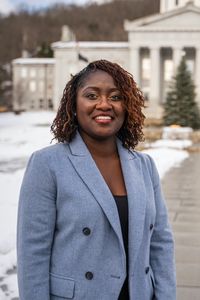
Esther Charlestin lives in Middlebury, Vermont. She holds an undergraduate degree in history and communication. Charlestin earned master's degrees in corporate communications/public relations and in teaching from Sacred Heart University in 2014 and 2016 respectively. Her career experience includes working in higher education and the public school system. Charlestin was elected to the Middlebury Selectboard. She co-chairs Vermont's Commission on Women.[1]
- Graduate:
- Sacred Heart University, 2016
- Bachelor's:
- Western Connecticut State University, 2012
Campaign themes
Esther Charlestin did not complete [the profile publisher]'s 2026 Candidate Connection survey.
Who are you? Tell us about yourself.
I am a Mother, an Educator, a Small Business owner, and a Public Servant. There are many reasons why I am running to be the next Governor of Vermont, but the biggest reason is to create a better, more livable state for my two children.
After years of working in education, I ran and won a seat on the Middlebury Select board, and in 2023 received a Leahy award for exceptional leadership in the community. I was overwhelmingly re-elected to my seat, ranking as the top vote getter in the race.
One of my great strengths as a prospective Governor is my lived experience. The empathy I have for those in our communities that often are with out voices or seats at the table I believe is an imperative in our leader. I have dealt with the struggles of a lack of affordable housing. I have seen first hand the damage of climate change disasters. I have spent years in education witnessing the issues of a system that is underfunded and yet still disproportionately expensive for working families.
The other key strength I bring to this race is a passionate proactivity. We live in a world where the issues of tomorrow are not far in the distance. They are here. We need a governor who will proactively work with others to find comprehensive solutions, and fast. That is what I promise to do. Inaction is not a luxury we can afford.
Please list below 3 key messages of your campaign. What are the main points you want voters to remember about your goals for your time in office?
There are two undeniable truths about the way our education system is funded: 1) Our schools MUST be fully funded. Full Stop. 2) The burden of funding our schools at an adequate level falls disproportionately onto lower and middle income Vermonters. As governor, I would work to develop and implement innovative and viable funding models to ease the education tax burden on low and middle-income Vermonters while ensuring our schools are preserved.Climate Change is costing Vermont residents money and pain right now, and it will only get worse going forward if we do not act. The bills passed by our hardworking legislature are the kinds of progress we need to be making in addressing climate change. Bills such as h.687 h.289 and the Climate Superfund act are comprehensive compromises that demand a better, more sustainable future for our state while acknowledging the need for a just energy transition. Additionally, we need to invest in local clean energy projects that ensure both equity for all residents as well as taking a local approach to our shift to clean energy and sustainability.Vermont’s housing crisis is constantly on my mind, and it is an issue I feel must be attacked from multiple angles.
First, we need to build more affordable homes. Plain and simple. And updating Act 250’s land use policy to allow for the construction of more affordable homes was the kind of bipartisan compromise I would champion if elected, rather than vetoing it as Gov. Scott did. Second, we need to increase aid for low and middle income residents to purchase, rent, and keep homes. This means looking at inclusionary zoning, supporting housing first models, implementing rental and second home taxes, and increasing urban density.
What areas of public policy are you personally passionate about?
-Addressing Climate Change Resiliency and a Just Energy Transition
-Creating more Attainable Housing and increased Livability for Working Families
-Innovating our Education Funding and Systems
Who do you look up to? Whose example would you like to follow, and why?
Shirley Chisholm
What characteristics or principles are most important for an elected official?
There are many traits needed to be an effective leader. However, I believe that Proactivity, Empathy, Intelligence, and Humility are absolutely integral to a good leader and elected official.
What do you believe are the core responsibilities for someone elected to this office?
This is a job of representing the people's interest in both speaking up on their behalf and executing the laws put in place to make their lives better. As someone with the lived experience of many of those facing our state's most pressing challenges, I am fully committed to doing both.
A governor is the top executive authority in his or her state. What does that mean do you?
This means that the people of the state look to me to be their number one employee. I will be hired to do the job of looking out for all of their best interests, no matter who they are or how long their voices have gone unheard. It also means to me that I must be proactive on their behalf, and that sitting by complacency for a term is not an option where they are concerned.
Governors have many responsibilities, which vary from state to state. Which of those do you personally consider the most important in your state?
Executing the laws in the way that best supports the people, and ensuring our state promotes livability for all. That means creating affordable housing. That means ensuring every one gets a seat at the table. That means creating systems that allow people to thrive. And it means protecting all of us from a future threatened by climate change.
What organizations or individuals have endorsed your campaign?
Howard Dean (former Gov of Vermont), David Zuckerman (incumbent Lt. Gov of Vermont), Emma Mulvaney-Stanek (Mayor of Burlington), the Vermont Progressive party, and more to come.
What are your views on financial transparency and government accountability?
It is imperative that constituents can trust their elected officials. There is no way to do this without transparency.
Campaign website
Charlestin’s campaign website stated the following:
Our Platform
Vermont is at a crossroads, and we need a leader with a strong vision. Vermonters deserve sustainable education systems, accessible housing and livability, and strong leadership to become a climate-resilient state with a just energy transition. Esther has experienced these hardships firsthand and is acutely aware of the necessity for real, effective solutions. Here is our platform.
Sustainable Education Systems & Affordable Childcare for All
Sustainable Education Systems
Vermont children and families deserve quality childcare and the best educational system possible. As the mother of two young children, Esther is deeply committed to making this a reality across our state.
Esther will:
Work to develop and implement innovative and viable funding models to ease the education tax burden on low and middle-income Vermonters
Explore expanding mental health care funding in public schools
Support programs that are expanding opportunities for teacher licenses
Affordable Childcare for All
Esther believes that now is the time to make further investments in the childcare system so that we can retain and attract working families and educators.
Esther will:
Support Paid Family Leave for all working families
Advocate for Livable wages for childcare providers
Attainable Housing & Livability
Attainable Housing
Charlestin’s administration would expand Vermonters’ access to attainable housing. Attainable housing is crucial for fostering inclusive communities where residents of all income levels and backgrounds can live and thrive in Vermont.
Esther will:
Augment accessibility and quantity of transitional housing projects in alignment with “Housing First” models
Explore options to aid low and middle-income families in renting and purchasing homes by supporting changes in zoning policies that are a barrier to increasing housing density
Enhancing regulatory mandates and municipal supervision pertaining to the implementation of inclusionary zoning within housing development projects
Enact Just Cause Eviction for the towns that have passed it
Support H.687 legislation to modernize Act 250
Exploring the feasibility of raising taxes on second homes and short-term rentals
Livability
It's time to address poverty, strengthen economic stability, and foster a more inclusive society where small businesses, farmers, and individuals can afford to support and elevate their families
Esther will:
Secure livable wages for all working Vermonters including migrant workers
Collaborate with labor unions to enhance safeguards for workers
Climate Resilience and a Just Energy Transition
Vermont requires a just energy transition that safeguards and prioritizes our most vulnerable populations, reaches our net zero energy goals, protects our natural resources and holds those who are responsible accountable.
Esther will:
Support efforts within the Climate Superfund Act and enforce accountability measures for polluters
Support legislation similar to H. 298 for a better Renewable Energy Standard
Explore investment in sustainable development including renewable energy projects, public transit, energy efficiency, sustainable agriculture, and conservation
Work to elevate dam safety enhancement
Support Increasing watershed resilience by restoring wetlands, promoting sustainable land use, and managing stormwater runoff
[2]
—Esther Charlestin’s campaign website (2024)[3]
On the 2026 ballot
Links
Compiled from the candidate’s published profile as of September 30, 2026.
Source(opens in new tab)