
Background
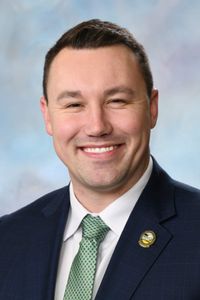
Erik Muckey was born in Platte, South Dakota. He earned a high school diploma from Corsica High School, a bachelor's degree from the University of South Dakota in 2014, and a graduate degree from the University of Minnesota, Twin Cities, in 2020. His career experience includes working as a nonprofit consultant and executive director.[1][2]
- Graduate:
- University of Minnesota, 2020
- Bachelor's:
- University of South Dakota, 2014
- High school:
- Corsica High School
In their own words
Who are you? Tell us about yourself.
I’m Erik Muckey, a sixth-generation South Dakotan and a Representative for District 15 in the South Dakota House. My wife, Sadie, and I live in downtown Sioux Falls. Before and alongside my legislative service, I served as CEO of Lost&Found, a nonprofit focused on preventing youth suicide, and helped pass bipartisan legislation in 2023 that delivered $2 million in state funding for suicide prevention. I also own a small business, PASQ, supporting communities statewide with strategic planning and nonprofit management, and I’ve taught economics at the University of South Dakota.
When I ran in 2024, I promised thoughtful, honest, hardworking leadership—listening first, solving problems, and delivering results. In my first two sessions, I served on the Joint Committee on Appropriations as the sole caucusing Democrat, fighting for every South Dakotan regardless of party or zip code. I’ve prime-sponsored four bills into law, including expanding access to free birth certificates and non-driver IDs for homeless youth, reconnecting people with unclaimed property, and guaranteeing equal access to administrative proceedings. I also helped advance a major reform of the state’s Futures Fund and worked to secure funding for federally qualified health centers and critical access hospitals, plus stronger support for TANF, special education, K-12 education, the state workforce, and Medicaid—while defending open government, public schools, and veterans.
Please list below 3 key messages of your campaign. What are the main points you want voters to remember about your goals for your time in office?
Education is the key to the future for the next generation of South Dakotans. I'll continue to make sure that funding and strengthening our education system is a top priority in Pierre. We can afford to keep great teachers, meet students’ needs, and stop shifting costs onto local property taxpayers.Health care, including mental health care, should be available when people need it. I’ll put my experience to work to continue improving healthcare access, invest in addressing workforce shortages, and ensure programs like Medicaid work for real people, doing so while balancing the state budget.Working people, families, and retirees deserve the same thing: a stable, affordable life in our district and our state. I’ll continue to focus on policies that help working families afford a quality home, improve the affordability of childcare, and deliver smart cost-of-living relief so people can afford their rent or their home, build careers and raise kids here, and age in place without getting priced out. A healthy community is one in which every generation can find a fulfilling life.
What areas of public policy are you personally passionate about?
I’m most passionate about mental health and ensuring folks have access to affordable healthcare, something I've spent the overwhelming majority of my career working on as a passionate youth suicide prevention advocate and a leader on the Joint Committee on Appropriations to sustain Medicaid services across South Dakota.
As an economist, I’ve long focused on research and actions that help ensure K-12 education funding is fair and sustainable, while also addressing the cost-of-living issues hitting District 15 hardest: housing, childcare, and wages.
Across the board, I care about transparent budgeting and accountable government, something I've brought several pieces of legislation to address.
Who do you look up to? Whose example would you like to follow, and why?
I look up to people who model service without ego—whether my wife, my sister and parents, mentors and professionals I've had the privilege to work with statewide, elected leaders like former US Senator Tim Johnson, and the people I've gotten to know in our district. All of these people taught me that leadership is showing up, doing the work, and solving real problems without needing all the credit.
What characteristics or principles are most important for an elected official?
Integrity over performance: tell the truth about what a bill does and what it costs.
Do your homework. Listen before acting. Stay calm and focus on what's good for people you serve. Measure success by whether real people can navigate life a little better because you showed up.
What do you believe are the core responsibilities for someone elected to this office?
To be useful: answer when constituents call, explain what’s happening in Pierre in plain language, advocate even when outnumbered, and find real leverage to improve outcomes.
Passing bills matters, but so does helping people understand government, defend fair process, and make sure systems work for, not against, the people of South Dakota.
What legacy would you like to leave?
I want to leave institutions stronger than I found them. I want to create conditions where others thrive and prove that a government created by people for people can be honest, competent, and humane. If people are better served and more able to build a life here because of thoughtful work put in, that’s the legacy I want to be known for.
What was your very first job? How long did you have it?
My first work in middle and high school was hands-on and community-based: running a lawn care business with my dad, umpiring and coaching youth baseball, and working as a hired hand on a cattle operation, fixing fence and taking on "other duties as assigned." Those jobs taught me the value of hard work and that no matter the weather, some work can't wait.
What is something that has been a struggle in your life?
At the end of college, I went through a serious mental health crisis and suicidal ideation. With the support of my family, I sought professional mental health care that saved my life. I learned that I was not only stronger for seeking help, but also that I could be an advocate and support others who needed help.
It’s why I care so much about mental health policy that works in practice, not just “on paper," and why I take seriously what people carry that you can’t see. In an incredibly dark point in my life, I was fortunate to find strength and purpose.
What do you believe is the ideal relationship between the governor and state legislature?
Separate branches with shared responsibility. The governor proposes and executes; the legislature deliberates independently, asks hard oversight questions, and makes budget decisions transparently. The public loses when hearings are theater and decisions are made before the work is done. It's why we not only need strong, coequal branches of government but a more balanced perspective in the Legislature.
What do you perceive to be your state's greatest challenges over the next decade?
Keeping South Dakotans here, especially our graduates and our kids, by investing in livability: public schools, healthcare (including mental health), and an economy where wages can actually cover housing and childcare.
Unless we strengthen our partnerships with local communities, schools, colleges, and universities, and with sovereign tribal nations, we can't build an economy that offers opportunity for every South Dakotan.
Do you believe that compromise is necessary or desirable for policymaking?
Compromise is necessary when it produces real progress without surrendering core principles. I’ll take 60% over 0% when it helps people and can be implemented well. But I won’t “compromise” by harming vulnerable people, by pretending agreement, by staying silent about injustice, or by lying to constituents.
What was the first historical event that happened in your lifetime that you remember?
I was 9 years old in my mother’s 4th-grade classroom in Corsica, South Dakota, watching the attacks of 9/11 live as the towers fell. It shattered any sense of invincibility, but it also clarified what matters: building a strong country that cares for its people.
Who are you? Tell us about yourself.
I'm a sixth-generation South Dakotan whose life and work has focused on serving the needs of my community and state and helping people achieve their full potential. With my wife, Sadie, I'm a proud resident of downtown Sioux Falls and excited to work hard, work smart, and work together for our neighbors in District 15 as a Representative in the South Dakota Legislature.
For the past decade, I have led Lost&Found as its CEO, building one of the most effective organizations in our state focused on addressing youth and young adult suicide. Through this work, I led efforts to pass bipartisan legislation during the 2023 Legislative Session that brought $2 million in new funding to prevent youth suicide—the state’s leading cause of death for South Dakotans under the age of 29.
Today, I also own a small business, PASQ, that aids rural communities across South Dakota with strategic planning, board development, and nonprofit management services. Combined with past service as an Adjunct Instructor of Economics for the University of South Dakota and lived experience in a household of rural educators, I bring unique perspective, valuable experience, and a track record of effective collaboration to the South Dakota Legislature.
Our community and our state are ready for a new generation of leadership in Pierre, and I would be honored to be your Representative in the South Dakota Legislature.
Please list below 3 key messages of your campaign. What are the main points you want voters to remember about your goals for your time in office?
State investment in public education is essential for the success of the next generation of South Dakotans and for the reduction of local taxpayer burden.Caring for our community means ensuring healthcare is accessible to all South Dakotans, regardless of their zip code, lived experience, or socioeconomic status.We will strengthen our state’s economy and meet workforce shortages by addressing issues keeping South Dakotans from their potential.
What areas of public policy are you personally passionate about?
I have spent 14 years advocating for the needs of South Dakotans impacted by suicide risk and death. As the co-founder and CEO of Lost&Found, I have successfully lobbied the South Dakota Legislature for bipartisan investment to curb the leading cause of death for South Dakotans under the age of 29: suicide.
I have also extensively researched the South Dakota K-12 education funding formula and its impact on school districts across the state, as well as previous service as an agricultural market researcher. Through these experiences, I bring a wealth of knowledge and understanding of the way our state funds and supports education and agriculture.
No matter the issue, I'll be a passionate advocate for our community in Pierre.
What characteristics or principles are most important for an elected official?
Elected officials need to have a listening ear, deal with their work honestly and with integrity, seek to understand before being understood, put in the hard work, and put their community, state, and country above party affiliation.
These principles will guide how I serve as a legislator.
What do you believe are the core responsibilities for someone elected to this office?
Serving in the South Dakota Legislature requires someone who is willing to work hard, work smart, and work together for the good of the communities and state we serve.
I've always believed that being a legislator means rising above petty partisanship to govern effectively for the state of South Dakota. That means focusing on real issues and creating real policy that meets the needs of our state's residents, not grandstanding or disrupting or sewing discord simply to prove a point.
You deserve effective representation in Pierre, and our responsibility to you as legislators is to listen, understand real problems, deliver real solutions and support, and continue to learn from you as policy is put into action.
That's what you can expect me from as a legislator.
What legacy would you like to leave?
When we work harder, work smarter, and work together, good things happen. I want to leave a legacy of policies that help South Dakotans from every background with the opportunity to build a life for six generations in our state, like my family has.
I learned these values at a young age when I first heard the story of how my parents came home to Corsica after receiving their teaching degrees at the University of South Dakota. They had many choices and opportunities in front of them, but one thing brought them home: a farm accident.
My grandfather’s accident ultimately led to my parents choosing to make a life in the rural South Dakota community that our family had known for generations. My father took on farming—mostly alone—while both he and my mother began their decades-long teaching careers. Like many families in the 1980s, our family found themselves no longer on the land—but they didn’t leave the community.
Instead, my parents cared for aging family members, raised their two kids to understand the value of community service, and invested their lives into helping others discover their potential through education—all while serving in numerous leadership roles in our church, school, and community. No matter the challenge, they met it head on by working harder, smarter, and together.
That's why I'll focus my time as a legislator on education, healthcare, and economic opportunity and seek to ensure our state sustainably supports every South Dakotan, regardless of zip code.
On the 2026 ballot
Links
Compiled from the candidate’s published profile as of September 30, 2026.
Source(opens in new tab)