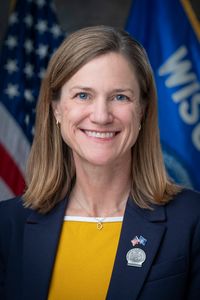
Background
Deb Andraca was born in Springfield, Massachusetts. Andraca earned a high school diploma from Manheim Township High School, a bachelor's degree from Syracuse University in 1992, a master's degree from George Washington University in 1996, and a teaching license from Alverno College in 2016. Her career experience includes working as a legislator, an elementary school teacher, a vice president at FleishmanHillard International Communications, a communications director and lobbyist with the Environmental Law and Policy Center of the Midwest, and a press secretary on a congressional re-election campaign.[1][2]
- Graduate:
- The George Washington University, 1996
- Bachelor's:
- Syracuse University, 1992
- High school:
- Manheim Township High School
In their own words
Who are you? Tell us about yourself.
I was first elected to the Wisconsin State Assembly in 2020 and I am proud to be running for my fourth term representing the people of the 23rd Assembly District. I currently serve as a member of the Joint Finance Committee; the Forestry, Parks and Outdoor Recreation Committee; and the Joint Survey Committee on Tax Exemptions.
My family and I have lived in Whitefish Bay for over 20 years and we all do our best to give back to our community. Before running for office I pursued my teacher’s license part-time at Alverno College, completing my coursework in 2018. I taught third-grade math at Bruce Guadalupe Community School and was an elementary substitute in the Whitefish Bay School District. While home with my young daughters I served as PTO president, Girl Scout troop leader, a volunteer fundraiser for the Urban Ecology Center, and a Milwaukee-area leader for Moms Demand Action for Gun Sense.
Prior to my teaching career I was a vice president at FleishmanHillard International Communications, communications director and lobbyist for the Environmental Law and Policy Center of the Midwest, and press secretary on a Congressional campaign. I have been married to my husband Marc for 27 years and we have two daughters in college.
Please list below 3 key messages of your campaign. What are the main points you want voters to remember about your goals for your time in office?
Safer - I will continue my advocacy in the Assembly for a safer Wisconsin, including common-sense firearm safety measures, red light cameras, and other measures to reduce violence and crime.Smarter - As a member of the Joint Finance Committee, I have been a strong and consistent voice for sustainable, reliable public school funding indexed to inflation, especially funding for our special needs students. Schools must be equipped with the tools they need to help every child succeed. When the state invests more in education, local districts don't need to turn to referendums to provide school basics and we can stop putting pressure on local property taxpayers.Healthier - The cost of living is straining budgets in every part of our state. We must take steps to make healthcare and the everyday cost of living more affordable and less stressful for Wisconsin families. We also need to preserve our parks and open spaces so families have access to the outdoors and keep taxes low on middle-class families so they can keep more of their hard-earned money.
What areas of public policy are you personally passionate about?
As a parent and former teacher, education is one of my top priorities. As a former leader with Moms Demand Action and a gun owner, I have been a champion for common-sense gun safety reform in the legislature. As a former environmental advocate I am also very interested in clean energy and environmental conservation.
What organizations or individuals have endorsed your campaign?
My current endorsements are listed on my web page, www.debforwi.com. Past endorsements have included Wisconsin Conservation Voters, Planned Parenthood, and Everytown for Gun Safety.
Who are you? Tell us about yourself.
I was elected to the Wisconsin State Assembly in 2020 and I am proud to be running for my third term as a representative. My family and I have lived in Whitefish Bay for over 20 years and we all do our best to give back to our community. Before running for office, I served as PTO president, a Girl Scout troop leader, a volunteer fundraiser for the Urban Ecology Center, and a Milwaukee-area leader for Moms Demand Action for Gun Sense.
I pursued my teacher’s license part-time at Alverno College, completing my coursework in 2018. I taught third-grade math at Bruce Guadalupe Community School and was an elementary substitute in the Whitefish Bay School District.
Before starting my teaching career, I was a vice president at FleishmanHillard International Communications, communications director and lobbyist for the Environmental Law and Policy Center of the Midwest, and press secretary on a Congressional campaign. After graduating from Syracuse University in 1992, I lived in Washington DC where I earned a master’s degree at George Washington University while working full-time at the Solar Energy Industries Association.
My family includes my husband Marc and two daughters in college.
Please list below 3 key messages of your campaign. What are the main points you want voters to remember about your goals for your time in office?
I will continue my advocacy in the Assembly for a safer Wisconsin, including common-sense firearm safety measures, red light cameras, and other measures to reduce violence and crime.As a member of the Education Committee, I have been a strong and consistent voice for sustainable, reliable public school funding, especially equitable funding for all of our special needs students.The health of our state is a top priority for me, as I believe that every individual and family in the state should be able to access affordable healthcare. I have also been a champion for responsible stewardship of Wisconsin’s natural resources, funding for state parks, and clean air and water.
What areas of public policy are you personally passionate about?
As a longtime advocate for common sense firearm laws, I am passionate about policies that promote safer schools and communities. During my two-terms as a representative, I have also become a dedicated advocate for environmental stewardship and transparent governance.
Who do you look up to? Whose example would you like to follow, and why?
I look up to women who ran for office before we had strong anti-discrimination policies in place. I remember when Geraldine Ferraro was nominated for Vice President and Elizabeth Dole was a candidate for President. Knowing what a male-dominated industry politics still is today I can truly appreciate what they went through decades ago.
What characteristics or principles are most important for an elected official?
I believe elected officials need to have an open mind and be willing to listen. We are elected to represent our constituents, so weighing all constituents' concerns is important when deciding how to vote on issues. Only listening to one side or one political party is easier, but that is not what we are elected to do. We are elected to serve all of our constituents.
What do you believe are the core responsibilities for someone elected to this office?
As a "down ballot" race, State Representatives should work hard, be present, and be accessible. Most constituents would have a difficult time getting an in-person meeting with a US Senator or Representative, but on the state level we have an opportunity to make real connections and help the people we serve. As a State Representative, I hold weekly constituent office hours, offer in-person meetings in the district and Capitol, and speak to groups whenever I can.
What is the first historical event that happened in your lifetime that you remember? How old were you at the time?
I grew up in Pennsylvania. When I was in second grade the Three Mile Island nuclear accident happened not far from where we lived. I distinctly remember parents being very worried and picking up their children from school.
What was your very first job? How long did you have it?
My first job was as a lifeguard and swim instructor. I started when I was in high school and continued through my first year of college.
What do you perceive to be your state's greatest challenges over the next decade?
Wisconsin is a purple state, and overcoming partisanship is a huge challenge. I am optimistic that our new, more balanced legislative maps will help. We will need to come together to address one of our other challenges, which is that our state population is getting older. We must enact policies that can attract and retain young people and families so our economy can continue to grow and thrive. This would include investing in public education, affordable housing, high-quality child care, paid family leave, and protections for our parks and natural areas.
Do you believe that it’s beneficial for state legislators to have previous experience in government or politics?
I did not have previous experience when I was elected in 2020. I think it is better to have a broad range of backgrounds and experiences so that different perspectives are incorporated into the legislative process.
Do you believe it’s beneficial to build relationships with other legislators? Please explain your answer.
Yes! No bill can be passed without help from colleagues, and this includes working with people who may not always agree with you. From my first days in office I have made it a priority to reach across the aisle at the beginning of each session and invite new and returning colleagues to collaborate.
What organizations or individuals have endorsed your campaign?
Wisconsin Conservation Voters Honor Roll and Champion, Planned Parenthood Advocates of Wisconsin, Gun Sense Distinction from Moms Demand Action for Gun Sense
What committees interest you?
I currently serve on the Joint Committee on Finance, Education, and Forestry Parks and Outdoor Recreation. I previously served on the Veterans Affairs Committee and was a member of the Governor's Blue Ribbon Task Force on Veteran Opportunity.
What are your views on financial transparency and government accountability?
I strongly believe in government transparency. In my first term I fought against an "anonymous objector" on the Joint Finance Committee who was trying to stop some lakeshore property from becoming a park. I sponsored the "Voucher Transparency Bill" so that taxpayers could see on their property tax bills how much state funding was leaving their local school districts for private schools. And I was the lead author of the Fair Maps Bill that would establish a nonpartisan redistricting process rather than allowing any political party to draw gerrymandered maps behind closed doors.
Would a state ballot initiative process be good or bad for your state?
There are many issues in Wisconsin that are popular with a majority of voters - fair maps, paid family leave, stricter gun laws, Medicaid expansion, abortion rights - but the Republican majority has successfully blocked these bills from even getting a public hearing, let alone a vote, for years. This is wrong. I would support a ballot initiative process for our state so that one party could no longer block widely-popular legislation.
Deb Andraca did not complete [the profile publisher]'s 2022 Candidate Connection survey.
Video for [the profile publisher]
Video submitted to BallotpediaReleased May 23, 2020
Who are you? Tell us about yourself.
Deb Andraca is running for Wisconsin State Assembly to make our communities safer, smarter and healthier. Deb was previously a vice president at a global PR firm, an environmental lobbyist, and a press secretary for a successful Congressional campaign. After being a stay-at-home mom for several years, Deb earned her teacher's license through Alverno College and works as a substitute at Bruce Guadalupe Community School and in the Whitefish Bay School District. An active community volunteer, Deb was PTO president at her daughters' school, a fundraiser chair for the Urban Ecology Center, and a Girl Scout leader. Most recently, Deb became a Milwaukee leader for Moms Demand Action for Gun Sense after experiencing a terrifying lockdown drill while teaching. She has a master's degree in political management from George Washington University and a bachelor's degree in public relations and political science from Syracuse University. A district resident for 17 years, Deb has two daughters at Whitefish Bay High School and has been married to Marc for 21 years.
Please list below 3 key messages of your campaign. What are the main points you want voters to remember about your goals for your time in office?
When I met with Jim Ott just a few days before the special session on gun safety, I asked him to support background checks and extreme risk protection orders. Jim Ott said no. I am a gun owner, and I will say YES to measures that reduce gun violence while protecting our second amendment rights. We all need to feel safe in our homes, on our roadways, in our schools, and in our places of worship. To help prevent mass shootings, and to help reduce the epidemic of suicide in our state, I support measures such as red flag laws that allow a judge, using evidence and due-process protections, to remove guns from individuals who are a threat to themselves or others. Right now the state's share of education funding remains below 2011's level, despite recent claims of "historic investments in public schools." The state should invest more in public education, and ensure our local schools are equipped to prepare students for a global economy. There are great teachers in our schools who are being hired and fired because our elected leaders are playing politics with school budgets. At the same time, I know students who desperately need special education intervention, but there isn't enough funding or trained staff to meet their needs. Education should not be a partisan issue. All students deserve high quality schools. My first "real" job out of college was in Washington DC at the Solar Energy Industries Association, and later I became communications director at the Environmental Law and Policy Center of the Midwest. I learned how green technology can create 21st century jobs while driving economic development, and I worked to preserve natural areas such as the Chequamegon-Nicolet National Forest and valuable prairie land along the Mississippi. Jim Ott is a former TV weatherman who denies that climate change is real. In fact he used to publish a newsletter "debunking" climate scientists. He says he loves to go fishing but votes against measures that would protect our waterways. I will vote to protect our environment while driving economic development.
What areas of public policy are you personally passionate about?
I am running for Wisconsin State Assembly to build a safer, smarter, healthier Wisconsin. Safer refers primarily to common sense gun laws. Smarter refers primarily to better and more consistent support for our public schools and teachers. Healthier refers primarily to creating a cleaner environment and better access to healthcare. Also, fundamental to all of these policies is the issue of fair maps. Because politicians shouldn't choose their voters - voters should choose their representatives.
What characteristics or principles are most important for an elected official?
Elected officials must be open to new ideas, wiling to listen to all points of view, transparent about their decision-making process, and honest with constituents.
What qualities do you possess that you believe would make you a successful officeholder?
I think teachers make good legislators because we love to learn. My father was a Republican, I am running as a Democrat, and I believe legislators need to listen, learn, and be open to ideas and all points of view before deciding how to vote on behalf of their districts.
What do you believe are the core responsibilities for someone elected to this office?
I believe an elected official must listen to and respond to his or her constituents. This is largely what has motivated me to run for office. For many years, as a constituent, I tried to convince Representative Jim Ott to support common-sense gun laws. To take action to prevent climate change. To support our public schools and teachers. To ensure all Wisconsin families had access to affordable, high-quality health care. Most of my calls, letters and meeting requests were ignored. So I decided that if I can't change our Representative's MIND, I would have to change his JOB.
What was your very first job? How long did you have it?
My very first job was in high school. I was a swim instructor for little kids and a lifeguard. I loved to help young kids overcome their fear of the water, help them take risks and learn new things. All through high school I worked at our local pool in the summers and taught swim lessons at my high school pool in the winter. Although my career went in a different path originally, after my own kids got older I returned to teaching by earning my license in elementary education.
What was the last song that got stuck in your head?
"Baby Shark." I teach elementary school.
Every state besides Nebraska has two legislative chambers. What do you consider the most important differences between the legislative chambers in your state?
The state assembly is very localized, allowing - if not requiring - assembly persons to stay closely connected with his or her constituents. I am motivated to run for office, in part, because I believe the current incumbent failed to do this.
Do you believe that it’s beneficial for state legislators to have previous experience in government or politics?
I believe responsiveness to constituents is the most important aspect of an elected official, regardless of experience in government or politics.
What do you perceive to be your state’s greatest challenges over the next decade?
If we do not address gerrymandering in Wisconsin in this census year, we will be stuck with another 10 years of a broken political system where politicians chose their voters (instead of the other way around). This year is a census year. Thus, district maps will be redrawn in 2021 based on the census. If WI state Democrats do not win a few seats (or if WI state Democrats lose just a few seats) in the November 2020 election, the Wisconsin state Republicans will have enough seats to override Democratic Gov. Evers' veto. If that happens, Republicans will redraw the district lines with zero check on them. And all evidence suggests that they will do exactly what they did last time - rig maps in secret to override the will of the people and maintain power at all costs. This is wrong when Democrats do this in other states and it is wrong when Republicans do this in Wisconsin and elsewhere. If we let this happen - again - it will be nearly impossible to address all the issues we care about, including health care, education, gun safety, and the environment.
What do you believe is the ideal relationship between the governor and the state legislature?
Like the federal system, our states are built on a structure of checks and balances. So long as the governor and state legislature have been fairly elected, some tension between them is fine and represents a healthy democratic process. The governor has the responsibility of bringing the state forward as a whole, while each state representative is responsible for advocating for the unique demands of his or her constituents.
Unfortunately, in Wisconsin, the state legislature has been horribly gerrymandered, significantly reducing the power of constituents to demand change from their representatives. This needs to change to restore a healthy democracy to Wisconsin.
Do you believe it’s beneficial to build relationships with other legislators? Please explain your answer.
Absolutely. Building relationships with like-minded legislators helps create power to organize for change. But even more importantly is the need to build relationships with legislators from across the aisle. Gerrymandering promotes extremism - on both sides. We need to use a system where a healthy state democracy forces legislators to come together to create better solutions.
What process do you favor for redistricting?
Iowa has provided a good model. Iowa uses an independent legislative agency to draw district lines. This agency must disregard political objectives and conduct public hearings to ensure the maps are fair. The Iowa Legislature is compelled to vote up or down on the agency's maps without amendments. Other states utilize nonpartisan, independent, and bipartisan commissions. I am open to different methods so long as the process is independent, transparent, and open to the public.
If you are not a current legislator, are there certain committees that you would want to be a part of?
Some of the committees where I feel I could contribute the most include Environment, Energy and Utilities, Education, and Transportation
On the 2026 ballot
Links
- Campaign X(opens in new tab)
- Official X(opens in new tab)
- Official tiktok(opens in new tab)
- Campaign website(opens in new tab)
- Official website(opens in new tab)
- Official youtube(opens in new tab)
- Campaign facebook(opens in new tab)
- Official facebook(opens in new tab)
- Personal facebook(opens in new tab)
- Personal linkedin(opens in new tab)
- Campaign instagram(opens in new tab)
- Official instagram(opens in new tab)
Compiled from the candidate’s published profile as of September 30, 2026.
Source(opens in new tab)