Background
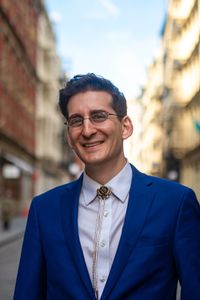
David Siffert earned a high school diploma from Horace Mann School. Siffert earned a bachelor's degree from the University of Chicago in 2006 and earned a law degree from New York University Law School in 2009. Siffert's career experience includes working as a civil rights attorney.[1]
- Law:
- New York University Law School, 2009
- Bachelor's:
- University of Chicago, 2006
- High school:
- Horace Mann School
In their own words
Who are you? Tell us about yourself.
I am a civil rights lawyer, NYU Law Professor, born-and-raised New Yorker, and parent raising a toddler in District 66. I teach law students about the NYS Legislature, and I am one of NY’s premier experts in technology policy. I have written over 100 bills, built coalitions, and filed lawsuits to protect our neighborhoods, on issues including defending immigrants, standing up to Trump, making housing more affordable, protecting LGBTQIA+ and marginalized New Yorkers, regulating AI, and expanding healthcare access. I have watched good legislation get gutted, killed, or just plain ignored by Albany’s apathy, and I am running to bring our community’s urgency upstate.
Please list below 3 key messages of your campaign. What are the main points you want voters to remember about your goals for your time in office?
The NYS Legislature is my area of expertise. I teach about the legislature at NYU Law School, and I have written over 100 bills.
In my class, I pair 10 law students with 10 legislators and work with the students, the legislators, and outside experts to draft legislation – 20 bills per year. I bring key players – legislators, central staffers, unions, lobbyists, and more – to class as guest speakers. I know how the sausage is made.
I have also experienced it first-hand, as Legal Director of a civil rights non-profit at the intersection of technology, privacy, and civil rights. I drafted bills, negotiated them, built coalitions, and got legislation passed.
I will be ready on day one to draft and pass legislation our community needs.As the former Legal Director of the Surveillance Technology Oversight Project, I am one of New York’s experts in technology policy. The rise of unregulated AI should scare all of us, but for some reason policymakers in Albany show no urgency in solving the problems AI is already posing.
AI creates risks to privacy, civil rights, education, the environment, jobs, and more, and ultimately poses catastrophic risks to our society. AI is already creating havoc in the labor market, but no one seems to be doing anything about it.
I have drafted bills that would mitigate most of these harms. AI dystopia is not inevitable. But I realized I can’t pass these bills from the outside, which is why I’m running for office.Change is possible–I’ve seen it happen.
In 2019, Democrats took control of all three branches of NYS government and passed landmark legislation protecting the environment, tenants, and civil rights. But since then, momentum has stalled, and some of these laws have even been rolled back.
Today, New Yorkers are worried about the climate, healthcare, housing costs, the rise of fascism, and the looming specter of AI. But these problems are not inevitable.--we know how to solve, or at least mitigate, all of these issues. . If we elect people that put more stock in their constituents than their donors, we can see that change.
We must reject hopelessness, and elect officials who aren’t satisfied with business-as-usual.
What areas of public policy are you personally passionate about?
Making housing more affordable: Instead of handouts to developers, New York must invest in deeply affordable housing, create a Social Housing Development Authority, and fund expanded housing vouchers, paid for by a tax on vacant and warehoused units.
Protecting immigrants: Donald Trump cannot be allowed to keep terrorizing our communities. We must make New York a sanctuary state, ban ICE from state and municipal property, and allow New Yorkers to sue when ICE breaks the law.
Regulating AI: Unregulated AI poses risks to privacy, civil rights, our environment, our education, and our jobs, and ultimately it poses existential risks. I have already drafted many of the bills we need to pass to protect ourselves.
Who do you look up to? Whose example would you like to follow, and why?
My State Legislative Externship co-professor, Assemblymember Jessica González-Rojas, has a unique ability never to back down, to speak her mind, to call out injustice, and still to be extremely effective in passing meaningful legislation.
What characteristics or principles are most important for an elected official?
Integrity. It’s so easy, once one gets power, to use your power to keep your power, as opposed to using it to benefit others.
Impatience. The biggest obstacle to change is inertia. Especially in New York State, where Democrats control all branches of government, the easiest thing to do is still to create additional bureaucratic hoops, make things wait, and eventually put them off until next year. This is why New York is still not a sanctuary state after close to 10 years of advocacy. A good legislator must fight that inertia, and agitate for change on the timeline the voters need.
Compassion. A representative must understand what their constituents need, and must care deeply about New Yorkers who are having a hard time. Representatives must be willing to spend their time, energy, and political capital on things that will help people who need help – whether it be legislation or direct services.
What do you believe are the core responsibilities for someone elected to this office?
Drafting and passing legislation
Constituent services
Speaking up for our communities and for justice
What legacy would you like to leave?
I want to pass legislation that makes my community, my city, and all of New York State a better place – one that works for everyone.
I want my constituents to know that I care about them and their needs, and that I am personally there for them when they need it.
What was your very first job? How long did you have it?
I was a summer intern for Human Rights Watch when I was 15.
What is something that has been a struggle in your life?
I am non-binary, and I would be the first openly non-binary person elected to government office in New York State history. Being gender-non-conforming unsurprisingly made adolescence difficult, and it continues to be a challenge on the campaign trail, but I am proud to be breaking new ground.
What do you believe is the ideal relationship between the governor and state legislature?
The legislature must be willing to stand up to a Governor who puts the interests of her donors over the interests of New Yorkers.
What do you perceive to be your state's greatest challenges over the next decade?
It’s impossible to pick one single challenge in the face of global climate change, national fascism, and the rise of AI, but New York specifically faces a disproportionate housing crisis.
There is no silver bullet to solving our housing crisis. We must build more permanent, accessible, deeply affordable housing. We must expand our voucher programs. We must partner with non-profits to build social housing, including more supportive housing. We must pass laws to help older New Yorkers age in place. We must provide right-to-counsel to anyone facing eviction. And we must create a vacancy tax on investment properties, second-homes, and warehoused units to help pay for this.
Do you believe that compromise is necessary or desirable for policymaking?
Yes. In a body of elected officials with different values, different interests, and different constituencies, compromise can be the only way to help New Yorkers. Being a good negotiator means figuring out how to compromise in ways that do not betray your values or constituents while still getting tangible benefits to constituents and New Yorkers more broadly. Compromising too quickly, or refusing to compromise at all, will usually wind up in worse outcomes.
I have personally done this work. As a civil rights lawyer, I often wind up adversarial to NYPD in lawsuits and in legislative advocacy. Last year, however, I negotiated with NYPD to pass NYC Council legislation that dramatically increased NYPD’s disclosure obligations around the surveillance technology they use. This legislation required spending a year negotiating in good faith with NYPD, each party making compromises along the way, until we had language that both NYPD and the civil rights community could agree upon.
What organizations or individuals have endorsed your campaign?
New York Progressive Action Network, The Sunrise Movement NYC, Village Independent Democrats, Downtown Women for Change, UNITE HERE Local 100, State Senator Jabari Brisport, Assemblymember Emily Gallagher
What was the first historical event that happened in your lifetime that you remember?
The Presidential election of 1988.
On the 2026 ballot
Links
Compiled from the candidate’s published profile as of September 30, 2026.
Source(opens in new tab)