
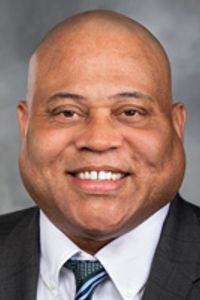
Background
David Hackney was born in Cleveland, Ohio. Hackney earned a bachelor’s degree from Cornell University in 1987 and a J.D. from Harvard University Law School in 1993. His career experience includes working as an attorney and federal prosecutor. Hackney co-founded a community kitchen in Washington, D.C., and served on the Washington State Human Rights Commission and on the board of the Idjwi Island Education Fund.[1][2][3]
- Law:
- Harvard Law School, 1993
- Bachelor's:
- Cornell University, 1987
Campaign themes
David Hackney has not yet completed [the profile publisher]'s 2026 Candidate Connection survey.
Send a message to David Hackney asking him to fill out the survey.
If you are David Hackney, click here to fill out [the profile publisher]'s 2026 Candidate Connection survey.
Who fills out the candidate survey?
Any candidate running for elected office, at any level, can complete [the profile publisher]'s Candidate Survey. Completing the survey will update the candidate's [the profile publisher] profile, letting voters know who they are and what they stand for. More than 32,000 candidates have taken [the profile publisher]'s candidate survey since we launched it in 2015. Learn more about the survey here.
You can ask David Hackney to fill out this survey by using the button below or emailing info@hackney4the11th.com.
David Hackney did not complete [the profile publisher]'s 2024 Candidate Connection survey.
David Hackney did not complete [the profile publisher]'s 2022 Candidate Connection survey.
Who are you? Tell us about yourself.
My name is David Hackney, and I am running for State Representative in the 11th Legislative District because we need representation that is reflective of the community. My paternal grandfather was a member of the Brotherhood of Sleeping Car Porters. My maternal grandfather was a member of the UAW. I was born in Cleveland, Ohio, the youngest of three. Neither of my parents completed college, but they did everything in their power to make sure I received a quality education. During my Senior year of college my mother was diagnosed with terminal cancer and denied health insurance. The healthcare costs crippled my family financially. Despite those setbacks, I graduated from Cornell University and Harvard Law School. The last several years I have devoted myself to causes I believe in. I currently serve on the Boards of Tabor 100 and the Alliance for Gun Responsibility, and as a Commissioner on the Washington Human Rights Commission. My background has allowed me to work on issues that I deeply care about, and that impact all of us - climate change, human rights, economic opportunity in rural and urban disadvantaged neighborhoods, gun violence prevention, and criminal justice reform.
Please list below 3 key messages of your campaign. What are the main points you want voters to remember about your goals for your time in office?
Housing: The 11th is one of the few relatively affordable areas remaining in King County, but rising property taxes and housing prices threaten to disrupt our community. For too long, the impetus for addressing housing issues has been placed on city and regional entities. The legislature must do more to ensure renters are treated humanely, are able to rely on a Landlord Code of Conduct and stable rent prices, so that hard working people can enjoy the peace of mind that comes from stable housing. In addition, there should be a moratorium on evictions in areas where the Governor has declared a state of emergency, for the term of the emergency. The legislature must do more to protect renters and keep them in their homes and communities.Healthcare: When I was in college my family suffered a healthcare crisis that crippled my family financially. There are far too many people in the 11th LD who are dealing with similar healthcare crises and costs associated with it. Healthcare for all should be considered a right that can be exercised by any person in the State, without regard to immigration status, gender, religion, race, nationality, or ability to pay. In addition, hard-working people in the 11th deserve paid sick leave, so they never have to choose between their health, the health of their co-workers and customers or their paycheck. In addition, workers should be free from discrimination or harassment for exercising their right to healthcare.Education: Schools in the 11th have some of the highest free and reduced lunch rates in Washington, yet are receiving less funding than the wealthiest districts in the state. I believe every student in the 11th deserves the opportunity to receive a quality education that prepares them for careers of their choice, and to attend community colleges, universities or apprentice programs for skilled trades. My parents realized that knowledge is power and that parents and communities have to make sacrifices to empower the next generation to fulfil their dreams, feed and clothe their families, obtain stable housing and save for the future. We must do everything we can to close the opportunity gap, support teachers, and students.
What areas of public policy are you personally passionate about?
In the summer before my sophomore year of high school, my best friend, Ed Czerniak was shot to death by a lone perpetrator in a vehicle. Although the perpetrator was never arrested or charged, we knew Ed did not die in an attempted robbery, or a random attack. Ed was shot by another teenager who was attempting to scare Ed by shooting at his feet as a prank. Lethal gun violence is preventable. The adolescent perpetrator should have never had access to a firearm. Prior to initiative 1639, an 18-year-old could legally purchase a firearm in the state of Washington, gun owners were not required to safely store their firearms and were not held accountable if their negligently stored firearm was used in a crime. In recent years, south King County has experienced three-quarters of all the incidents of gun violence in King County. I am passionate about preventing senseless gun violence by removing access to firearms from youth, domestic abusers, persons convicted of certain misdemeanors associated with violence, and persons who threaten to commit hate crimes. In addition, I would prohibit the sale and possession of high capacity magazines. Gun violence is preventable- we just need the legislature to enact sensible gun laws with adequate tools for enforcement. I am also passionate about addressing the housing crisis, the lack of healthcare and paid sick leave and increasing funding for our schools.
What characteristics or principles are most important for an elected official?
Trustworthy, Respectful, Hardworking. An essential part of any relationships is trust. In the legislature relationships are the currency you need to make deals and move or block legislation. Trustworthiness is measured by the following question: "[C]an you be counted to do what you agreed to do, even when it is difficult? " In order to make deals to move legislation, your colleagues must feel confident you are going to uphold your end of the bargain. In addition, another key characteristic of a successful legislator is to learn how to disagree without being disagreeable. A successful legislator has to be able to work with conflict without unnecessarily antagonizing their opponents. A colleague that is a foe on one issue may very well be a helpful ally on another issues. Finally, there is no real substitute to hard work. In order to be a leader on issues, you need to put the effort in to identify accurate facts and practical solutions. If elected I will serve with integrity, treat friends and foes respectfully and serve with a strong work ethic.
What qualities do you possess that you believe would make you a successful officeholder?
I am running for the state legislature in the 11th LD because I believe I have the empathy, tenacity and leadership skills to be an effective advocate for the most critical
issues in the 11th LD. I have empathy for those without affordable housing, renters without protection from predatory landlords, those without healthcare, victims of preventable gun violence and families struggling to obtain a quality education. Because I have walked in their shoes, I understand how critical those issues are and will work hard to address them. I also have tenacity. I set goals and I work hard to achieve them. In my younger days, I completed nine marathons, eventually running a personal record (PR) of 3 hours and five minutes. I ran my first marathon as a dare and it took me almost six hours and a trip to the medical tent for treatment. I set a goal to train and qualify for the Boston Marathon, which I did when I ran my PR. In High School, I set the goal to graduate from law school and pass the bar on the first attempt. Years later, I graduated from Harvard Law School and later took and passed the Georgia and California bar exams on the first attempt. Finally, when I moved to the Seattle area, I set a goal to become active in my community. I now serve on the boards of two influential organizations: Tabor 100 and the Alliance for Gun Responsibility Foundation and serve as a Commissioner on the Washington Human Rights Commission. Finally, I look for opportunities to lead on issues that are important to me. I co-founded a community kitchen in Washington DC that I managed for several years that served over 1,500 meals per month. In addition, I joined the Boards of Tabor 100 and the Alliance for Gun Responsibility, because of my passion for civil rights and gun violence prevention, respectively. If elected to the state legislature, I will address issues that are important to the 11th LD and that are part of my story, set goals to address complex issues and sponsor legislation to address these issues.
What is the first historical event that happened in your lifetime that you remember? How old were you at the time?
I was four years old when my parents gathered my family around a black and white television to watch Neil Armstrong walk on the moon. I did not understand the significance at the time, but I noticed my parents and other adults were in awe. I think our country and the state of Washington can successfully take on problems like climate change and income inequality, just like the country met the challenge to be the first and only nation to put a man on the moon. It is important for our national and state government to set big goals and gather the resources and knowledge to achieve them. I am an optimist who believes that the main impediment to accomplishing greatness is our failure to try. If elected to the state legislature, I will address the housing shortage, lack of support for renters, lack of medical coverage and paid sick leave and the lack of adequate funding for education in the 11th District.
What is your favorite book? Why?
The Warmth of Other Suns by Isabel Wilkerson, In this book the author describes the history of the great migration of African-Americans from the Jim Crow South, to the relatively more humane "North." Ms. Wilkerson provided narratives of real people and the struggles and tragedies that they endured to build a better life for themselves and their families. This book is important to me because it helped me understand the journey my grandparents took during that era. It provided an insight into the strength and courage of my own family and others, who risked their lives for me and my generation. I particularly like when history is told through the narratives of actual people and the author does not "sugarcoat" the story to create fake heroes. Ms. Wilkerson understood that the people she profiled, much like my own grandparents, were not perfect, but they completed a long journey under difficult circumstances. Both sets of my grandparents participated in these historic events and Ms. Wilkerson's book honors their sacrifice.
Do you believe that it’s beneficial for state legislators to have previous experience in government or politics?
I think it is more important for state legislators to have a passion for solving problems of their constituents. I think it is possible to learn on the job how to get things done. The more critical qualification is the ability to walk in the shoes of your constituents and work with them to construct solutions to problems big and small. I have served in the US Department of Justice for 11 years and volunteered on multiple political campaigns. However, I think my most important qualification is my life experience. In my early years, I experienced a family healthcare crisis, and lost a close friend to gun violence. As I matured, I learned the value of a good education and that the key to success of any endeavor is to never give up. As a former federal prosecutor, I learned that our criminal justice system is broken and can only be fixed from the outside. In general, the justice system preys on vulnerable groups, particularly low-income individuals and people of color. My experience performing criminal justice reform work in Kosovo and Uzbekistan taught me that a fair, transparent justice system is an essential part of a Democracy. I will definitely rely on this experience to promote criminal justice reform if elected. However, I think my personal experience with a broken health care system, lethal gun violence and challenges in getting an education had a bigger impact on my life. In this way, I believe my personal experiences are the most important because I learned first-hand the personal cost of not having healthcare resources for your family, the pain of losing a friend to preventable gun violence and the importance of getting a solid education.
What do you perceive to be your state’s greatest challenges over the next decade?
in light of this pandemic, the biggest challenge will be how to address the budget deficit that will occur from the lack of sales tax revenue during the mandatory stay-at-home orders. The coming budget shortfall will be exceptionally difficult because of the need for the state to address climate change, healthcare for all and fully funding the educational system. The state must develop new sources of revenue from progressive tax systems that do not disproportionately impact low income constituents or their families. Systemic reform may be harder to accomplish during a crisis, but it is the costs of the crisis that make clear the need for systemic reform. In this crisis, we learned, among other things, we have to have a progressive tax system and we should not rely on a regressive sales tax to fund the state government; all residents deserve adequate housing and protection from predatory landlords, all workers and residents deserve paid sick leave and adequate healthcare.; and finally we need adequate and equitable funding of schools. Our greatest challenge will be to implement systemic change to address these issues. I believe my experience and leadership will be an asset to the state legislature as they grapple with these important issues.
Do you believe it’s beneficial to build relationships with other legislators? Please explain your answer.
Yes. At the core, a legislature is an institution that requires cooperation to get anything done. This means an effective legislator builds relationships inside and outside caucus and party affiliation. It is important to have principles and objectives when you run for office. Once elected, you need to develop a strategy on how to get others to agree with your agenda. Absent an effective political strategy, your agenda will not get any attention and will not make it into legislation or policy. I am not running for the state legislature to make a statement. I am running because I believe the legislature can adopt legislation and policy that is badly needed in my Legislative District. In order to enact my agenda of addressing the housing shortage, protection for renters, income inequality, gun violence prevention, paid sick leave, healthcare for all and full funding for education, I am going to need to recruit like-minded allies. I am also going to need to work with legislators who may be my ally on one of those issues, but my opponent on other issues.
On the 2026 ballot
Links
Compiled from the candidate’s published profile as of September 30, 2026.
Source(opens in new tab)