
Background
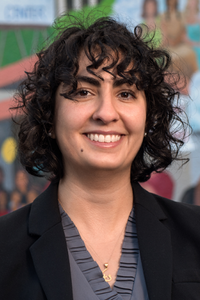
Darya Farivar was born in Seattle, Washington. She earned a high school diploma from Roosevelt High School and a bachelor's degree from the University of Redlands in 2016. Her career experience includes working as a policy director.
Farivar has served with the following organizations:[1]
Washington Coalition for Police Accountability, founding board member
Peyvand Non-Profit, board member
Seattle Women’s Commission, former co-chair
Roosevelt High School Women’s Water Polo, coach
Washington State Special Education Advisory Council, policy chair
PFLAG, volunteer
Lake City Collective, volunteer
- Bachelor's:
- University of Redlands, 2016
- High school:
- Roosevelt High School
Campaign themes
Darya Farivar has not yet completed [the profile publisher]'s 2026 Candidate Connection survey.
Send a message to Darya Farivar asking her to fill out the survey.
If you are Darya Farivar, click here to fill out [the profile publisher]'s 2026 Candidate Connection survey.
Who fills out the candidate survey?
Any candidate running for elected office, at any level, can complete [the profile publisher]'s Candidate Survey. Completing the survey will update the candidate's [the profile publisher] profile, letting voters know who they are and what they stand for. More than 32,000 candidates have taken [the profile publisher]'s candidate survey since we launched it in 2015. Learn more about the survey here.
You can ask Darya Farivar to fill out this survey by using the buttons below or emailing info@daryaforhouse.com.
Darya Farivar did not complete [the profile publisher]'s 2024 Candidate Connection survey.
Who are you? Tell us about yourself.
The 46th District is my home, I've lived here my entire life. In fact, when my parents fled Iran because of the revolution they met at my high school and put down roots in Lake City.
While much of the 46th is quite affluent, there are few places you can go in Lake City without being directly confronted by the housing and behavioral health crisis and seeing neighbors cycle through the criminal legal system. These issues have been core to my role as Public Policy Director at Disability Rights Washington. We need a system that provides help the moment it's needed, not after individuals have fallen through every crack in our systems.
I'm also running because representation matters. As a first-generation Iranian American young woman, I understand the importance of representation and leadership by those most impacted. If I’m elected, I would proudly serve as the youngest to ever serve the district and the first Middle Eastern woman in the Washington State Legislature. We need a representative who has a proven track record of successfully tackling hard issues in Olympia and one who knows what it means to lift every voice.
Please list below 3 key messages of your campaign. What are the main points you want voters to remember about your goals for your time in office?
These systems were not built for underrepresented communities. To achieve equity we must lift every voice. Participation in public policy and government must be accessible to those directly impacted. This is how we create policy that will truly address constituent needs.Our systems wait for individuals to fall through every crack in our social services system before providing help. We need to provide help as soon as its needed. We cannot wait for individuals to experience homelessness or meet the criteria for involuntary treatment before providing meaningful behavioral health and housing supports. We need a full continuum of care.We need to elect individuals who can hit the ground running, know how to succeed in Olympia, and understand how these policies work on the ground. Our legislators are up against some of the biggest challenges of our lifetime, we need to elect individuals who are equipped to take on these challenges and wont waste time.
What areas of public policy are you personally passionate about?
My priority is the intersection of behavioral health, housing and homelessness, and the criminal legal system because these are the issues directly impacting my neighbors and constituents. I live in the Lake City neighborhood, a lower-income community of color, where you can’t go anywhere without being directly confronted by the behavioral health and housing crisis. Over 40% of people experiencing homelessness have a disability, many a behavioral health disability. In Washington State, our lack of a behavioral health system drives people with serious psychiatric disabilities into the revolving door of homelessness, crisis, incarceration, and institutionalization.
Our current system misses the mark because it focuses on providing care only when someone meets criteria for involuntary treatment. This is a fine line to walk, and many tip over this line into the criminal legal system during crisis. Involuntary commitment was designed to be a last resort, not the cornerstone of our behavioral health system yet our current system is centered around it. This is the work I know best as Public Policy Director at Disability Rights Washington and as part of the Trueblood Court Monitor’s Diversion Team. I’ve also overseen 12 different diversion programs across the state which do just this, provide help as soon as help is needed. These programs are doing well enough that they just recently received funding from the state legislature to keep them running. We need more of this.
What characteristics or principles are most important for an elected official?
Yes, absolutely. The legislative process is complex and it takes time to learn it. We need to elect individuals who can hit the ground running to tackle some of the biggest human and civil rights challenges of our lives. They must understand deeply and navigate with agility the power dynamics of the Legislature. There are many unwritten rules of the legislature that legislators and some lobbyists are familiar with, these practices often result in unfair decisions regarding bills and funding. Legislators must be committed to principles and ideas, while staying open to facts and arguments that challenge their beliefs. A legislator must be practical, and be able to get things done. That said, a representative must be tuned to the interests of their district, not just their political party, or the Legislative power structure.
What legacy would you like to leave?
I’d like to leave a legacy of access and leadership by those most impacted. If I’m elected I’d be the first Middle Eastern woman ever elected to the state legislature, I don’t want to be the last. I want to have left the legislature a more equitable and representative place for all underrepresented communities.
What is the first historical event that happened in your lifetime that you remember? How old were you at the time?
The first historical event that happened in my lifetime, that I remember, was 9/11, and I was in first grade. I went to a predominantly white school where I stood out among my peers. This was an unforgettable event for a first-generation Iranian-American girl who was already being bullied. In school I was bullied tremendously for being different, for being brown, for speaking Farsi before English, for bringing different food to school, for having full eyebrows that connect in the middle, and more. We need elected officials who understand this experience, who understand what equity and inclusion look like because they were excluded. We need to elect politicians who have our best interest in mind because our best interest is also their best interest. We need to elect people who are from our underrepresented communities.
What do you perceive to be your state's greatest challenges over the next decade?
The United States’ greatest challenges as a nation over the next decade will be based on the cases recently overturned by the Supreme Court and what they will overturn next. The highest court in the United States just set a dangerous precedent that their rulings can, and will, be overturned. These cases were not decided in one night, these were decades-long battles to earn human rights. We will not go back and we are ready to act locally to preserve these rights.
Tell us your favorite joke.
I can't tell dad jokes, that would be a faux pas!
On the 2026 ballot
Links
- Campaign X(opens in new tab)
- Personal tiktok(opens in new tab)
- Campaign website(opens in new tab)
- Official website(opens in new tab)
- Campaign facebook(opens in new tab)
- Official facebook(opens in new tab)
- Personal facebook(opens in new tab)
- Personal linkedin(opens in new tab)
- Campaign instagram(opens in new tab)
- Personal instagram(opens in new tab)
Compiled from the candidate’s published profile as of September 30, 2026.
Source(opens in new tab)