
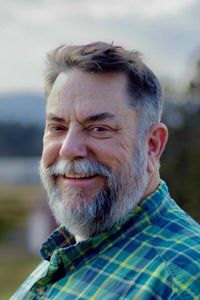
Background
Darren Fix served in the U.S. Navy from 1989 to 1993. His career experience includes working as a computer programmer.[1]
In their own words
Who are you? Tell us about yourself.
I like people. I like helping people. Winning this election will let me help a lot of people at once. I know that sounds corny, but it's true.
I'm Darren Fix, and I'm running for House District 6. I've spent over 30 years as a computer programmer, and the job taught me a habit I bring to everything: dig into a problem until you understand the root cause, work with everyone who's affected until you agree on a real solution, and then build it. My motto at the keyboard has always been: I take your pain, make it mine, then make it go away. You can't solve a problem until you take responsibility for the outcome. That's how I'd serve in Helena.
I'm a U.S. Navy veteran. I've served as a CASA advocate for kids in foster care, volunteered with hospice, and taught kids to code after school. I was born and raised in Texas; I came to Montana in 1999, spent a couple of years in Seattle working at some of the big tech companies, and moved back to Kalispell in 2006 to raise my son. In 2011, my family grew a bit, and now I've raised four kids in the Flathead Valley. This is my home, and I'll fight to keep it The Last Best Place.
Please list below 3 key messages of your campaign. What are the main points you want voters to remember about your goals for your time in office?
Every Montana kid deserves a great public school, taught by great teachers, close to home. I've taught kids to code after school for years, and I've seen what teachers and families are up against. They don't need lectures from politicians or dark money flowing in from out of state to undermine their vocation. They need the resources to do their jobs and the room to do them well. I'll fight to fully fund our public schools, pay teachers what their work is worth, and keep national culture-war fights out of Montana classrooms. The fight here isn't red versus blue. It's whether the next generation of Montana kids gets the start they deserve.Our public lands are Montana's birthright. They're where I take my old dog for a slow walk, where families teach their kids to fish, where elk hunters carry on a tradition older than the state. I'll fight to keep them public, accessible, and well cared for. That means fully funding FWP and DNRC, defending Montana's stream-access law, and opposing every effort to move our public lands out of public hands when the real plan is to sell them off to the highest bidder. This isn't a red or blue issue in Montana. It's a Montana issue. Keep our lands public.My first piece of legislation will ban elected officials from serving as officers of a Political Action Committee (PAC.) You shouldn't get to write the rules and then play by a different set. That's common sense. As a Navy veteran, I swore an oath to the Constitution — and I take it seriously. The same oath that asks elected officials to put the public interest first should be backed by laws that prevent the obvious conflicts. We need leaders who respect the rules, respect the institutions, and respect the voters who hired them. That's not a partisan promise. That's just the job.
What areas of public policy are you personally passionate about?
I'm passionate about public schools that work for every Montana kid - fully funded, taught by teachers who are fairly paid for the critical work they do. About public lands that stay public, in public hands, accessible to neighbors who hunt, fish, and hike them. About a government that follows its own rules: my first bill will ban elected officials from serving as PAC officers. And about a clean energy future built around community solar and local co-ops, not subsidized data centers that shift their grid and water costs onto residential ratepayers. Common sense, applied consistently.
Who do you look up to? Whose example would you like to follow, and why?
When I moved back to Kalispell in 2006 and enrolled my son at St. Matthew's School, I enrolled myself in RCIA at the same time — the Rite of Christian Initiation of Adults. I'd been baptized and raised Catholic but never confirmed as a kid, and it felt like time. The classes were taught by men I'll never forget. One had been a paratrooper and won a boxing title in his 60's. Another was a Navy corpsman who deployed with the Marines before becoming a successful lawyer. The third was our priest — a serious scientist who loved logic as much as his flock. Three fundamentally different men. Each showed me me how to love my neighbor - and that you can be your true self, no matter how rough around the edges, and still be a man of peace, and someone who works to make his neighbors' lives better through a life of service.
That's who I look up to. That's the example I want to follow.
What characteristics or principles are most important for an elected official?
An elected official should dig into a problem until they understand the root cause — then work with everyone affected until there's a real solution everyone can stand behind, then build it. That's how good developers work, and it's how good lawmakers should work too. They should have the integrity to do what they said they'd do, the humility to ask before solving for someone instead of assuming they know best, and a real respect for the oath of office. The job isn't to win arguments. It's to solve problems.
What do you believe are the core responsibilities for someone elected to this office?
The job is to pass laws that make Montanans' lives better, to provide a constitutional check on the executive branch, and to be a clear-eyed steward of the public's money. It also means listening to neighbors back home — the people whose lives your votes touch — and being transparent about how you vote and why. And it means following the same rules you write for everyone else. That's the spirit behind my first bill, the PAC-officer ban: if I expect you to follow the rules, I have to follow them too.
What legacy would you like to leave?
I'd like to be remembered as someone who showed up - for kids in foster care, for families in hospice, for neighbors who needed an effective voice in Helena and didn't have one. If I can leave Montana a little better than I found it, that's enough. And if the PAC-officer ban I plan to introduce is still on the books a generation from now — quietly making sure elected officials follow the same rules they write — that would be the kind of legacy I'd be proud of.
What was your very first job? How long did you have it?
The first money I ever earned was watching neighborhood kids, but I count my first real job as bussing tables at a small hole-in-the-wall catfish restaurant out by Lake Conroe in Texas. I was a kid — too young for a driver's license — so my parents drove me, about ten miles each way, to get to work. I probably only lasted a couple of weeks before my folks got tired of driving me all the way out there. I didn't love bussing tables, but the job taught me to show up on time and to do work I didn't love because I said I would. My next job was working retail at a small, locally owned shop that sold gifts and stationery. None of my early jobs were glamorous — but jobs in customer service rarely are.
What is something that has been a struggle in your life?
As a programmer, I'm hardwired to look for the optimal solution to any problem in front of me. That instinct served me well at the keyboard, but it hasn't always served me well with people. Raising four kids and teaching dozens of others to code and build robotics taught me something important: meeting people where they are, and helping them advance, is fundamentally different from solving their problems for them. Even now, I have to actively resist the pull to fix things for people who can fix them themselves. My workaround is simple — before I jump in, I try to remember to ask: "Can I offer some advice?"
What do you believe is the ideal relationship between the governor and state legislature?
They're co-equal branches by design, and the friction between them isn't a bug — it's the system working. The legislature writes the laws and decides how the state's money is spent. The governor executes those laws and runs the agencies that carry them out. Both answer to Montana voters. Neither branch should be a passive partner — and neither should treat the other as an enemy. The job is to work the issues through, in public, with respect for the office on the other side. When that works, Montana wins.
What do you perceive to be your state's greatest challenges over the next decade?
Four big ones. First, keeping our public lands in public hands — the steady push to transfer federal lands to state control, which is so often the first step toward selling them off, is the threat we have to keep naming and resisting. Second, data centers — these facilities can stress our grid and our water in ways that reach far beyond any one county, and we have to make sure they pay their own way instead of shifting costs onto residential ratepayers. Third, defending Montana's voter-access tradition — same-day registration, mail ballots, the right to vote without unnecessary obstacles. Fourth, public school funding, particularly for rural schools that hold their communities together. If we get these right, we can keep Montana the last best place.
Do you believe that compromise is necessary or desirable for policymaking?
Compromise isn't just necessary in a functioning legislature — it's desirable. Lasting solutions to hard problems almost always come from sitting at a table with people of good faith who see things differently and working until you've built something that holds up. That's how I worked as a programmer for 30+ years, and that's how I'd work in Helena. There is one important caveat: compromising on tactics is part of the job, but compromising on principle isn't. The oath of office isn't negotiable. Neither is the rule of law. But on almost everything else — funding levels, program design, timelines — there's room to find common ground, and there's a duty to look for it.
What organizations or individuals have endorsed your campaign?
Montana Federation of Public Employees (MFPE) PAC.
What was the first historical event that happened in your lifetime that you remember?
A memory from the news that stuck with me since I was a kid: I was watching TV with my folks back in Texas, sometime in the late 1970s or early 1980s, when a story came on about the Ku Klux Klan attacking Vietnamese shrimpers in the bays near NASA's Johnson Space Center, not far from where we lived. The shrimpers were refugees. They had been our allies in Vietnam — they had fought alongside us, risked everything for us, and after the war was lost they fled to America. And now armed Klansmen were patrolling the bay in boats, firing on them, trying to drive them off the water. I was a kid. I remember how surreal it was. How wrong.
That kind of racism, violence, and brutality wasn't shocking where I grew up — it was treated as normal, or at least not surprising. The subdivision I grew up in had its streets named after Confederate generals, the so-called heroes of a lost cause. The reverence in the street signs and the brutality on the water were part of the same fabric.
That memory is part of why I serve. You can't have rule of law when armed men get to terrorize their neighbors and call it patriotism. Some things have to be said out loud.
On the 2026 ballot
Links
Compiled from the candidate’s published profile as of September 30, 2026.
Source(opens in new tab)