
Background
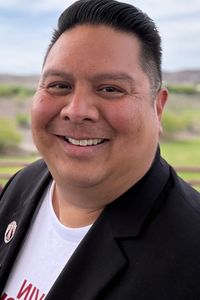
Calvin Sandoval earned a high school diploma from Cimarron-Memorial High School. His career experience includes working as a plumber.[1]
- High school:
- Cimarron-Memorial High School
In their own words
Who are you? Tell us about yourself.
I’m Calvin Sandoval. I grew up in Las Vegas and have spent more than two decades helping build the community I call home. As a plumber and pipefitter, I worked at the Nevada Test Site and helped build major Las Vegas Strip properties, including Wynn and Palazzo. I did not just watch Southern Nevada grow. I had a hand in building it.
I’m a husband, father, third generation union member, and an enrolled member of the Omaha Tribe of Nebraska. My family, my Native heritage, and a lifetime in the trades taught me to work hard, keep my word, listen to people, and respect an honest day’s work.
Years of representing workers also taught me that leadership is not about being the loudest person in the room or always picking a side. It is about listening, negotiating, understanding different perspectives, and solving problems.
I respect anyone who gets up in the morning, goes to work, provides for their family, and contributes to their community, regardless of whether they have representation or not. My days still start around 4 in the morning and often do not end until 6 at night.
I’m not a career politician. I’m a tradesman, husband, father, and Nevadan who believes in showing up and doing the work. I’m also proud to be seeking the opportunity to become Nevada’s first Indigenous state senator.
Please list below 3 key messages of your campaign. What are the main points you want voters to remember about your goals for your time in office?
I come from the trades, and that experience has shown me how laws and regulations affect people in the real world. I have spent more than two decades working on major projects, at the Nevada Test Site, and alongside workers, contractors, and management. I have also seen firsthand how systems like workers’ compensation can become overly complicated and fail the people they are supposed to protect.
That experience has taught me that good laws need to be clear, practical, and structured around how people actually work and live. I believe we should fix what is broken, simplify what does not make sense, and make sure the law works the way it was intended.I use independent judgment and practical leadership. I do not take a position just because a party, special interest, or political label says I should. I look at the issue, listen to the people affected, weigh the facts, and make the decision I believe is right for Nevada. I will work with anyone when there is common ground, and I am willing to disagree with my own side when I think they are wrong.I come from the trades, and that experience has shown me how laws and regulations affect people in the real world. I have spent more than two decades working on major projects, at the Nevada Test Site, and alongside workers, contractors, and management. I have also seen firsthand how systems like workers’ compensation can become overly complicated and fail the people they are supposed to protect.
That experience has taught me that good laws need to be clear, practical, and structured around how people actually work and live. I believe we should fix what is broken, simplify what does not make sense, and make sure the law works the way it was intended.
What areas of public policy are you personally passionate about?
I am most passionate about policies that affect working families in their everyday lives. That includes workers’ compensation reform, fair labor standards, workforce training, infrastructure, and making sure laws are written clearly and work the way they are intended. I also care deeply about healthcare access, mental health, affordable housing, and helping families navigate government systems without unnecessary barriers. As an enrolled member of the Omaha Tribe, I am also committed to Indigenous issues, tribal sovereignty, protecting sacred places, and making sure Native communities have a voice in state government. Across all of these areas, I believe policy should be practical, accountable, and built around real world experience.
Who do you look up to? Whose example would you like to follow, and why?
I look up first to my family. My grandfather and stepdad taught me the dignity of hard work, the value of a good wage, and what it means to provide for your family. My grandmother taught me to be unapologetically authentic and true to who I am. My mother showed me what sacrifice looks like and how much strength it takes to put family first.
Politically, I admire John F. Kennedy for his belief in service, opportunity, and personal responsibility. I also respect John McCain for his independence, his willingness to work across party lines, and his refusal to be boxed in by his own party.
What characteristics or principles are most important for an elected official?
Integrity, transparency, and communication are the most important qualities I look for in an elected official. Integrity means doing what you say you are going to do, even when it is difficult. Transparency means being honest with people about decisions, challenges, and how government is operating. Communication means listening as much as speaking, staying accessible, and making sure people understand what is happening and why.
I also believe elected officials need the courage to call out nonsense when something is being mishandled. Public service is not about protecting egos or pretending everything is fine. It is about being honest, fixing problems, and earning the public’s trust.
What do you believe are the core responsibilities for someone elected to this office?
First and foremost is representation. The people who elect you have to come before politics, party, or personal interests. Second, I believe you have to treat public service like a job. Show up, do the work, stay accessible, and be accountable for the results.
I also believe most problems can be worked through when people are willing to communicate and actually listen to one another. You may not always agree, but you should understand the problem before trying to solve it. An elected official’s responsibility is to listen to their constituents, communicate honestly, and make sure the people they represent always have a voice at the table.
What legacy would you like to leave?
As meaningful as it would be to become Nevada’s first Indigenous state senator, I would want my legacy to be much simpler than that. I would want people to say I showed up, did the work, represented them honestly, and always gave them my best.
I believe compromise is sometimes necessary to get things done, but transparency should never be optional. That applies not only to me, but to every elected official. Voters deserve to know where their representatives stand, why decisions are being made, and when something is being mishandled.
Public office belongs to the people, not the person holding it. I want to be remembered as someone who stayed accountable, spoke plainly, and never forgot who I worked for.
What was your very first job? How long did you have it?
My first job was in retail at 16 years old while I was also playing sports in high school. I stayed in that job through my second year of college, so it became an important part of how I learned to work with people.
What stuck with me most was learning how to help someone solve a problem. Sometimes the issue seemed small, but to the person standing in front of me, it mattered. That taught me not to dismiss people’s concerns just because they may not seem important to someone else.
Balancing work, school, and sports also taught me responsibility, time management, and how to show up consistently. More than anything, that first job taught me that helping people starts with listening.
What is something that has been a struggle in your life?
One of the biggest struggles in my life has been learning how to be the best husband and father I can be. I have made mistakes, gone through the end of a marriage, and had to learn some lessons the hard way.
What that taught me is that being there for your family takes more than providing financially. It takes patience, communication, humility, and being willing to admit when you are wrong and do better.
I still work at that every day. I do not think being a good husband or father is something you ever completely master. It is something you have to keep showing up for, learning from, and putting effort into.
What do you believe is the ideal relationship between the governor and state legislature?
I believe the governor and the Legislature should be able to work together regardless of party. I believe in Nevada first policies, and our responsibility should always be to the people who live, work, raise families, and build businesses here.
There will be disagreements, and that is healthy. Even if one party holds a supermajority, that should not replace communication or compromise. A supermajority should not be a license to ignore the other side, just as the veto should not become a substitute for working through disagreements.
The governor and Legislature should communicate early, improve legislation where possible, and use the tools given to each branch responsibly. At the end of the day, the question should not be which party won. It should be whether Nevada got a better result.
What do you perceive to be your state's greatest challenges over the next decade?
I think Nevada’s biggest challenge over the next decade is whether we can keep growing without pricing people out or breaking the systems we depend on. Water, power, roads, schools, housing, and healthcare all have to keep up.
We also cannot keep depending so heavily on tourism and gaming. I understand that personally. During the 2008 recession, I was out of work for more than a year and a half between 2009 and 2010. When one part of Nevada’s economy gets hit, working families feel it fast.
That is why I believe we need more manufacturing, skilled trades, logistics, technology, and other industries that create stable, good paying jobs. We need to plan ahead instead of waiting for the next crisis to force us to act.
Do you believe that compromise is necessary or desirable for policymaking?
Yes, I believe compromise is necessary in policymaking. Very few problems are solved when everyone refuses to move. I believe in listening to all sides, understanding what people actually need, and finding common ground where possible.
At the same time, compromise should not mean abandoning your principles or supporting a bad idea just because your party wants it. I am willing to support a good idea regardless of who brings it forward, and I am willing to disagree with my own side when I believe they are wrong.
To me, compromise works when it moves Nevada forward, protects the people you represent, and produces a better result than simply digging in and doing nothing.
What organizations or individuals have endorsed your campaign?
Nevada AFL CIO, Southern Nevada Central Labor Council / AFL CIO CLC, UA Local 525, SMART Local 88, UAW Region 6, IATSE Local 720, SEIU Local 1107, IUOE Local 12, OPCMIA Local 797, Communications Workers of America, Native Voters Alliance, Omaha Tribe of Nebraska. Upcoming Culinary Workers and IBEW 357
What was the first historical event that happened in your lifetime that you remember?
The first major historical event I remember is the Space Shuttle Challenger disaster in 1986. I was very young, but I remember being at school and seeing the reaction around me when the shuttle exploded. It was one of those moments where even as a child, you could tell something serious had happened.
What stayed with me was not just the event itself, but how everyone around me responded to it. It is probably the first time I remember seeing a national tragedy unfold in real time and understanding that something happening far away could affect everyone around you.
On the 2026 ballot
Links
Compiled from the candidate’s published profile as of September 30, 2026.
Source(opens in new tab)