
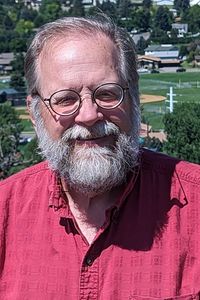
Background
Brian Close was born in Highland Park, Illinois. He earned a bachelor's degree from the University of Chicago in 1981, a graduate degree in tax law from New York University Law School in 1988, and a graduate degree in history from Montana State University in 2001. His career experience includes working as a tax attorney. Close has served on the GALAVAN Board, the Bozeman City Study Commission, and the Bozeman Park & Recreation Board. He received an Intellectual Freedom Award from the Montana Library Association.[1]
- Graduate:
- New York University Law School, 1988
- Bachelor's:
- University of Chicago, 1981
Campaign themes
Brian Close has not yet completed [the profile publisher]'s 2026 Candidate Connection survey.
If you are Brian Close, click here to fill out [the profile publisher]'s 2026 Candidate Connection survey.
Who fills out the candidate survey?
Any candidate running for elected office, at any level, can complete [the profile publisher]'s Candidate Survey. Completing the survey will update the candidate's [the profile publisher] profile, letting voters know who they are and what they stand for. More than 32,000 candidates have taken [the profile publisher]'s candidate survey since we launched it in 2015. Learn more about the survey here.
Help improve [the profile publisher] - send us candidate contact info.
Who are you? Tell us about yourself.
My efforts in the Bozeman community have measurably improved public transportation, public health, good government, and public recreation.
Arriving in Bozeman in 1994 I joined the paratransit GALAVAN Board. I pushed through a senior transportation levy to ensure GALAVAN's continued service to seniors. I then was chair of Galavan from 1999 to 2003.
I then chaired a city task force that led to the creation of public transit in Bozeman.
I was a leader in the movement to make bars and restaurants smoke-free. The city commission adopted my strategy to make that happen.
In 2004 I was elected to the Bozeman City Study Commission. The result was the first successful city charter that passed in 2006. I fought for the charter provisions requiring that there be an ethics board and that everyone in city government receive annual ethics training.
As a member of the city planning board, I wrote the first light pollution ordinance adopted by a city in Montana.
I received an Intellectual Freedom Award from the Montana Library Association.
As Chairman of the Bozeman Park & Recreation Board, I led the effort to create the Bozeman Park District.
I attended the University of Chicago, received my Master in Tax Law from New York University, and a Master in History from Montana State University. I have been a practicing tax attorney 1987. I live in a union household with my lovely librarian wife, Beth Boyson, and my trusty dog, Sam.
Please list below 3 key messages of your campaign. What are the main points you want voters to remember about your goals for your time in office?
Everyone has the right to their individual dignity. I support the LGBTQ+ community in their struggle for respect and dignity and have been serving the LGBTQ+ as an attorney since moving here in 1994. I will oppose any legislation that attacks people based on who they are, who they love, or what they believe.
I support Reproductive Freedom, the Right to Privacy, and Personal Autonomy.I support the bill to provide home care for seniors that the governor vetoed. Seniors should have the dignity to stay in their homes.
We need stronger financial protections so that Seniors will not be exploited. In particular, we need to revise our laws on Guardians and Conservators so that they are properly trained, licensed, and audited.
I support the proposal of democratic leadership to give an income tax credit to seniors and other fixed-income individuals to offset property tax increases.Our teachers need our support, not threats or censorship!
Our children are our future, and our schools should be fully funded and free from outside interference and bigotry.
We need to protect the independence of our universities from any attempt to encroach on their rights.
What areas of public policy are you personally passionate about?
Tax planning, education,local government operations, and protecting seniors
Is there a book, essay, film, or something else you would recommend to someone who wants to understand your political philosophy?
De Officiis, by Cicero
What characteristics or principles are most important for an elected official?
An elected official must genuinely represent the interest of his or her constituents and use his or her expertise to advance their agenda. Sometimes this means staking out a position and hanging tough. Sometimes this means compromsiing, even with the opposition. Sometimes this means filling the hearing room with angry citizens to apply maximum pressure. Sometimes this means a quiet word in a side alcove. The trick is to know when to apply each tactic.
In doing so, the elected official must never lose sight that the goal is to serve the interests of the constituents (even above that of the elected official)
What qualities do you possess that you believe would make you a successful officeholder?
Determination, intelligence, integrity and trustworthiness. A capacity to develop different strategies depending upon the situation. Looking at the long game as well as the immediate issue,
What do you believe are the core responsibilities for someone elected to this office?
First, to be fully versed in the major issues that will come before the legislature in the next 90 day session.
Second, to communicate with constituents and to address their issues and individual concerns.
Third, to create a legislative agenda that can pass. Which means reaching out to opposition law makers when necessary, reaching out to affected interests for areas of potential compromise, lining up testimony, and relying on outside expertise. Every piece of legislation must have a legislative strategy for passage.
What legacy would you like to leave?
A more rational tax system; effective workforce housing; and better protected seniors and others needing protection
What is the first historical event that happened in your lifetime that you remember? How old were you at the time?
The assasination of JFK on the day after my 5th birthday
What was your very first job? How long did you have it?
Cashier, 2 years
If you could be any fictional character, who would you want to be?
Captain Nemo
What is something that has been a struggle in your life?
Patience.
What do you believe is the ideal relationship between the governor and state legislature?
A governor who vetos a bill is a failure. The Governor must be involved during the legislative process so that bill issues can be addressed so he does not need to exercise his veto. Of course, this is part and parcel of the failure of the Gianforte adminstration on every issue he has touched, be it medicaid, property taxes, mental health, state hospital, etc.
What do you perceive to be your state's greatest challenges over the next decade?
Affordable housing; supporting schools; aging population demographics. These are all interelated moving parts. Fixing this will be like fixing a moving car. We need government intervention in workforce housing; we need new sources of revenue to address underfunded schools and underpaid teachers; and we need to address the issues facing the increasing senior population.
Do you believe that it’s beneficial for state legislators to have previous experience in government or politics?
Definitely. "Mr Smith Goes to Washington" is a movie, not real life. Working with complex issues in a group setting on any level of government is good preparaton for the legislature (or so I hope).
Do you believe it’s beneficial to build relationships with other legislators? Please explain your answer.
One's word must be trusted, even when there are serious ideological differences. Much can be accomplished if there is trust and mutual respect within a caucus and with the opposition. Never leave someone to hang out to dry, tempting as it may be.
Is there a particular legislator, past or present, whom you want to model yourself after?
Mike Wheat, who succeeded in revamping the entire public defender system of this state while serving in the minority.
Are you interested in running for a different political office (for example, the U.S. Congress or governor) in the future?
Perhaps the State Senate.
Both sitting legislators and candidates for office hear many personal stories from the residents of their district. Is there a story that you’ve heard that you found particularly touching, memorable, or impactful?
Literally, the first door I knocked on held a widow on fixed income who was considering selling her house because her property taxes had been doubled by the Repulican party.
Should the legislature oversee or grant the use of emergency powers?
This is a consttitutional issue I need to examine. I am sure procedures are in place, constittutionally or by legislation, as we only meet every two years for 90 days.
What is the first bill you would introduce if elected?
Revising the laws pertaining to Guaridans & Conservators. The current system was deisigned in the 19th century and is not protecting the interests of people who need protection.
What committees interest you?
Taxation, local government, Housing
What are your views on financial transparency and government accountability?
All too often legislators are voting on their own interests with minimum or non-existent disclosure requirements and no mandatory recusals. We are doing an awful issue on policing this.
Open government laws need to be updated in Montana in recogniton of the electronic age
Do you support or oppose changes to the current state ballot initiative process? If so, what kind of changes would you consider?
I support one person one vote, including for signature gatehring. Anything that deviates from that for the petition process betrays that fundamental principle of democrary. I will oppose any further restrictions on Montana's initiaive process and will support any measure that leads to more democracy.
Brian Close did not complete [the profile publisher]'s 2020 Candidate Connection survey.
On the 2026 ballot
Links
Compiled from the candidate’s published profile as of September 30, 2026.
Source(opens in new tab)