
Background
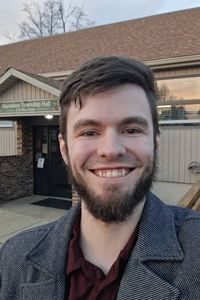
Brendan Johnson earned a high school diploma from the Great Lakes Bay Early College and an associate degree from Delta College in 2019. His career experience includes working as an IT professional.[1]
- Associates:
- Delta College, 2019
- High school:
- Great Lakes Bay Early College
In their own words
Who are you? Tell us about yourself.
I’m a 29-year-old who grew up on my family’s dairy farm in Fostoria, right on the Tuscola-Lapeer county border. I went to Mayville Public Schools for elementary, St. Paul Lutheran in Millington from 5th through 8th grade, Great Lakes Bay Early College for high school, and graduated from Delta College in 2019 with my associate degree in computer programming. I now live near Bridgeport in Saginaw County with my fiancée. Just a grassroots campaign built on showing up, listening, and doing right.
I come from an IT background where you understand how the whole system operates before making changes. That’s how I plan to approach every issue: understand how the system actually works and how to improve it best before proposing specific fixes. That's part of why I was happy to volunteer for Voters Not Politicians in 2017-18 to help end gerrymandering in Michigan.
My dad is a retired third-generation Michigan union member and commercial carpenter. He taught me how to work with my hands, how to see a problem, and how to not quit until it’s fixed. I’ve worked as a grocery bagger, an IT technician, a construction laborer, and a chauffeur. At every job, I’d finish my work properly and start looking for what else needed doing.
When I looked at this district and what people here actually need from their senator, it felt like I’d finally found the right place for that energy and determination. Long shots are how 29-year-olds from dairy farms in Fostoria change things!
Please list below 3 key messages of your campaign. What are the main points you want voters to remember about your goals for your time in office?
Before I ever set foot in Lansing, I’m attending township, city, and village meetings across all four counties of District 26. This isn’t a campaign stunt — it’s how I believe the job should start. If you’re going to represent people, you need to actually listen to them all first. Constituent services is the foundation of this office. When someone in District 26 calls, they will get answers. When there’s a problem, I’ll work at it until it’s solved right.
This district deserves a senator who’ll listen to everyone here, who understands what it’s actually like to live here, and who treats the job as a proper public service — not just a stepping stone.Michigan has some of the highest car insurance rates in the nation, and too many drivers in our district are paying way more than they should. I’ll push for proper car insurance reform, giving real authority to the Insurance Commissioner to hold companies accountable, and work to seriously address the territorial rating practices that punish people for just living in certain areas.
On healthcare, many Michiganders rely on the Healthy Michigan Plan. I’ll fight to protect it, strengthen it, and strongly oppose cuts that would strip coverage from working families or put rural hospitals at risk.
These aren’t partisan issues — they affect everybody here, and they deserve someone willing to fight for what’s right.Our schools shouldn’t have their entire year’s funding depend on a single count day. Michigan’s count-day system creates perverse incentives that distract from teaching. I’ll work to make school funding stable, predictable, and fair.
Our local roads also need real investments — bad roads cost drivers money and hold our communities back from attracting employers. And our workforce pipeline needs to connect residents with in-demand skills.
My dad built his career in the skilled trades, and that kind of steady work with good benefits is what too many people here can’t find close to home anymore. I want to fix all that.
What areas of public policy are you personally passionate about?
Constituent services! The part I most look forward to about this job is helping people with the state government whenever they need it. Helping people has always been my favorite part of any job.
Beyond that, I’m most passionate about car insurance and healthcare costs and school funding reform. I’ve dealt with insurance companies that don’t treat you fairly after any claim is made. I watched Mayville High School nearly close due to funding shortfalls.
These aren’t abstract policy topics for me, I've personally lived through them.
Who do you look up to? Whose example would you like to follow, and why?
My dad. Third-generation Michigan union member and retired commercial carpenter. He taught me how to work hard, fix things properly, and treat everyone fairly. He never cut corners and never complained about putting in an absurd amount of work to provide for us. That’s the kind of standard I hold myself to.
Beyond family, I also admire anyone who I spot quietly doing the right thing when they think nobody’s watching — the township clerk who stays late, the teacher buying supplies out of pocket, the person cleaning up their street voluntarily. Those people hold communities together and make them a place worth living.
What characteristics or principles are most important for an elected official?
Honesty, integrity, and humility. Actually following through — political campaign promises have literally become a national joke. I’d much rather under-promise and over-deliver.
Showing up reliably, not just during election season. Admitting when you don’t know something, and knowing how to research it later. Telling the truth even when it’s inconvenient.
Lastly, it’s vital to remember the job is a public service, not some personal achievement. The moment you start believing that it’s about you instead, you’ve lost what it takes to be a good public servant.
What do you believe are the core responsibilities for someone elected to this office?
Constituent services, first and foremost. A state senator’s most critical job is helping all of the people they’re elected to represent, not just who voted or supported them — answering the phone, cutting through red tape, and being a real resource when someone needs help with the state government.
Beyond that, representing the actual interests of your district in Lansing — not the other way around. That means attending local meetings, staying connected to what’s actually happening in the communities you serve, and voting based on what’s truly right for the people back home. Not just voting with the people with the same party or beliefs as you.
What legacy would you like to leave?
That I did what I said I was going to do, I didn’t compromise on my personal integrity, and that people can see in hindsight how God guided me in all that I do. I don’t want a bench or building named after me. I want people in this district to be able to say they had a senator who genuinely treated the job as a public service — answered the phone, attended the meetings, fought hard for their best interests, and was honest even when the answer wasn’t what they were hoping to hear.
What was your very first job? How long did you have it?
Grocery bagger, or courtesy clerk, at the Kroger in Essexville. I was a bagger for 3 months before I was promoted to cashier.
It taught me how to interact with all kinds of different people, how to best prioritize different tasks, and how to take pride in doing a simple job properly. Every task matters because they all add up to something important in the end, even when not everyone notices the small things.
What is something that has been a struggle in your life?
Finding the right fit for my skills and energy. I have a degree in computer programming, but good tech jobs in this area are hard to come by, as some of you may know. I’ve worked many jobs that didn’t even come close to fully using what I’m capable of, and I know a lot of people in this district feel the exact same way. Qualified for more than what’s available close to home. That’s part of what drives me to improve our workforce development.
To be honest, an on-and-off struggle has been financially. I know what it’s like to be giving it everything that you’ve got, and still only being able to barely survive, let alone thrive. At one point while I was going to Delta College, I was working 3 part-time jobs simultaneously while also being a full-time student. God blessed me with always having exactly what I needed at the time to keep going in my life, but it’s absolutely not been easy to do what I needed to do. I drive a 2006 manual transmission Corolla with over 265,000 miles — I do the maintenance myself because I want it done right and it’s cheaper this way.
What do you believe is the ideal relationship between the governor and state legislature?
Respectful, collaborative, and independent.
The legislature should work to represent the people in their districts — not to rubber-stamp the governor’s agenda or obstruct it on principle. Both branches should communicate honestly, negotiate in good faith, and push back on each other when the people they’re serving would benefit from something different. Voters are tired of watching the governor and legislature fight for the sake of fighting or passing legislation through without proper deliberation. They want real results that make things better for them and their neighbors.
What do you perceive to be your state's greatest challenges over the next decade?
Affordability, infrastructure, and the workforce.
Far too many people in Michigan are working at least 1 full-time job or 2 part-time jobs, yet still struggling to pay for their car insurance, healthcare, and housing, let alone save for their future. At the same time, employers can’t even fill specific positions while workers can’t find good jobs close to home. The pipeline between training, or retraining, and employment needs to be stronger and more accessible, especially for people without a four-year degree.
Infrastructure is another challenge — not just roads, but all the kinds of investments that make communities attractive to both employers and families. If a town can’t even maintain its roads and water systems, it can’t attract the growth it needs to thrive.
And all of this ties back to education. If we don’t fund our schools in a way that’s stable and fair, we’re undercutting the next generation’s ability to provide for themselves properly when they’re older.
Do you believe that compromise is necessary or desirable for policymaking?
Absolutely. You can’t serve a district spanning four counties with very different communities without being willing to work with multiple different viewpoints.
Compromise doesn’t mean giving up what you believe in — it means being honest about what’s achievable and finding the best version of a solution that actually helps the most people. I’d rather work to pass a good bill that solves at least 80% of a real problem within a few years than hold out for a “perfect” bill that takes years just to write, let alone pass.
That said, I will never compromise on my integrity, honesty, or determination to do right for the people I’m running to represent.
What was the first historical event that happened in your lifetime that you remember?
The 2000 presidential election. I was only three years old, but I remember seeing magazines everywhere with names I didn't recognize.
I kept seeing the names "Bush" and "Gore" all over and couldn't figure out what was happening — I just knew "Gore" sounded kind of gross. So I asked my parents, and they explained that the country was trying to choose the next president. That was the beginning of a lifelong interest in politics, even before I knew the word for it.
My parents did a great job of keeping me engaged and discussing issues as I grew up, even when I didn't have a voice with my vote yet.
On the 2026 ballot
Links
Compiled from the candidate’s published profile as of September 30, 2026.
Source(opens in new tab)