
Background
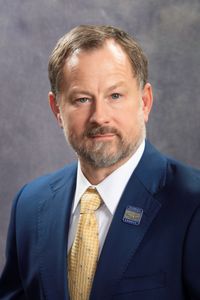
Brad Barker was born in Altus, Oklahoma. Barker served in the United States Army from 1994 to 2014. He earned a bachelor's degree from the United States Military Academy at West Point in 1994, a graduate degree from Georgetown University in 2004, and a graduate degree from the United States Marine Corps University in 2006. Barker's career experience includes being a business owner.[1]
- Graduate:
- Marine Corps University, 2006
- Bachelor's:
- U.S. Military Academy at West Point, 1994
Campaign themes
Brad Barker has not yet completed [the profile publisher]'s 2026 Candidate Connection survey.
If you are Brad Barker, click here to fill out [the profile publisher]'s 2026 Candidate Connection survey.
Who fills out the candidate survey?
Any candidate running for elected office, at any level, can complete [the profile publisher]'s Candidate Survey. Completing the survey will update the candidate's [the profile publisher] profile, letting voters know who they are and what they stand for. More than 32,000 candidates have taken [the profile publisher]'s candidate survey since we launched it in 2015. Learn more about the survey here.
Help improve [the profile publisher] - send us candidate contact info.
Brad Barker did not complete [the profile publisher]'s 2024 Candidate Connection survey.
Who are you? Tell us about yourself.
Grounded by a ranch upbringing, I have over 28 years of combined public service as an Army Aviator and Commander in combat, School District Administrator and School District Trustee to defend the Constitution and provide quality education for all of our kids. Having served around the world in countries both rich and poor, stable and wrecked by conflict, I know that we are extremely blessed. Montanans have the resources, ingenuity, work ethic and grit to conquer any challenge put before us if we work together, without arbitrary government constraints, and honor the institutions and traditions that got us here. I prefer to solve problems rather than throw rocks.
Please list below 3 key messages of your campaign. What are the main points you want voters to remember about your goals for your time in office?
Improve regulatory framework & transparency in the energy & housing permit approval process to increase free market supply.Address teacher shortages and increase career and technical education opportunities to improve outcomes for all students.Continue to improve voter registration & voting systems to ensure integrity while acknowledging that there is no evidence of significant election fraud in Montana.
What areas of public policy are you personally passionate about?
Infrastructure (Energy, Housing, Ag)
- Energy, housing & food are vital to our security & the most significant drivers of inflation.
- Improve regulatory framework & transparency in the energy & housing permit approval process to increase free market supply.
- Protect water rights & streamline the waterway improvement process to reduce the risk of flooding.
- Ensure abundant, affordable & reliable energy by all means - natural gas, clean coal, renewables & safe nuclear power.
Education (Teacher Shortages, CTE, Maintain Parental Rights)
- Increase career & technical education (CTE) opportunities & the public-private partnerships that support them with an emphasis on the construction trades & healthcare to improve outcomes after graduation for all students.
- Pursue initiatives to better attract, retain, compensate & train teachers to address shortages while remaining budget neutral.
- Maintain parental rights with increased curriculum transparency & focus on academics instead of partisan issues.
Trust in Government (Transparency, Accountability, Integrity)
- Continue to improve voter registration & voting systems to ensure integrity while acknowledging that there is no evidence of significant election fraud in Montana.
- Improve the accuracy of voter registration lists with measures like comparing to SSN death record & ensuring registrants are citizens.
- Restore trust in our institutions & elections by addressing both fraud & unsubstantiated allegations.
Who do you look up to? Whose example would you like to follow, and why?
Ronald Reagan. He recognized America as a "shining city upon a hill" because of how blessed we are, inspired confidence in our future despite the challenges that we faced and promoted peace through strength.
What characteristics or principles are most important for an elected official?
Integrity, Sense of Duty & Thick Skin
What qualities do you possess that you believe would make you a successful officeholder?
My experience is based on a lifetime of service committed to protecting and defending the Constitution to support the best interests of all Americans and the future of our kids.
What do you believe are the core responsibilities for someone elected to this office?
Represent the interest of constituents within the framework of the US and State Constitutions without purposely pushing the "Easy Buttons" of hate, fear and resentment to get support and votes. Elected officials should truly lead by speaking truth even when not popular and be willing to accept the results.
What legacy would you like to leave?
Policy that serves the best interest of all Montanans.
What is the first historical event that happened in your lifetime that you remember? How old were you at the time?
I most clearly remember President Reagan being shot in 1981 when I was 9 and the gas prices and inflation of the late 70s and early 80s.
What was your very first job? How long did you have it?
Worked for my Dad at his large animal veterinary practice, farming and ranching.
What is something that has been a struggle in your life?
Commanding in combat in Afghanistan is the most challenging thing I've done.
What do you believe is the ideal relationship between the governor and state legislature?
A collaborative relationship of mutual respect to meet the needs of constituents.
What do you perceive to be your state's greatest challenges over the next decade?
Education is one of the most important things that we do as a society. Preserving our freedoms and prosperity requires a populace educated enough to think and act on their own. We must improve the quality and agility of education.
What are the benefits and drawbacks of a unicameral state legislature, in your opinion?
Legislatures are and should be the most powerful and diffuse branch of state governments. A unicameral legislature has the potential to be more efficient with the risk of more narrowly concentrating power that strong personalities could potentially take advantage of to pursue an agenda that does not represent citizens. I favor keeping that power divided with bicameral legislatures.
Do you believe that it’s beneficial for state legislators to have previous experience in government or politics?
It is beneficial to have legislators from a multitude of backgrounds, experiences and perspectives.
Do you believe it’s beneficial to build relationships with other legislators? Please explain your answer.
Yes. That's how it works.
What process do you favor for redistricting?
Stick as closely as possible to existing boundaries i.e. towns, counties, etc. rather than gerrymandering based on other factors. Gerrymandering increases divisiveness and tribalism.
If you are not a current legislator, are there certain committees that you would want to be a part of?
Appropriations; Energy, Technology and Federal Relations; Education
Tell us your favorite joke.
What three things do you never want to hear in Army Aviation? A Second Lieutenant say, "Based on my experience"; a Commander say, "I've been thinking and come to a decision"; or, a Warrant Officer say, "Hey, watch this S#!&".
Should the legislature oversee or grant the use of emergency powers?
It depends. At the Federal level, we have seen what happened in the aftermath of Hurricane Katrina when restrictions imposed by posse comitatus and politics kept Federal troops from being able to respond to support the citizens of Louisiana. As representatives of their constituents, only legislatures should be able to grant the use of emergency powers that potentially infringe on the natural rights of citizens while they are still capable of making decisions and caring for themselves. Conversely, legislatures should oversee standing authorities for the use of emergency powers for catastrophes, specifically identified, where citizens cannot take care of themselves without assistance. For example, a governor should be able to immediately respond to a natural disaster with oversight but not be able to shut down businesses due to a pandemic without a grant from the legislature.
Do you believe that compromise is necessary or desirable for policymaking?
Yes. Our democratic form of government as a Constitutional Federal Republic requires achieving consensus to overcome hurdles imposed by the separation of power among branches and level of government. Winner take all approaches to policy, if successful at all, achieve short-term results, inspire resentment, increase inefficiencies in governance, whiplash citizens and last about as long as a politician patting themselves on the back. The clash of ideas and debate has made us great. Accumulation of power at the Federal level makes compromise more difficult and eliminates the opportunity for States and municipalities to be laboratories of democracy where policy initiatives can be vetted in reality at lower cost.
On the 2026 ballot
Links
Compiled from the candidate’s published profile as of September 30, 2026.
Source(opens in new tab)