
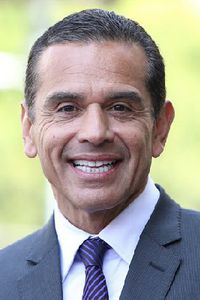
Background
Email editor@[the profile publisher].org to notify us of updates to this biography.
A graduate of the University of California at Los Angeles and People's College of Law, Villaraigosa worked as a union organizer after his graduation, working with the Service Employees International Union and United Teachers Los Angeles and serving as president of the American Federation of Government Employees and the Southern California chapter of the American Civil Liberties Union. Villaraigosa was elected to the California State Assembly in 1994 and as the Speaker of the Assembly in 1997. He also worked in Los Angeles municipal government, winning election to the city council in 2003 and as mayor in 2005.[1]
Campaign themes
Antonio Villaraigosa did not complete [the profile publisher]'s 2026 Candidate Connection survey.
blockquote{border-left:none !important;padding-left:2em;position:relative;color:#444;font-family:"Libre Franklin",Helvetica,Arial,sans-serif;font-size:16px;color:#202122;font-style:normal;}blockquote::before{content:open-quote;font-size:3em;line-height:0.1em;position:absolute;left:-10px;top:40px;color:#ccc}blockquote::after{content:close-quote;font-size:3em;line-height:0.1em;position:absolute;right:0;bottom:0;color:#ccc}
Campaign websiteVillaraigosa's campaign website stated the following:IssuesA Thriving California Starts with AffordabilityCalifornia is the state where anything is possible with hard work and determination. But our future depends on our willingness to face our biggest challenges – skyrocketing housing and living costs, homelessness, climate change, and keeping good jobs in California.In 2023, we had a net loss of over 268,000 residents . They left because things in California got too hard – and too expensive. California has the fourth highest cost of living in the United States and the second highest typical home value. Single-family homes in California are 216% more expensive than the rest of the United States, and the average rent in California is $2,795 per month. Now, we have the added burden of an unpredictable federal government slashing funding, cutting jobs, and engaging in trade wars that are already destabilizing the economy.We have serious problems and need to focus on real solutions. The state needs to stop throwing money at problems and expecting a different result. Instead, we need to fix what’s broken, find new solutions, and only invest in what works.Stand up to Donald TrumpAntonio Villaraigosa has never been afraid to stand up to bullies, and that includes Donald Trump. While Trump sows division and fear, Antonio has always fought to bring people together, to protect our communities, and to ensure every voice is heard. As Mayor and Speaker, he took on powerful special interests to deliver results for working families, and he’ll bring that same courage to standing up to Trump’s extreme MAGA agenda. Antonio knows our values are on the line and will stand up to defend our democracy, protect immigrant communities, and ensure fairness for every Californian. He’s ready to fight back with the strength, integrity, and leadership this moment demands.We Need to Build AgainTo make California affordable again, we need to start building again. Yes, we need to fast track new home construction, but we also need to jumpstart building up our energy grid, water storage, and transportation infrastructure. Building increases supply and capacity, and will create hundreds of thousands of good-paying, middle-class jobs.We have the know-how. We can build housing that working families can afford. We can modernize and expand our energy grid so blackouts don’t become routine. We can capture, clean, and store the water we will desperately need in the years ahead. But we don’t. We let endless lawsuits and bureaucratic inertia grind progress to a halt.If California is to remain a place where people can thrive, we must break the logjam. That means streamlining permitting, challenging local opposition that has long blocked progress, and making the hard choices that past leaders have avoided.Affordable Energy for AllWe need an “All of the Above” energy policy, with renewables like solar and wind, but also nuclear, natural gas, and yes, gas-powered cars. We must keep our commitment to tackling climate change, but we can’t do it at the expense of good-paying jobs; and we can’t just have energy mandates that unfairly burden working families.To secure our energy future, we need to build. We need to build for greater solar and wind generation. Texas and Florida have now passed California in solar generation capacity. By building our generation capacity, we can meet our energy needs and goals, while creating jobs and ultimately, making energy more affordable. If we are truly committed to meeting our climate goals, we have to build transmission lines. It currently takes over a decade to build new transmission projects in California. California has the slowest transmission approval amongst the ten western states. Without reducing these lead times, it’s unlikely we’ll meet our energy goals.Cut Red TapeBy reforming our permitting and regulatory processes, we allow Californians to spend more time building and less time buried in legal battles. We need to reform California Environmental Quality Act (CEQA). Rather than continuing to make piecemeal exceptions, we need to reform CEQA so it does what it was intended—to minimize the likely environmental effect of development. Instead, CEQA is often abused and used to slow down or stop developments all together. CEQA battles not only delay building projects, they make them more costly. If we are serious about making California affordable, we must streamline CEQA reviews.Protecting Consumers and Financial TechnologyFifty-two million Americans own crypto, and nearly nine in ten (87%) Americans believe the financial system is outdated. Government has always fallen behind technology, but failing to act on cryptocurrency puts us at risk of losing millions of jobs, and driving innovation and global leadership out of the U.S. I believe we should protect the right of Americans to choose to use crypto, foster innovation and create jobs while protecting consumers, and enable America to remain the leader in financial services for decades to come and make greater progress towards regulatory clarity.Come Together to Lift Californians UpWe can do big things in California, because we’ve done it before. It’s time to come together—left and right, north and south, coastal and inland—to lift Californians up. It’s time for bold action, not the status quo that’s leaving too many behind. By building homes and infrastructure, by supporting an entrepreneurial spirit, and making the cost of living more affordable for working families, we can make sure California continues to be the state where anything is possible.— Antonio Villaraigosa's campaign website (April 8, 2026)Note: This text is quoted verbatim from the original source. Any inconsistencies are attributable to the original source.
Economic Prosperity & Equality
It is a frequently repeated fact: If California were a nation, our gross domestic product would rank us as the sixth largest economy in the world. Sounds impressive, doesn’t it?
But recent numbers confirm that not every area of the state is doing quite that well.
Compare two regions, the Bay Area and the San Joaquin Valley.
According to recent numbers, the Bay Area (with a population of about 5.7 million) has a larger economy than the Netherlands and ranks in the top 20 worldwide. However, the San Joaquin Valley (population 4.1 million) keeps much less prestigious company – according to a recent article in the Central Valley Business Times, the Central Valley would fall between Iraq and Algeria and not even make the top 50.
No one would mistake the economy of the Netherlands for that of Algeria, and no one should mistake the wide economic opportunity gap that exists in our state.
It’s a tale of two Californias, one coastal and thriving, one inland and still suffering the effects of the Great Recession. That’s why we need to rethink our one-size-fits-all approach to economic policy and regulation.
A policy that might make sense in Silicon Valley doesn’t necessarily make a difference in Fresno. A regulation that is a small annoyance for a thriving business on the west side of Los Angeles could be a job killer for an industry in the Inland Empire.
We certainly need to set big economic goals, but then give each of our economic regions the tools and autonomy they need to grow our economy fairly. We once enabled “enterprise zones,” which were largely county based. These zones were swept away in the last recession when Sacramento took the funds that were dedicated to local economic development to help close a statewide budget gap.
While we have taken the limited step of restoring some local infrastructure financing, we need to be bolder. We need to fully restore those local economic development funds because when it comes to local economic growth, Sacramento doesn’t always know best. And we need to establish broad regional economic opportunity zones and cooperation, so economically challenged areas can work together to attract high-wage jobs.
The facts show the stark disparities in our economic progress. In recent years, the Bay Area accounted for 62 percent of the growth in high-wage jobs in areas like information technology and professional and business services. The Central Valley lost jobs in these high-wage sectors.
Per capita income in the Central Valley is now 30 percent below the statewide average. And families in the Inland Empire fare even worse, with incomes 34 percent below the California average.
When I served as speaker of the state Assembly, I was not shy about passing bold new laws and new mandates. But as mayor of Los Angeles, I learned that statewide mandates, regulations and interventions didn’t always make sense from a local perspective. What seemed easy from the Capitol building is a whole lot more complicated up close.
I recently proposed restoring the ability of local governments to keep local funds to invest in the creation of housing for teachers, nurses, firefighters and others. Such a power will most likely be used in the Bay Area and along the coast, where red-hot economic growth has caused housing costs to soar to astronomical levels.
Now, it is time to give a similar power to those parts of our state facing another challenge – slow economic growth and a lack of high-wage jobs.
These new Prosperity Zones need the power to keep local funds local. They need the ability to adapt regulations to local realities while continuing to meet statewide goals. Most of all, they need the authority to act together as regional economies to help lift up every family in every part of California.
Franklin Roosevelt once said, “The test of our progress is not whether we add more to the abundance of those who have much; it is whether we provide enough for those who have too little.”
The challenge facing California in the years ahead is making sure that abundance extends to every part of our great state so that we are making economic progress for everyone.
Equality in Education
Will California lead the nation in educational excellence and opportunity or will we continue to trail behind states like Massachusetts that made a commitment decades ago to high expectations and meaningful accountability?
I believe in the power of education to make the American Dream possible for anyone willing to work hard. I not only believe it. I know it firsthand.
Education is often called the great equalizer — putting all kids on a level playing field and giving them an equal shot at a good life. But American education is still unequal and inadequate for too many young people. We are one of the few developed nations in the world that spends less to educate poor kids than to educate rich ones.
And when the system of education is unequal, the results will be unequal. Consider California’s results on the national NAEP test — often referred to as the “gold standard” of assessments.
Our Latino students have made some gains over the years, but California is still ranked near the bottom and the gaps remain large. For example, in eighth-grade math only 15 percent of our Latino kids are at grade compared to 53 percent of white students — a 38-point difference. In fourth-grade reading, the percentage of Hispanics at grade is 31 points lower than for white students. For black students, it’s 33 points lower.
Unless we change those numbers, education will perpetuate inequity instead of reducing it. Instead of driving economic mobility and providing a ladder to the middle class, it will lock access to the middle class and beyond.
The current presidential election has focused discussion on income inequality but it mostly glosses over the most important lever for addressing it, which is strengthening K-12 education. Education alone can’t eliminate poverty, but for millions of young people, it’s the only real path out of poverty.
On average, a person with a college degree will earn nearly one million dollars more over a lifetime than a person with only a high school degree. Add a million college graduates to our economy and that’s a trillion dollars more in wealth. More important, it’s a million families with the means to live a decent life.
The good news is that California has adopted high standards. The Common Core standards are in schools and classrooms across the state and kids are better off for it. It’s more rigorous and more aligned to what they will need to succeed — both in college and in life.
California has also been a leader in innovation — with nearly 1,200 charter schools across the state — more than any other state in the country. The best ones, like the Alliance and the “PUC” schools in Los Angeles, the Summit Schools in the Bay Area and many others, are proving that poverty isn’t destiny.
The bad news, however, is that California has backtracked from accountability, putting disadvantaged children at greater risk than ever before. For the last three years, we have stopped reporting accountability ratings in California during the transition to new standards and new tests. It’s not clear when we will start again.
And this undermines our efforts to improve schools. Without transparency around performance, states and districts can’t help low-performing schools get better. Without the data you can’t make the case for change.
Parents also need data to make informed decisions. Increasingly, we live in a choice-based education system, not a neighborhood-based system. They want their kids to go to college. They want more learning time in school and they want the very best teachers in front of their children. They know all children are not the same and they want to find the right educational fit for each child.
Education Trust West has developed a set of common-sense recommendations around improving public education and holding ourselves accountable. The only question is, do we have the will and courage to adopt effective policies that lift the teaching profession, strengthen our schools and put children’s needs ahead of politics? Parent voice matters. We have to keep up the pressure. We can’t accept mediocrity and ignore the facts. It’s time we define our own destiny and demand quality education for our children. That’s what our parents want and our kids need. Anything less is unacceptable.
Building Affordable Housing
Politicians like to use the word “crisis” to describe the skyrocketing cost of California housing. But that doesn’t even begin to capture a man-made housing disaster that is driving millions of families into poverty and tens of thousands more into homelessness.
California has the highest effective poverty rate in the nation, in large part because of our high cost of housing. But the good news is that addressing our housing shortage will help lift millions of families into the middle class – because it will lower the cost of their housing and create hundreds of thousands of new high-wage construction jobs.
A 2016 McKinsey Global Institute Report found that California must build 3.5 million new housing units by 2025 if it is to relieve the demand and reduce cost. Their study showed we need to identify construction opportunities by looking at vacant urban land and areas around urban transit hubs, bringing jobs closer to housing so we can make our housing problem better without making traffic gridlock worse.
Already elected officials like Berkeley city councilman Ben Bartlett and San Jose Mayor Sam Liccardo, and many others as well, are rising to this challenge. They realize that it will take the public sector working in partnership with the private sector, and innovation at every level, to fulfill our demand for new housing.
I believe a comprehensive plan for affordable housing must start with bringing back reformed Community Redevelopment Agencies, which can be done by building on the Enhanced Infrastructure Financing Districts law enacted in 2015.
Redevelopment Agencies once invested nearly a billion dollars a year into new housing. And when California took that tool away, we made a bad situation worse.
We must certainly reform our permitting laws. If we can waive CEQA requirements for a football stadium, we should be able to speed permitting of affordable housing.
I believe we will also need a $10 billion revolving fund to help home and property owners build Accessory Dwelling Units (“in-law units” or “granny flats”). Some estimates show that up to one third of our housing shortage could be addressed with these lower-cost units.
We should create regional housing trust funds and make sure all parts of our state share the burden of creating more housing. If some cities refuse to build new housing, they should pay into a fund to help other cities do so.
We must encourage private-public financing to build and support workforce housing for teachers, nurses and police officers, starting with a partnership with local schools to use vacant land. We should develop pathways to affordable home ownership with programs such as “tenant opportunity to purchase acts,” and consider the establishment of a state lending institution to provide resources to lower-income tenants so they can purchase housing.
We can’t forget that by helping more people transition from renters to homeowners, we can begin to close the wealth gap which stems significantly from low home ownership for many people. Homeownership does more than build stable communities, it helps families send kids to college, start small businesses and retire in dignity.
We certainly must lower the cost of construction through the use of technology, and other innovative construction options.
And throughout this effort we can’t forget that we can help create hundreds of thousands more middle class jobs by partnering with labor, community colleges and the construction industry with apprenticeship programs to train the hundreds of thousands of new workers, including workers from traditionally disadvantaged communities, we will need for these high-wage jobs.
More housing will mean more economic opportunity, more economic equality, more families with jobs that bring respect and dignity, lower rates of homelessness and a dramatically reduced level of poverty.
Let’s get to work!
Protecting Dreamers & Immigrants
California’s economy has withstood the first dot-com bubble burst, a direct hit in the housing crisis, a subsequent recession and the worst drought in the modern history of our state, all in the past two decades.
We also outperformed the nation and the world by almost every economic measure: growing at more than five times the rate of Japan’s economy in 2015, creating more jobs than any other state (more than Florida and Texas combined) and raking in close to $40 billion annually from agriculture, $255 billion from manufacturing and $732 billion from tech.
All the while, we’ve welcomed more immigrants than any other state.
California has long been synonymous with innovation, multiculturalism and our own palm-tree-lined version of the American Dream. The secret to our success is that we attract the brightest minds from all over the world.
Nearly 40 percent of our state’s full-time workers are immigrants – the highest rate in the nation. In California, foreign-born people account for 60 percent of construction laborers, half of all dentists and childcare workers and a quarter of all social workers.
Immigrants start small business at double the rate of native-born citizens and outperform their share in patent filings and leadership of venture-backed companies. One third of all companies that went public between 2006 and 2012 had at least one immigrant founder.
Today, immigrants are making their mark on the economy against the backdrop of a president who rose to notoriety by claiming Mexican immigrants are rapists and criminals.
Hollywood could not have scripted a better foil for California than President Trump.
With an administration following through with campaign promises of deporting as many undocumented immigrants as possible, building a border wall and ending Deferred Action for Childhood Arrivals (DACA), it’s wise to pause and consider the broad economic impact of such proposals.
Let’s start with the breakfast table: California grows everything from artichokes to apricots, and – blessed with an enviable climate and optimal soil conditions – we do so at outputs that no other state can come close to approximating.
But California’s bounty isn’t simply the result of good luck; it’s the product of what is often extremely difficult physical labor, which for decades has been the work of predominantly migrant workers.
This labor permits us to feed our state and the nation and accounts for more than 15 percent of U.S. agricultural exports – $20 billion worth of food. With increased fears of raids and labor drying up, farm owners are faced with having either to move operations abroad or replace them with machines – both likely to cause food prices to skyrocket.
Moving on to our piggy banks: With more boomers aging into Social Security each year, the consistent influx of immigrants is what helps keep the Social Security Trust Fund afloat. Without the $300 billion immigrants have contributed over the years, it’s estimated that full benefits would not be able to be paid out beyond 2037.
Furthermore, undocumented immigrants pay an average of $11.64 billion in state and local taxes each year. And with more than 200,000 initial DACA recipients in California, ending DACA would eliminate an estimated $433.4 billion in GDP over the next decade.
We are a nation of immigrants, and treating undocumented people with dignity and respect is not just the right thing to do morally – it is the prudent thing to do financially.
President Trump launched his career in business, and any sensible businessperson should focus on the bottom line. The bottom line is clear: Without the work and contributions of immigrants, our state would be in deep economic trouble.
Defending Affordable Healthcare
I grew up in East Lost Angeles where many residents had no health insurance or were dramatically underinsured.
When I was a teenager I was diagnosed with a tumor in my spinal canal. It sent me to the emergency room and for a moment I was so sick a priest was called to give me last rites just in case. There is a decent chance I am here today because my mother, a public employee, had good health care.
I have never forgotten that — the difference between quality health care and no care. And that’s why I have never stopped fighting my entire adult life for quality, universal and affordable health care for all Californians.
Health care is now front and center as an issue in the campaign for governor of California, in particular the debate around a plan called Senate Bill 562, which seeks to create a $400 billion single-payer system in California.
Some quick facts about SB562. The independent Legislative Analyst’s Office calculates it will cost $200 billion in new taxes to implement. By way of comparison, the entire state budget proposed for next year is $190 billion — meaning SB562 would require more than doubling of state taxes. Just as significantly, the SB562 plan would end Medicare as we know it, forcing all Medicare recipients into a new state-run system. SB562 would end successful plans like Kaiser and union-based plans, again forcing all those enrolled in the new state-run system. And it is worth noting, the entire plan is based on the dubious premise that President Donald Trump would agree with the plan, since it would require a federal waiver to implement.
I oppose SB562 because right now when health care in California is under assault by the Trump administration, our priority should be to achieve universal health care in California by expanding the Affordable Care Act and Medicare, not ending these successful programs. SB562 has no reasonable funding plan, needs approval by the Trump administration and has no reasonable chance of ever moving forward.
SB562 isn’t a sound health care policy. It is essentially a political press release.
When I was in the state Assembly I fought to expand access to Medi-Cal for children from 100 percent to 200 percent above poverty line. I couldn’t get any support from my colleagues because I did not have a funding plan.
The next year, I authored the Healthy Families program, which expanded health coverage to nearly 750,000 California children. I had learned from my earlier mistakes that when it comes to changing health care law, it is important to think it through, get it right and make sure you know how you are going to pay for it.
As mayor of Los Angeles, and certainly as chair of the Democratic National Convention in 2012, I fought to protect Barack Obama’s Affordable Care Act. The ACA has lowered the rate of California’s uninsured from a staggering 17 percent in the year before it passed to 6.8 percent today.
This translates to more than 4 million Californians who now have life-saving access to health care because of the Affordable Care Act.
That’s why for me, the very first priority of our next governor must be to stand up to Donald Trump and preserve the ACA. Losing what is known as “Obamacare” would be a disaster for California.
We need to do a better job of containing costs, including controlling drug prices, building up our prevention strategies by expanding our primary care network, focusing on preventing costly and chronic conditions like diabetes and coronary heart disease, utilizing technology where appropriate to reduce costs and working to eliminate toxins in our environment which contribute to adverse health conditions.
But we also must remember that the very best way to cover more people with quality health care is to create millions more high-wage jobs that pay decent benefits, starting with excellent health care benefits. That’s why I have said my first three priorities as governor will be high-wage jobs, high-wage jobs and high-wage jobs.
We can, and will, protect the ACA and Medicare and expand them toward universal care. But it will take more than slogans and press releases. It will take a real plan.
Transportation for the 21st Century
The importance of transportation infrastructure for American society cannot be overstated. Our highway system, ports, airports and railroads are the arteries of the economy, moving goods, services and workers inside cities and between states.
In urban areas, public transit plays an equally important role not just for workers but for connecting all Americans to opportunities in their communities. In New York City, some 55 percent of all commuters take public transit every day. As our cities become more congested, a growing transit system can provide an alternative to driving. At the same time, our population of baby boomers will most likely rely on public transit as they age. Improvements in public transit can spur economic development and increase the capacity to move people.
Yet despite its significance, we as a nation have neglected our transportation infrastructure. The American Society of Civil Engineers’ 2013 report card graded the national transportation infrastructure from a high of C+ for bridges and rail to an embarrassing D for aviation, roads, and public transit. It estimates that highway congestion costs the U.S. economy $101 billion annually and that $170 billion per year of annual investment is needed to make significant improvements. Likewise, deficiencies in our transit systems cost another $90 billion per year.
The next president of the United States should pursue a national surface transportation agenda that addresses funding issues, staffing, and other targeted policy areas. The president should work with Congress to implement various changes related to federal transportation funding, the gas tax, the vehicle-miles traveled tax, tax credit bonds, the transportation authorization bill and congestion pricing, among other programs.
Transportation innovations like Uber and Lyft, same-day shipping of products to homes and offices, and driverless cars are fortunately changing our transportation system and the choices Americans have. Nevertheless, all of these innovations depend on a robust and effective transport network. Ride sharing, Google Express and automated vehicles all require roads, so investment in our highway system must continue to be a national priority.
Historically, transportation investment at the national level has been a bipartisan – indeed, even a nonpartisan – issue, with leaders from both sides of the aisle partnering to advance this common good. Unfortunately, political cooperation has been strained over the last decade, and Congress has struggled to pass surface transportation authorization bills in a timely manner. These congressional battles create massive uncertainty because state, regional and local governments frequently depend on the federal government to fund a portion of their construction, operating and maintenance needs.
Notably, the Highway Trust Fund, which pays for investments in highways and public transit, is insolvent, generating less revenue from federal taxes on gasoline and diesel fuel than the U.S. a
On the 2026 ballot
Links
Compiled from the candidate’s published profile as of September 30, 2026.
Source(opens in new tab)