
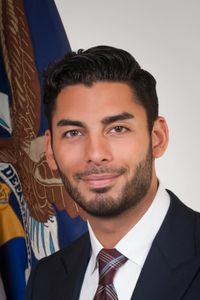
Background
Campa-Najjar worked on Barack Obama's presidential re-election campaign as a deputy regional field director before joining the Obama administration in the Executive Office of the President. He worked at the United States Hispanic Chamber of Commerce as a communications and marketing director and for the U.S. Department of Labor as a public affairs officer. He also founded ACN Strategies. Campa-Najjar graduated from San Diego State University.[1][2]
Campaign money
- Raised
- —
- From individuals
- $0
- From PACs & party
- $0
- Own money
- —
FEC filings.
View on FEC.gov(opens in new tab)Campaign themes
Ammar Campa-Najjar did not complete [the profile publisher]'s 2026 Candidate Connection survey.
Who are you? Tell us about yourself.
I grew up on Woodlawn Avenue in West Chula Vista before moving to Eastlake in the home I still live in today.
As a third-generation Chula Vistan and product of the Sweetwater School District, I began working in high school as a church janitor in Chula Vista, graduated from Southwestern College and SDSU, served President Obama's White House as a GS-12 Federal official, worked as an executive for the U.S. Hispanic Chamber of Commerce and started a business.
As Mayor, I'll work with local, state and federal officials to deliver results. I'll increase public safety and reduce crime, keep our schools and children safe, and improve housing opportunities. I'm prepared to bring a fresh vision that will attract more economic opportunities and investments in our community.
We must meet this moment with a vision that innovates and rejuvenates Chula Vista from Broadway to 3rd Avenue, to Millenia.
Our most trusted public servants are united behind our campaign.
Chula Vista' s first responders and firefighters have called on me to be our next Mayor.
I'm endorsed by Governor Gavin Newsom, U.S. Senator Alex Padilla, Congressman Juan Vargas, Chula Vista teachers, President of the Chula Vista Chamber of Commerce, and Chula Vista Councilmembers Jill Galvez and Andrea Cardenas.
With your support, I'll be ready to serve Chula Vista on day one.
I want to hear from you. Text or call me at 619-721-5148 and I'll answer you personally.
Please list below 3 key messages of your campaign. What are the main points you want voters to remember about your goals for your time in office?
Safe Neighborhoods and Reducing CrimeReducing the Cost of Housing and JobsTackling Homelessness
What areas of public policy are you personally passionate about?
I’m passionate about education, bringing a university to our city will be a top priority. Also, bringing more investment to our city through federal and state grants — I’ll use my experience in federal government and relationships to do that.
The next mayor will determine the success of our bayfront development, four-year university and the sports arena announced last month. These projects will create jobs, spur businesses and housing opportunities, and drive revenue to better fund public safety, schools and ensure Chula Vistans who want to live here aren’t forced to leave due to limited opportunity.
I’ll bring innovative leadership and build coalitions to improve public safety and reduce crime, increase housing opportunities, and create jobs and grow our economy.
Ammar Campa-Najjar did not complete [the profile publisher]'s 2020 Candidate Connection survey.
Campaign website
PRE-SCHOOL, CHILDCARE AND EARLY EDUCATION
The single most impactful investment we can make to strengthen our middle-class economy and way of life is in our children. As a child, my mother couldn't afford childcare but thankfully my grandmother was able to watch over me. During my service in the US Department of Labor, we promoted affordable, high-quality childcare for working mothers and single parents. We also supported expanded family leave because a parent should never have to choose between their job and newborn child.
Studies show that 85 percent of brain development occurs within the first three years of a child’s life. That's why I support investing in proven programs such as prenatal and developmental screenings and post-natal family nurse visits. We should invest in universal preschool, so that every child has a head start to succeed in kindergarten. Investing in our children should be an end in itself, but it also has a broader community impact: students who participate in early education programs end up relying less on government assistance, have fewer altercations with the criminal justice system, are high academic achievers, and go on to lead successful careers.
With the common core curriculum standards in place now, kindergarten classrooms are more like the first-grade classrooms of the past. Children are expected to be reading by the end of their kindergarten year. This gives preschool educated children a huge advantage in the classroom over their non-preschool educated peers. The likelihood of being school ready is 9 percentage points higher for children attending preschool.
From a family perspective, universal preschool provides a lifeline for struggling families who often rely on both parents to work extra jobs solely for the purpose of paying for childcare. Providing quality preschool education to children ages 3-5 can eliminate the need for expensive private childcare and put that money back into the pockets of American moms and dads.
How do we invest in our children without raising taxes on middle-class families? First, By asking individuals who are worth more than $50 million to pay 2 cents for every dollar exceeding $50 million and 3 cents for every dollar exceeding $1 billion toward funding childhood development programs. This plan would only impact the 75,000 wealthiest families in America and raise $2.75 trillion dollars over the next 10 years.
Second, I would eliminate the excessive tax loopholes for multinational corporations that have doubled over the past 40 years. Under President Ronald Reagan, tax loopholes were at $800 billion and now they're at $1.6 trillion.
Thirdly, I would tax stock trades. This would raise and estimated $800 billion over the next decade.
Lastly, I would cut down on the excessive fraud waste and abuse that exists in our federal government by streamlining and modernizing our government through the use of technology.
JOBS AND INFRASTRUCTURE
Among District 50’s top challenges are economic growth and income inequality. Instead of excessive government spending on corporate subsidies and tax cuts that aren’t reinvested in American workers, Congress should invest in millions of American workers to help working families punch their ticket to the middle class.
The unemployment rate of CA50 is 8 percent, over double the rate of San Diego county. 1 in 3 children in El Cajon are in poverty, and over 6,000 children go to bed hungry each night. I’ve seen firsthand how lives and families are hurt when we put special interests ahead of the American worker. I know that our rural and suburban communities need a seat at the table when it comes to new workforce programs. As congressman, I will be your voice. I will do everything I can to bring quality job opportunities to California’s 50th.
FEDERAL APPRENTICESHIP PROGRAM
There are 7 million job vacancies in America, including 360,000 in manufacturing, 200,000 in construction and millions more in advanced manufacturing, construction, renewable energy, healthcare, education, financial services/business, hospitality, telecommunication, IT/cyber security, transportation and other high growth sectors. We can fill these vacancies by investing in childcare and innovative programs like “Registered Apprenticeships” — an earn-while-you-learn program that connects job seekers with employers who are in search of skilled workers.
While working at the US Department of Labor, I found that the average registered apprentice earns $70,000 a year — double the median individual income in America. Apprenticeships have employed half-a-million workers who are ready to learn and earn on their first day on the job. That gives apprentices the financial freedom to pursue either higher education or higher positions in their industries.
Do the math: 7 million job vacancies x $70k salaries [equals] $490 billion added to our nation’s economy each year. That’s more consumer spending in local businesses, and billions of dollars in tax revenue to preserve Medicare and social security. All without raising any taxes.
How do we pay for it? Employers are willing to pay good money for skilled workers. For every $1 employers invest in apprenticeships, they average a $1.47 return on investment in productivity, front line innovation, and reduced error, time, and waste.
All we need to do is promote vocational training through community colleges, trade school, and unions.
By investing billions into this program instead of other vanity projects like a wall we don’t need, we can give every American the dignity of a good paying job that would end welfare as we know it.
OTHER JOB TRAINING
If elected, I'll work with unions and colleges on legislation that brings job training programs to our district in traditional sectors, as well as in high growth-sectors including advanced manufacturing, construction, renewable energy, healthcare, education, financial services/business, hospitality, telecommunication, IT/cyber security, transportation and other high growth sectors. Federal investment must also target communities with the highest unemployment rates and increase training for low-paying industries such as home health care, hospital care, child care, cleaning and other service work.
UNIONS AND FAIR WAGES
I will continue to support collective bargaining and a seat at the table for America’s unions that play such a vital role in protecting the American worker. I support prevailing wages for all government contracts, as well as grants, small business tax breaks and other investments to pull more workers out of poverty. I support gender equity in wages and access to paid sick leave for all workers.
TRADE
I opposed the Trans-Pacific Partnership and support adjustments to NAFTA that redress its deficiencies for workers in both developed and developing countries. I pledge to support trade agreements that advance domestic manufacturing and enforce equitable labor and environmental protections. I will also work to expand federal investment in training and services for workers displaced by unfair trade agreements, such as the Trade Adjustment Assistance program that I helped to further while working at the US Department of Labor.
INFRASTRUCTURE
I commit to work to bring federal infrastructure projects to our district and region. We must modernize our utility pathways and grid lines to increase their efficiency and reduce hazards as average temperatures continue to rise. Improving our mass transit, airports, roads, bridges and tunnels will not only create good jobs, it will also facilitate and enhance both commerce and workers’ access to employment.
DEFEND AND STRENGTHEN PUBLIC EDUCATION
There are two facts about our education system you need to know up-front. First, 94% of teachers paying for supplies out of their own pocket while making 11% less than other similarly educated professionals. Teachers help raise our children 9 hours a day, we need to pay them their value.
Also, 80% of students attend our public schools. We need to make sure our Nation's public learning institutions are properly funded.
I’m a product of the public school system. I have attended Eastlake High school, Southwestern College, Grossmont College and San Diego State University. I found my lifelong mentors attending public schools. There are so many bright students out there waiting to be discovered. That's why I’ll prioritize investing in high-quality education that sets our children up for social success, financial independence and meaningful careers.
Below are my education proposals from cradle to career.
PRE-SCHOOL, CHILDCARE AND EARLY EDUCATION
The single most impactful investment we can make to strengthen our middle-class economy and way of life is in our children. As a child, my mother couldn't afford childcare but thankfully my grandmother was able to watch over me. During my service in the US Department of Labor, we promoted affordable, high-quality childcare for working mothers and single parents. We also supported expanded family leave because a parent should never have to choose between their job and newborn child.
Studies show that 85 percent of brain development occurs within the first three years of a child’s life. That's why I support investing in proven programs such as prenatal and developmental screenings and post-natal family nurse visits. We should invest in universal preschool, so that every child has a head start to succeed in kindergarten. Investing in our children should be an end in itself, but it also has a broader community impact: students who participate in early education programs end up relying less on government assistance, have fewer altercations with the criminal justice system, are high academic achievers, and go on to lead successful careers.
With the common core curriculum standards in place now, kindergarten classrooms are more like the first-grade classrooms of the past. Children are expected to be reading by the end of their kindergarten year. This gives preschool educated children a huge advantage in the classroom over their non-preschool educated peers. The likelihood of being school ready is 9 percentage points higher for children attending preschool.
From a family perspective, universal preschool provides a lifeline for struggling families who often rely on both parents to work extra jobs solely for the purpose of paying for childcare. Providing quality preschool education to children ages 3-5 can eliminate the need for expensive private childcare and put that money back into the pockets of American moms and dads.
How do we invest in our children without raising taxes on middle-class families? First, By asking individuals who are worth more than $50 million to pay 2 cents for every dollar exceeding $50 million and 3 cents for every dollar exceeding $1 billion toward funding childhood development programs. This plan would only impact the 75,000 wealthiest families in America and raise $2.75 trillion dollars over the next 10 years.
Second, I would eliminate the excessive tax loopholes for multinational corporations that have doubled over the past 40 years. Under President Ronald Reagan, tax loopholes were at $800 billion and now they're at $1.6 trillion.
Thirdly, I would tax stock trades. This would raise and estimated $800 billion over the next decade.
Lastly, I would cut down on the excessive fraud waste and abuse that exists in our federal government by streamlining and modernizing our government through the use of technology.
STRONG PUBLIC SCHOOLS
I believe public funds should go to public education, especially when over 80% of students attend public schools.
I also believe parents should be allowed to explore other choices to meet their children’s unique needs and talents. For example, many parents in our district homeschool their children entirely out of their own pocket. And even though they pay taxes, no public funding goes toward their children’s education.
With respect to charter schools in California, the original intent was to improve student learning while encouraging the use of different and innovative teaching methods and creating new professional opportunities for educators. It was important that charter schools were developed at the local site level and with the full participation of all “stakeholders,” including educators, school board members, parents, guardians and other members of the community. These “laboratories of innovation” were meant to try new pedagogical approaches on a small scale.
Unfortunately, as charter schools expanded in California many departed from this original vision. Increasingly, charter schools are operated by large charter management organizations (CMOs). This means important decisions are frequently made without sufficient oversight and far from the school communities they are meant to serve.
Now, there is a movement to change this and return to the original vision. Charter school educators, parents, students and community members are standing up to make sure charter schools are accountable to our communities.
A moratorium on expanding large-scale charter schools should be instituted until:
Charter schools are subject to the same transparency and accountability standards as public schools.
public funds are not diverted to charter schools at the expense of the public school system.
Charter schools cease expelling students that public schools have a duty to educate.
Charter schools cease to perpetuate de facto segregation of the highest-performing children from those whose aspirations may be high but whose talents are not yet as obvious.
Once elected, I will protect public schools. It’s crucial to the success of our future generations that parents are deeply involved in their children’s education and the schools they attend but placing this heavy burden solely on parental shoulders is a mistake for our nation which all but guarantees inequity in educational opportunities. The idea that only children with devoted parents with educations themselves and ample family time would succeed is unpatriotic.
AMERICA’S COMMUNITY COLLEGE PROMISE PROGRAM
During my time at the Department of Labor, I worked on promoting tuition-free community college. Inspired by President Obama’s America’s College Promise plan to make two years of community college free for responsible students, America’s Promise grants are designed to accelerate the development and expansion of regional workforce partnerships committed to providing a pipeline of skilled workers in specific sectors.
As a result, in communities all across America, a new promise is being made. High School students that reach their full potential and meet clear objectives are able to attend two year community college programs free of charge. These programs are popular and already setting new standards of excellence in the communities they serve.
Take for example the city of San Marcos, here in our district. San Marcos instituted the “Palomar Promise” program in the fall of 2017 in conjunction with Palomar College. Eligible San Marcos High School students can receive two years of college courses towards their Associate’s Degree, tuition-free. Similar statewide programs have been a major success. The “Tennessee Promise,” has been successful in every way imagined - better student retention, higher overall college enrollment, higher full-time college enrollment and better success rates in general.
Community Colleges and trade schools are the backbone of our higher education system. If elected, I would go to Washington D.C. with the purpose of advocating to secure more funding for our district’s community colleges.
MAKING UNIVERSITIES AFFORDABLE
Universities are laboratories of innovation and forward thinking, no community is complete without one. We are fortunate to have California State University San Marcos in our district.
I believe we should restore America’s basic bargain: If you take responsibility, America will give you opportunity. We cannot spend money we don't have and leave the next generation with soul crushing national and personal debt. But we can provide the opportunity of debt-free college for those who need it, if they’re willing to take responsibility and earn it through merit.
In America, it’s your decisions rather than your conditions that should determine your future. We should reward students who are working hard in school, but whose families lack the financial means to support their higher education. For debt-free college to work, students and the wealthiest among us must fulfill their responsibilities to each other. This means asking America’s wealthiest families — those who pay zero in taxes by holding offshore accounts — to pay their fair share to the very country that made their success possible.
With the idea of opportunity for all and responsibility from all in mind, here are a few ways we can make debt-free college a responsible reality:
Eliminate $17 billion wealthy tax loophole called "Stepped-Up Basis.” By cutting this loophole that is skewed toward the wealthy, we could put every qualified student in community college for free, cut the cost of 4 year college in half, and reduce the deficit by $11 billion dollars.
Promote alternatives to 4 year college. Let's start off with the honest truth: College isn't for everyone. Very often, students go straight to college without having the desire to. I believe we should expand choices for recent high school students through trade school, partnering with Grossmont, Palomar and Cuyamaca community colleges to provide high quality apprenticeship earn-and-learn job training (also referred to as "college without the debt") that pays an average of $70,000 a year, and other career pathways.
By diversifying career pathways, we save time and money for individuals who later on find out that college wasn’t their preference, we eliminate so-called “free-riders,” and free up funding for students who plan on completing their university education. If we can expose our youth to different pathways of higher learning, we’ll be able to reduce wasteful spending and make college more affordable for those truly seek it.
Move federal funding that is no longer being spent on workers and personnel (due to automation) toward debt-free college.
As automation begins to displace workers throughout entire industries, including our federal government, I would urge my colleagues in Congress to restructure our federal budget to make unprecedented investments in free college and on-the-job apprenticeship training so people can continue to work and retire with dignity.
For example, as evidenced by an agency of the United States Department of Defense responsible for the development of emerging technologies for use by the military known as DARPA, military personnel will soon be replaced by automation at an alarming rate.
While we will always need and honor our men and women in uniform, the automation of our military will decrease the number of vacancies in many military occupations. As a result, recent high school graduates who once opted to join the military because they couldn’t afford college will no longer have that option. It will become imperative to re-appropriate some of our defense spending as it pertains to recruiting, training, housing, feeding and deploying military personnel toward debt-free college for students who would’ve otherwise joined the military had vacancies been available.
The military will still need engineers and coders to design these automated elements of our military, so we must invest in education and automated military workforce training to meet these demands. This same scenario will apply to various agencies and departments within the federal government.
Once elected, I will explore every item in our federal spending that presents the same challenges and opportunities in order to make debt-free college possible without raising middle class taxes.
COLLEGE STUDENT LOAN DEBT
Student debt has become a 1.3 trillion dollar problem. Student debt has crippled an entire generation of Americans. If this issue goes unresolved, today’s generation of Americans may be the first to be left off worse than their parents.
Our nation was founded upon the values of equality for all Americans. Education as a public good has sustained our country through periods of prosperity and growth as well as periods of recession. But saddling our young people with debt that takes a lifetime to pay off is unfair and a contract no one should be forced to sign.
I believe we should forgive student debt for those who devote time out of college toward public service of their choice. Like the GI Bill, we should institute a Civilian Bill, where service, hard work, and responsibility is rewarded through debt free education.
OTHER EDUCATION PRIORITIES
Fully Fund the Individuals with Disabilities Education Act (IDEA). When Congress passed IDEA, they promised to cover 40% of the extra cost of special education. In other words, they would pay for nearly half of the additional cost required to educate students with disabilities (when compared to the cost per student without disabilities). Unfortunately, Congress has never come close to fulfilling that promise. The number of students with disabilities served under IDEA has increased by 25 percent in the past two decades. Yet, the IDEA state grant program was only funded at around $12 billion in 2017. The federal government is only covering 14.6% of the additional cost.
Support High Quality Teachers. We need to attract, not attack teachers as the current Administration has. I'm a proud supporter of teacher unions, and am proud to have their support. The only way to guarantee a good education for our children is to make sure our teachers have the security and dignity of a good-paying job. The best way to attract quality educators for our children is by providing teachers with quality pay and a good retirement plan.
Shortages of teachers caused by district instability, difficult working conditions and low pay have enabled thousands of teachers with just five weeks of summer training (and sometimes as few as 30 hours) to enter the classrooms of primarily poor children during the past 10 years. All children need teachers who have who have extensive training in classroom management and developing and delivering curriculum.
Equitable School Finance. Poverty and school finance do matter in schools, especially for immigrant students. Equitably funded schools ensure, as the U.S. Department of Education has said, that a “child’s critical opportunities are not a function of his or her ZIP code.”
Local Accountability. Top-down accountability policies inspired by George W. Bush’s No Child Left Behind law did not deliver on their goal to make all students academically proficient by 2014. Why? Because we need an accountability system that doesn’t stigmatize schools for students who score poorly on only one measure of success—high-stakes tests.
Arts and Other Extracurricular. National polls of parents show that one of the top three priorities for schools is funding for arts and other extracurricular activities. The past two decades of testing and accountability policies have caused a neglect of these programs.
Class size. Research solidly supports claims that smaller class sizes provide student success benefits for children. Additionally, parents I have spoken with are less likely to seek other school choices when their children’s class size remains 24 students or less.
Ending the School to Prison Pipeline. Schools in the United States are sending droves of young black and brown students into the school-to-prison pipeline via harsh discipline policies. Educators must utilize innovative and restorative disciplinary approaches to stem this trend.
After school and summer programs. I'm a big believer in after school programs, summer learning programs, and summer jobs programs for at-risk youth which I worked on with the White House. California now serves over half a million children in low income communities each day through after school programs. These programs are closing the opportunity gap, that's why we should extend them throughout the year, by investing in summer programs.
STEAM and Workforce Development programs. I was the lead on Public Affairs for the Employment and Training Administration for the US Department of Labor where we worked closely with school, agencies, companies and organizations to make sure we were retraining and retooling our workforce for the jobs of today. I believe we need an education renaissance and that means investing in Science, Tech, Engineering, the Arts, and Math (STEAM). For more on my comprehensive jobs program, please visit my jobs platform.
JOBS AND SMALL BUSINESS
As a business owner myself and a former executive director for a nation chamber of commerce, I understand the burdens small businesses face. That’s why one my top small business priorities is to eliminate the barrier entrepreneurs face trying to afford healthcare for themselves and employers.
One major barrier entrepreneurs face when trying to start and scale their small business is the cost of healthcare for themselves and employees. Click here to read my Healthcare Reform platform.
I’ll work to provide small businesses access to credit, capital and contracts to compete against big business.
By providing more tax cuts, federal and supply chain contracts with major companies, we can help small businesses flourish in CA50. Small businesses create 2/3 new American jobs, helping small businesses thrive is the best way to stimulate local economies throughout our district.
INVESTING IN SMALL BUSINESS
Small businesses are the lifeblood of our American economy and way of life, creating two-thirds of all new jobs. To keep the economy roaring and jobs growing, we have to invest in actual job creators.
In congress, I’ll help local businesses gain more access to credit, capital, and compete for contracts both through the SBA and industry supply chains.
ENDING CORPORATE WELFARE
We can create a 21st century economy that works for everyone. But first, we need to end the most burdensome and expensive welfare program in the United States: Corporate welfare.
Today, hundreds of billions of middle class taxpayer dollars are going to big corporations, like unaccountable pharmaceutical companies that jack-up prices for live-saving prescription drugs. Middle class taxes are being spent by big corporations to ship jobs abroad, replace American workers with automation, and provide an adva
On the 2026 ballot
Links
Compiled from the candidate’s published profile as of September 30, 2026 and FEC filings.
Source(opens in new tab)