
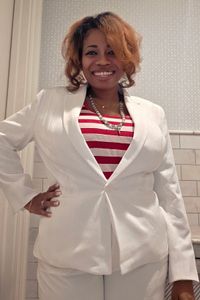
Background
Alexandria Butler was born in Kansas City, Kansas. She earned a high school diploma from the Wichita High School Southeast. Butler's career experience includes working as a minister. As of 2025, she was affiliated with Urban Conservatives of America.[1]
- High school:
- Wichita High School Southeast
Campaign money
- Raised
- —
- From individuals
- $0
- From PACs & party
- $0
- Own money
- —
FEC filings.
View on FEC.gov(opens in new tab)In their own words
State House
Alexandria Butler has not yet completed [the profile publisher]'s 2026 Candidate Connection survey.
Send a message to Alexandria Butler asking her to fill out the survey.
If you are Alexandria Butler, click here to fill out [the profile publisher]'s 2026 Candidate Connection survey.
Who fills out the candidate survey?
Any candidate running for elected office, at any level, can complete [the profile publisher]'s Candidate Survey. Completing the survey will update the candidate's [the profile publisher] profile, letting voters know who they are and what they stand for. More than 32,000 candidates have taken [the profile publisher]'s candidate survey since we launched it in 2015. Learn more about the survey here.
You can ask Alexandria Butler to fill out this survey by using the button below or emailing info@alexandriabutlercampaign.org.
U.S. House
What areas of public policy are you personally passionate about?
I’m passionate about protecting families, defending parental rights, and restoring freedom. I support school choice, homeschool liberty, and removing woke indoctrination from our classrooms. I advocate for faith-based solutions to crime, homelessness, and poverty. As a small business owner, I champion economic empowerment and entrepreneurship in underserved communities. I also support secure borders, justice reform, and policies that reflect biblical values and constitutional truth.
Who do you look up to? Whose example would you like to follow, and why?
I look up to those who stood for truth, even when it cost them everything—leaders like Deborah in the Bible, who rose as both a judge and a warrior when others stayed silent. I admire Dr. Ben Carson, who led with Godly wisdom and quiet strength.
But most of all, I look up to my Mema. She taught me how to stand—against bullies, fear, and anything life threw at me. She never let me cower, no matter how bad it looked. Because of her, I don’t flinch in the face of giants, fire, or storms. I lead like she lived: with fierce faith, quiet strength, and unshakable dignity.
Is there a book, essay, film, or something else you would recommend to someone who wants to understand your political philosophy?
The Bible, the U.S. Constitution, and 'The Law' by Frédéric Bastiat.
These works shaped my political philosophy. The Bible taught me righteousness and justice. The Constitution taught me liberty with order. Bastiat’s The Law showed how misuse of legislation robs people of dignity. Together, they inspire my mission: to protect freedom, serve truth, and uplift the people—especially those who've been overlooked.
What characteristics or principles are most important for an elected official?
An elected official must be honest, accountable, and unafraid to speak truth—especially when it’s unpopular. They should be guided by integrity, not influence; by conviction, not compromise. I believe in servant leadership rooted in faith, humility, and boldness. Officials must listen to the people, defend the Constitution, and uphold moral values without wavering. We don’t need more politicians—we need principled warriors who will lead with courage, not convenience.
What qualities do you possess that you believe would make you a successful officeholder?
I possess courage, discernment, and an unshakable commitment to truth. I’ve been tested by fire—personally, spiritually, and publicly—and I don’t fold under pressure. I lead with compassion, but I’m not afraid to confront what’s broken. I don’t serve for applause or attention—I serve with purpose, because I know what it feels like to be unheard, unseen, and unprotected. That’s why I fight hard for the voiceless and lead from conviction, not convenience.
What do you believe are the core responsibilities for someone elected to this office?
The core responsibility of a U.S. Representative is to serve the people—not a party or special interests. That means defending the Constitution, protecting our rights and freedoms, and being a voice for the district in Washington. It also means fighting for legislation that uplifts families, strengthens communities, and ensures government is accountable. A representative should bring truth to power, stand boldly for their constituents, and never forget who they work for: the people.
What legacy would you like to leave?
I want to leave a legacy of bold obedience. I want it said that I stood when others bowed, that I spoke truth when it wasn’t popular, and that I fought for the people no one else fought for. I want to be remembered as a woman who loved God, loved people, and never backed down from the fire—but walked through it so others could come out free. My legacy isn’t about position—it’s about impact, faith, and freedom.
What is the first historical event that happened in your lifetime that you remember? How old were you at the time?
The first historical event I truly remember was President Reagan saying, ‘Mr. Gorbachev, tear down this wall.’ I was 4 years and 10 months old, and even then, I felt the gravity in his voice. When the Berlin Wall eventually fell and East and West Germany were reunited, it stuck with me—not just as history, but as a revelation. One voice can confront division, call for unity, and shift nations. That moment taught me the power of truth spoken with boldness.
What was your very first job? How long did you have it?
My very first job was working in my family’s cleaning business—C.E.C. Cleaning, which stood for Carson, Edwards, Carson. Those are family names, and the Carson side connects us, indirectly, to Dr. Ben Carson. We cleaned move-in/move-out properties, Burger King kitchens and play areas, and it taught me early what hard work and family legacy really mean.
Outside of the family business, my first official job was at Foot Locker when I turned 16. I thought I’d be getting free shoes—but found out it was only a 10% discount! That’s also when I realized I was deeply introverted. I didn’t thrive in retail, but I learned a lot about myself.
What is your favorite book? Why?
The Bible is my favorite book—hands down. Not just because I’m a believer, but because it’s alive. Every time I open it, it reads me. It has corrected me, comforted me, equipped me, and transformed how I see the world, myself, and my assignment. It’s not just a book—it’s the breath of God on paper, and it’s the foundation of everything I do.
If you could be any fictional character, who would you want to be?
Wonder Woman because she had the lasso of truth
What was the last song that got stuck in your head?
Refiner’ by Maverick City Music. That song just wrecks me—in the best way. I’ve been in a season where I’m constantly asking God to purify my heart, my motives, and my path. So when it says, ‘I wanna be tried by fire, purified,’ it hits deep. It’s not just stuck in my head—it’s stuck in my spirit.
What is something that has been a struggle in your life?
One of the greatest struggles in my life has been rejection and abandonment. I grew up feeling unseen, unwanted—even by those who were supposed to love me. That pain followed me into adulthood, making it hard to trust, hard to rest, and hard to believe I belonged anywhere. But through faith in Jesus Christ, I’ve been healed, delivered, and raised up. That struggle birthed my strength. It gave me the heart to fight for others who feel forgotten. Now I lead with empathy—but I war with fire.
What qualities does the U.S. House of Representatives possess that makes it unique as an institution?
The House is the People’s chamber—closest to the community, fastest to respond, and fiercest in oversight.
It was designed to keep government accountable to the people. Unlike the Senate, the House is where urgent voices, local concerns, and grassroots momentum hit the floor first. Its two-year terms force Representatives to stay connected to real life—not political bubbles.
Do you believe that it's beneficial for representatives to have previous experience in government or politics?
Experience can help—but it can also create complacency. What matters most is conviction, courage, and connection to the people.
I don’t come from politics. I come from the people. And that’s exactly why I belong in Congress. Fresh voices bring fresh fire. We need less political polish and more prophetic clarity—because this nation’s future depends on bold obedience, not recycled agendas.
What do you perceive to be the United States' greatest challenges as a nation over the next decade?
America’s greatest challenges are spiritual decline, cultural division, economic instability, and the erosion of truth and accountability.
Over the next decade, we must confront rising lawlessness—both moral and governmental—rebuild the foundation of family and faith, secure our borders, restore domestic industry, and prioritize the needs of our people first.
I believe in sovereign strength, not global dependence. Our survival demands bold, America First leadership that restores both policy and the nation’s soul.
Do you believe that two years is the right term length for representatives?
Yes. Two years is the right length—it keeps Representatives accountable and close to the people.
That’s why I support term limits. If you can’t serve the people with integrity and urgency in two years, you shouldn’t be rewarded with decades in office. I’ve pledged to serve with purpose, not for a paycheck—and then pass the baton.
What are your thoughts on term limits?
I’ve signed the U.S. Term Limits pledge to support three House terms and two Senate terms—because public office is service, not a lifetime achievement award.
Is there a particular representative, past or present, whom you want to model yourself after?
I’m inspired by leaders who stood firm in truth—like Joseph Rainey, the first Black Republican in Congress, who fought for civil rights in the face of deep hostility. I admire Ron Paul’s constitutional boldness, Byron Donalds’ strength, and Michele Bachmann’s fearless faith. But I’m not running to imitate—I’m running to ignite.
I carry something ancient and fresh: prophetic conviction, constitutional courage, and a deep call to serve the people with power and purity.
Both sitting representatives and candidates for office hear many personal stories from the residents of their district. Is there a story that you’ve heard that you found particularly touching, memorable, or impactful?
A mother in District 9 told me she was scared to speak up at her child’s school—afraid her faith and values would get her labeled, or worse, silenced. She didn’t ask for favors—she just wanted a voice. Her courage moved me deeply. I’m running because no one in our district should feel ignored, threatened, or powerless for standing on what’s right.
Tell us your favorite joke.
Why did the scarecrow win an award?
Because he was outstanding in his field.
Do you believe that compromise is necessary or desirable for policymaking?
I believe in collaboration, not compromise of core values. We can work across the aisle—without crossing the line.
Compromise is necessary on logistics, not on principles. I’m willing to find solutions, but I will never dilute truth just to ‘get along.’ The people didn’t send me to D.C. to play politics—they sent me to protect what matters.
The Constitution says that all bills for raising revenue must originate in the House. What role would this power play in your priorities if elected?
As a Representative, I’d treat the House’s power to originate revenue bills as sacred. Every dollar Congress raises should reflect the people’s priorities—not special interests, global entanglements, or bloated bureaucracies.
I’d fight to ensure that taxpayer money is used to secure our borders, rebuild American infrastructure, protect families, and serve our communities first. Not one penny should leave this country unless the people have what they need at home.
How should the U.S. House use its investigative powers?
The House’s investigative powers are vital—but they must be used with integrity, not as political weapons.
These tools exist to expose real corruption, safeguard the Constitution, and protect the people’s trust—not to score points or target opponents. Misusing this power weakens our democracy. I believe in restoring its proper purpose: uncovering truth, enforcing accountability, and keeping the government honest—no matter who’s in power.
What organizations or individuals have endorsed your campaign?
Urban Conservatives of America, Dr. Linda Tarver, Unhyphenated America, The Mordecai Mission, Kyle Sims, Pastor Ed Smalls
What committees interest you?
I’m especially interested in the following House committees:
Homeland Security – to defend our borders, protect against trafficking, and ensure true national safety.
Energy and Commerce – because living near commercial ports, I care deeply about trade, infrastructure, and economic revitalization.
Oversight and Accountability – to investigate waste, fraud, and ensure transparency at every level of government.
Education and the Workforce – to empower families, advocate for parental rights, and promote real education—not indoctrination.
What are your views on financial transparency and government accountability?
Financial transparency and government accountability aren’t optional—they’re moral obligations. Taxpayers deserve to know where every dollar goes and who benefits. When public servants operate in secrecy, corruption thrives. I believe in open books, honest budgets, and consequences for misuse of funds. If the people can’t see it, they can’t trust it.
On the 2026 ballot
Links
Compiled from the candidate’s published profile as of September 30, 2026 and FEC filings.
Source(opens in new tab)