
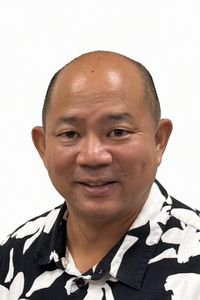
Background
Adriel Lam served in the U.S. Army from 1994 to 2018. He earned a bachelor's degree from the University of Washington in 1993, a graduate degree from the Missouri University of Science and Technology in 2000, a graduate degree from Tarleton State University in 2000, a graduate degree from the University of Hawaii in 2005, and a graduate degree from Wayland Baptist University in 2024. As of 2024, Lam was retired.[1]
As of 2024, Lam was affiliated with the following organizations:[1]
Veterans of Foreign Wars Post 110
MIS Veterans of Hawaii
American Legion China Post 1
Lions Club of Kaneohe
Kailua Elks
Koolaupoko Hawaiian Civic Club
Friends of Haiku Stairs
Kaneohe Business Group
Kaneohe Christmas Parade
Hawaii Advisory Committee to the US Commission on Civil Rights
Oahu Metropolitan Planning Organization
Pali View Baptist Church
Anchor Church
- Graduate:
- Wayland Baptist University, 2024
- Bachelor's:
- University of Washington, 1993
- High school:
- Morrison Academy
Campaign money
- Raised
- —
- From individuals
- $0
- From PACs & party
- $0
- Own money
- —
FEC filings.
View on FEC.gov(opens in new tab)In their own words
Who are you? Tell us about yourself.
My great-grandfather escaped a war-torn and divided Asian continent and came to Hawaii in 1872. My grandfather worked the Pearl Harbor Naval Shipyard the day it was attacked. My father began his missionary service with veterans from World War II who returned to Japan to share the Good News of Jesus. I benefited from the life and legacy, of my parents, my grandparents, and my great-grandparents who’s lives in Hawaii spanned the Pacific over the last century and a half. Their experiences shaped my perspective in working at all levels of government, from local, to state and federal, with extraordinary people from all walks of life, across the 50 states and 30 countries. While serving nearly 24 years of active duty service in the United States Army, I was blessed to lead small teams, combat units, and enterprise-wide efforts to collaborate with inter-agency and international partners. I was truly blessed to return home to Hawaii with my family, to serve in my neighborhood and community.
Please list below 3 key messages of your campaign. What are the main points you want voters to remember about your goals for your time in office?
Hawaii remains the strategic center of the Pacific. It is not only a military strong point and economic pathway to the Pacific, it is a cultural gateway and social nexus between two continents. We need a strong and sensible voice in Washington who will speak for the common values we share, advocate for the tremendous talent and potential of our people, and leverage the resources of the federal Union for our islands.Government accountability begins with safe and secure elections. Lack of a photo ID to vote is an insult to every minority and immigrant community who fought for the sacred right to vote. Elections need to be a definitive moment for a given day and time to choose and make a decision. This is every citizen's right to make a choice of their own without undue influence or external efforts to control. A safe and secure process for every individual vote is the most basic element of a functional government.This social contract we have with the federal government, called the Constitution of the United States, is to establish justice, insure domestic tranquility, provide for the common defense, promote the general welfare, and secure the blessings of liberty. Apart from the court system, police force, and military, promoting the general welfare is the quintessential American story of making available to all what was once reserved for the elites. Through innovation we have broken down the barriers of race and class, the American dream is still alive and well. Hawaii is no less with the talent and potential that we possess and contribute to the federal Union.
What areas of public policy are you personally passionate about?
Transportation and infrastructure are key elements to a thriving economy. While these have become commonplace in the 20th century, it is no less important to maintain, upkeep, and innovate for the 21st century. The technology for roads, highways, water supply, waste treatment, communications continue to improve, and we can adapt to the changing environment with effective solutions to benefit all.
Who are you? Tell us about yourself.
Adriel brings a lifetime of career and personal experiences in connecting diverse partners and forging a common path forward. He will advocate for Hawaii's proper place and role in the United States Senate at the forefront of our foreign policy and Pacific engagement.
Please list below 3 key messages of your campaign. What are the main points you want voters to remember about your goals for your time in office?
LOKAHI (United)
Empower local towns and communities
Collaborate with local civic and volunteer organizations
Coordinate on common ground and purposeALOHA (Love/Life Together)
Support free market principles
Value individual rights and responsibilities
Open economic and cultural pathways to the PacificMALAMA (Care and Protect)
Ensure free and fair elections
Apply practical environmental measures
Invest in innovative and creative solutions
What areas of public policy are you personally passionate about?
Foreign Policy, Pacific Strategy, Asia Engagement
What was your very first job? How long did you have it?
Delivering newspapers for the South Pasadena Journal and collecting subscription fees.
What committees interest you?
Armed Service, Foreign Affairs, Commerce
Campaign website
Lam’s campaign website stated the following:
Lokahi (United)
Empower local towns and communities
Collaborate with local civic and volunteer organizations
Coordinate on common ground and purpose
Aloha(Love/Life Together)
Support free market principles
Value individual rights and responsibilities
Open economic and cultural pathways to the Pacific
Malama (Care and Protect)
Ensure free and fair elections
Apply practical environmental measures
Invest in innovative and creative solutions [2]
—Adriel Lam’s campaign website (2024)[3]
Interview with Honolulu Civil Beat
Lam highlighted the following themes in an interview with Honolulu Civil Beat on July 4, 2024. The questions from Honolulu Civil Beat are bolded and Lam's responses follow below.[4]
Editor’s note: For Hawaii’s Aug. 10 Primary Election, Civil Beat asked candidates to answer some questions about where they stand on various issues and what their priorities will be if elected.
The following came from Adriel Lam, Republican candidate for U.S. Senate. His primary opponents are Melba Amaral, Paul Dolan, Bob McDermott, Arturo Reyes and Emmanuel Tipon.
Go to Civil Beat’s Election Guide for general information, and check out other candidates on the Primary Election Ballot.
1. What is the biggest issue facing Hawaii, and what would you do about it?
The biggest issue facing Hawaii is how to make Hawaii home again. Too many of our residents have to leave for better employment opportunities, and now even our kupuna are being priced out of their homes.
Cost of living, housing prices, noncompetitive business environment and stagnant bureaucracy all contribute to the decision to leave and never return home.
We need to provide a welcoming business environment and robust job market, encourage innovative solutions for competitive and niche industries to make make Hawaii home again for our future generations.
2. What can the U.S. Congress do to reduce gun violence?
Congress should invest in more self-defense and firearms education. Security is both a collective and individual responsibility.
Every citizen should have the required education to know the proper function and use of a firearm and the discipline to handle firearms in a safe and responsible manner. Safety and security begins with individual responsibility.
3. The polarization in Congress is worse than ever. Some say democracy itself is in trouble. How would you work to end the political polarization that divides both the Congress and the country?
Many will say journalist practices today are responsible for the polarization that pursue accolades and recognition from their peers over veracity and relevance.
With more than half the partisan races uncontested, many ballots in the August primary will have only one partisan decision to make, that is for the U.S. Senate race. Yet, Civil Beat’s June 5 report on the candidate filing deadline made no specific mention of the U.S. Senate Republican race, as well as advancing the narrative of low voter turnout. This deliberate omission and myopic partisanship undermine democracy.
4. Social Security, Medicare and Medicaid, while currently financially sound, risk future funding concerns because of changing demographics. What would you propose to shore up the country’s major safety net programs?
Social Security, Medicare and Medicaid are not financially sound. Putting a “currently” modifier before a statement does not make it any better. Current beneficiaries are depending on payments from the future workforce to pay the bill. Safety nets are for emergency, exigent circumstances, not routine, regular, or even abnormal conditions. These programs need to be given back to the individuals and/or collective entities to plan, manage, invest and incentivized to prepare for their future.
5. Currently, the filibuster rule in the U.S. Senate has prevented the chamber from voting on critical issues. Should it be eliminated? Why?
The Senate filibuster is a tradition to ensure trendy legislation and fleeting sentiments binding future generations to poorly conceived ideas are not easily codified into law.
“Critical issues” should be self-evident and have little difficulty passing with a two-thirds majority. Giving power to a simple majority of 50% plus one is dangerous and a threat to a constitutional republic.
Most issues in Congress are not contentious. The contentious ones should have robust discussions and deliberations, less media interference and partisan advocacy, to seek and find common ground.
6. Is the U.S. on the right path when it comes to mitigating climate change and growing renewable energy production? What specific things should Congress be considering?
Climate mitigation and adaptation is important to monitor and adjust to the changing conditions around us. Farmers and engineers alike, have observed these 5-, 10-, 20-year even 100-year cycles for centuries and adapted their methods and techniques to these changes.
Congress should invest in real, hard sciences, and not fund politically driven research based on dubious claims and questionable results.
7. What is your view on the U.S. role in foreign policy? What can the U.S. do to build better relations with the Asia-Pacific region?
U.S. foreign policy should be based solely on protecting the rights and interests of American citizens around the world. Partnering with key, like-minded friends and allies has been how the United States has maintained peace and stability in the Asia-Pacific region for decades.
While we provide incentives, aid, assistance to promote our values, our friends and allies should be free to choose and accept without coercion or undue political influence.
8. Should the state renew the U.S. military’s leases on training grounds in Hawaii? Should there be new conditions on the leases and if so what?
Federal land leases are negotiated on the basis of mutual benefit to the prospective tenant and landowner. While we all collectively benefit from the national security imperative to provide suitable training grounds for our military forces in the Asia-Pacific, the burden to provide these resources is not equally shared among the 50 states.
Fair compensation does not always have to be in financial terms, but partnering with the affected communities should be a necessary component to alleviating the burden they bear. Federal assistance through infrastructure, housing, remediation and mitigation can all be part of the solution for fair land use and compensation.[2]
Adriel Lam did not complete [the profile publisher]'s 2022 Candidate Connection survey.
On the 2026 ballot
Links
Compiled from the candidate’s published profile as of September 30, 2026 and FEC filings.
Source(opens in new tab)